Monstera deliciosa care guide
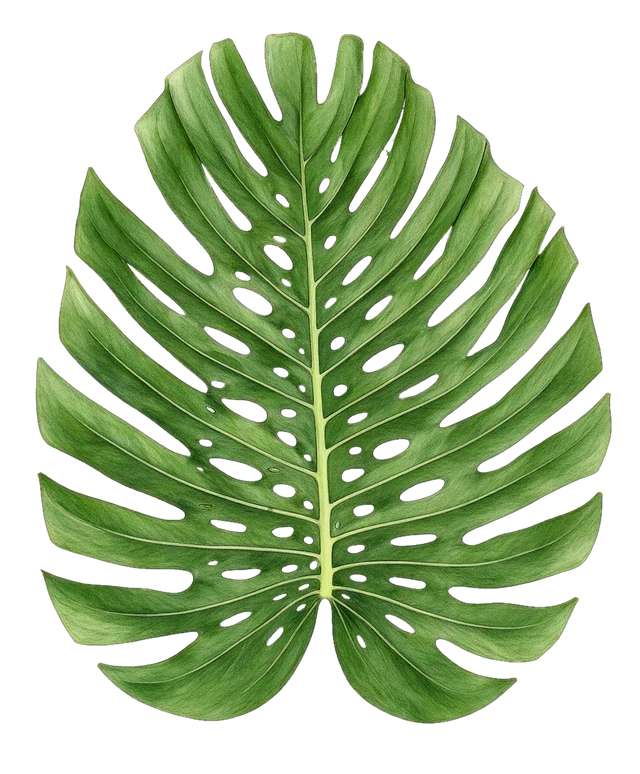
Monstera deliciosa is native only to southern Mexico and Guatemala. Wild adult plants always carry perforated leaves, with 10–101 holes of very unequal sizes per side of the blade and 6–12 lobes along each side. From seedling to adult the leaves change gradually, growing larger and more complex.
At a glance
- Light
- Green leaves that unfold in strong light, even under a full-sun glasshouse peak, build their own protection and show no lasting damage; what burns is a sudden jump from shade into strong lightA
- Grow lamp
- Under a constant lamp, give a green plant 120–250 µmol/m²/s at the leaf, about 8–18 klx under white LEDsB
- Water
- Water when the mix has dried, not on a fixed schedule; overwatering rots M. deliciosa more often than drought doesC
- Warmth
- Keep it above 12 °C; warmer nights mean more growthC
- Mix
- A coarse, airy mix holds more air after watering, which guards against waterloggingC
- Pot
- Repot one size up when the roots reach the bottom and sides; it tolerates a tight pot far better than an oversized oneC
- Feeding
- Feed with a soluble mineral fertiliser rather than compostB
- Support
- Give it something to climb: attached to a support, a green plant makes larger leaves in bright light and keeps its aerial roots growingB
- Humidity
- Misting puts almost no water into the leafC
- Pets
- Poisonous to cats, dogs and small petsC
A measured directly · B indirect or transferred with good grounds · C one report, or from another plant
Light
Green leaves that unfold in strong light, even under a full-sun glasshouse peak, build their own protection and show no lasting damage.1 What burns is a sudden jump: a shade leaf hit by strong light is damaged and recovers slowly and incompletely, so never move a plant from shade straight into strong light.1,2 Bring a plant from a darker spot into more light in steps of days to weeks, not hours, and hold each step until new leaves have unfolded under the new light.1,3
Under a constant lamp, give a green plant 120–250 µmol/m²/s at the leaf, about 8–18 klx under white LEDs.4,5 A lux reading depends on the light source: under white LEDs, 1 µmol/m²/s is about 64–74 lux, in daylight near full sun about 41 lux.5,6
From about 120 µmol/m²/s a green leaf works at a good share of its maximum, and near 250 it reaches it.4 Under glasshouse peaks of 1500 instead of 300 µmol/m²/s, its photosynthetic capacity stays the same.1
The evidence
The maximum near 250 µmol/m²/s was measured on single leaves after at least 3 days under a blue-red lamp at 500 µmol/m²/s and 21 °C.4 Another measurement on M. deliciosa reported net photosynthesis above this saturated rate at lower light, and the two results stand unreconciled.4
In pothos grown at the same photon flux of about 90 µmol/m²/s, the light source it grew under shifted the fitted saturation point: about 91 µmol/m²/s under fluorescent tubes against 132 and 236 under two red-blue LEDs; that the growth light shifts the fitted saturation point carries over to Monstera, which way and by how much does not.7
Above about 300 µmol/m²/s under a steady lamp a green leaf is not expected to gain further photosynthetic capacity, and plants under glasshouse midday peaks of 1500 µmol/m²/s ended with no higher photosynthetic capacity than plants under peaks of 300.1
These light sentences rest on glasshouse and growth-chamber measurements on green M. deliciosa.1 In a naturally lit glasshouse, plants grown under midday peaks of 1500 µmol/m²/s did not differ in photosynthetic capacity from plants grown under peaks of 300, and their leaves showed no lasting photoinhibition.1 Leaves developing under the 1500 peaks built much more fast photoprotection than under 300, while shade-grown leaves moved straight to 700 µmol/m²/s in a growth chamber were badly photoinhibited after 5 days and raised no such protection.1 Shade leaves lost 21 % of their photosystem efficiency after 1.3 hours at 600 µmol/m²/s, and more at higher light.2
Under a constant 12–14-hour lamp day, a green leaf needs about 0.5–0.6 mol/m²/day for net carbon gain in the lamp hours and saturates at about 10.7–12.4 mol/m²/day.4 A green leaf acclimated to bright lamp light starts net carbon gain at about 12 µmol/m²/s.4 After acclimation at about 20 µmol/m²/s with 8-hour days, a value of about 3 is given for M. deliciosa, second-hand and under the name Philodendron pertusum, and a second fit of the same data by the same group gives a much higher value.8
Green M. deliciosa can be grown indoors at 10 µmol/m²/s, but leaves grown there had significantly lower photosynthetic capacity than leaves grown under glasshouse peaks of 300 or 1500 µmol/m²/s.1 After three months at 10 µmol/m²/s, a potted plant in a closed chamber released more CO₂ than it fixed over the light-dark cycle, while at 40 µmol/m²/s it ended with net uptake.9 Shade-grown plants moved straight from 10 to 700 µmol/m²/s were badly light-damaged after 5 days and gained no photosynthetic capacity.1
In shade it is described as forming long, narrow internodes (the stretches of stem between two leaves) and staying smaller, and young plants in low light as keeping thin internodes instead of thickening.10 Young plants under LED light with 12 % far-red were not taller than under 1 % far-red, in a winter greenhouse with daylight plus at most 100 µmol/m²/s of LED light and one greenhouse half per spectrum.11 In its native forest it is described as growing across the full range of natural light, from the deep shade of the forest floor to the sunlit canopy.1
A lux meter’s own error is about 10–20 %, and light across a lit area can vary by up to 30 %.5 A conversion factor of about 53.8 lux per µmol/m²/s, used for daylight and white LED alike, overstates the photon flux of white LEDs by 19–38 %.12,5,13
Sources for this section (13)
- Demmig-Adams et al. (2006): “Modulation of PsbS and flexible vs sustained energy dissipation by light environment in different species”. Physiologia Plantarum 127(4):670-680 doi:10.1111/j.1399-3054.2006.00698.x
- Demmig et al. (1987): “Photoinhibition and Zeaxanthin Formation in Intact Leaves: A Possible Role of the Xanthophyll Cycle in the Dissipation of Excess Light Energy”. Plant Physiol. 84:218-224 doi:10.1104/pp.84.2.218
- Demmig-Adams, B. & Adams, W. W. III (1994): “Capacity for Energy Dissipation in the Pigment Bed in Leaves with Different Xanthophyll Cycle Pools”. Aust. J. Plant Physiol. 21(5):575-588 doi:10.1071/pp9940575
- Taylor, C. M., D. M. McCauley & L. L. Nackley (2026): “Illuminating Indoor Tropicals: Characterizing Photosynthetic Light Responses in High-value Houseplants”. HortScience 61(3):554-556 doi:10.21273/hortsci19169-25
- Sharakshane, Anton (2018): “An easy estimate of the PFDD for a plant illuminated with white LEDs: 1000 lx = 15 μmol/s/m2”. bioRxiv preprint doi:10.1101/289280
- Takahashi & Kondo (1990/91): “各種グラウンドカバープランツの日照条件に対する適応性に関する実験的研究" / "Experimental Study on the adaptability of Ground Cover Plants Under Sunlight Condition”. Journal of the Japanese Institute of Landscape Architecture (造園雑誌) 54(5):161-166 doi:10.5632/jila1934.54.5_161
- Wu et al. (2008): “发光二极管光源对绿萝生长及光合特性的影响” [English title as printed: Epipremnum aureum: growth and photosynthetic response to light-emitting diodes (LED)]. Journal of Zhejiang Forestry College 25(6):739-742 (Chinese with English abstract)
- Kang, S. & Lopez, R.G. (2024): “Photosynthetic Daily Light Integral Effects on Rooting and Vegetative Growth of Cuttings of Six Foliage Plants”. HortScience 59(12):1757-1765 doi:10.21273/hortsci18109-24
- Bui, Park, and Park (2025): “Carbon Dioxide Uptake of Six Plant Species Under Different Light Intensities”. Journal of People, Plants, and Environment 28(3):297-305 doi:10.11628/ksppe.2025.28.3.297
- Cedeño-Fonseca, Díaz Jiménez, Zuluaga & Blanco 2020, A comparison of Monstera deliciosa and M. tacanaensis, with comments on Monstera section Tornelia (Araceae), Aroideana 43(1&2):31–73
- Kempkes et al. (2026): “Kas 2030: Combinatieteelt Potplanten – Paprika. Teeltresultaten 2022-2024 Potplanten (winter) – Paprika (zomer)”. Wageningen University & Research, Rapport WPR-1525 doi:10.18174/707513
- Cheng, Darryl (n.d., accessed 2026-09-16): “Grow Light Strength Recommendations by plant” (Page 1) and "Bright Indirect Light 'Requirements' by Plant Type" (Page 2) houseplantjournal.com
- Sugano, Ishii & Tanabe (2024): “Adaptation of indoor ornamental plants to various lighting levels in growth chambers simulating workplace environments”. Scientific Reports 14:17424 doi:10.1038/s41598-024-67877-y
A pole to climb and the aerial roots
Give it something to climb: a green plant whose stem is attached to an upright support makes larger leaves in bright light, and its aerial roots keep growing.1,2 Once the stem climbs, it makes two kinds of aerial roots: clinging roots, which grow over the surface and hold on by root hairs, and feeding roots, about one per node, which grow downward and stay unbranched until they reach the soil.3,4
Clinging roots need contact to keep growing: where a stem grows past the top of its support, the next internodes form fewer roots, and these stop at about 1 cm.3,4
The evidence
The support result comes from a related Monstera and from pothos, carried over to M. deliciosa.1,2 On the support, the last leaf of the related Monstera obliqua reached about six times the first leaf’s area, against about twice on hanging shoots; these multipliers belong to that species.1 In pothos under high light, contact tripled leaf size, while a shoot led straight up without touching a support made leaves no larger than one lying flat.2 In pothos under low light, the support made no difference to leaf size.2 In Monstera obliqua, even hanging shoots doubled their leaf size, a difference between the species.2,1
In climbing aroids including Monstera, a shoot that gains a support makes short internodes with well-developed leaves and a stem that thickens until the species’ full size is reached.5 In Monstera and its relatives, side shoots arising from the axils of perforated leaves are described as soon making leaves with more holes and deeper cuts when they cling and grow upward, and not when they hang as whips.6
In the largest Monstera species, plants reach flowering size only on the largest forest trees: how large a plant can become depends on the size of its host.3 In the wild, a large Monstera on a tree too small for it grows away from the trunk at the first branches, and its hanging tip grows back down to the ground.3 In Monstera, adult stems that come loose and hang can turn juvenile again, with long internodes and reduced leaves, while M. deliciosa’s own section of the genus is named as a possible exception.7 In two wild Monstera species, large plants stay connected to the soil through their roots after the base of the old stem has died back.8
The two root kinds are described on wild climbing Monstera.3,4 In one wild example, a stem growing past the top of a stump formed fewer roots on the following internodes, and these stopped growing at about 1 cm.3 On wild M. deliciosa the clinging roots are grey and 5–8 mm thick.3,4 Free-hanging aerial roots of M. deliciosa in a summer greenhouse grew on average 9.6 mm a day.9 The part of an aerial root that hangs in the air loses water more slowly than the part of the same root that has grown into the soil.10 On one outdoor M. deliciosa whose hanging feeding roots were cut back regularly, the cut roots branched, while uncut feeding roots of the species normally stay unbranched in the air.4,3
In two wild climbing aroids, Philodendron radiatum and Anthurium clavigerum, soil-rooted feeding roots cut about 1.5 m above the ground dried at the cut end, and new tips grew on 87.7 % and 50.5 % of the cut roots against 7.7 % and 36.9 % of uncut aerial roots; in A. clavigerum cut and uncut roots did not differ statistically.11 In excised 5-cm pieces of host-attached feeding roots of two related climbing aroids, Rhodospatha and pothos, a tracer applied only to the bark-facing side reached the root’s core within two hours; the air-facing side was not offered the tracer, and no pole or moss was involved.12,10
Sources for this section (12)
- Steinitz, B. and Hagiladi, A. (1987): “Thigmomorphogenesis in Climbing Epipremnum aureum, Monstera obliqua expilata and Philodendron scandens (Araceae)”. J. Plant Physiol. 128(4-5):461-466 (1987) doi:10.1016/s0176-1617(87)80131-1
- Brito, Mantuano, De Toni & Mantovani 2022, Untangling leaf expansion triggers: A new experimental study with Epipremnum aureum (Araceae), Flora 295:152139
- Madison 1978, The Genera of Araceae in the Northern Andes, Aroideana 1(2):31–53
- Cedeño-Fonseca, Díaz Jiménez, Zuluaga & Blanco 2020, A comparison of Monstera deliciosa and M. tacanaensis, with comments on Monstera section Tornelia (Araceae), Aroideana 43(1&2):31–73
- Ray, T.S. (1990): “Metamorphosis in the Araceae”. Amer. J. Bot. 77(12):1599-1609 doi:10.1002/j.1537-2197.1990.tb11400.x
- Engler & Krause (1908): “Araceae-Monsteroideae (with Additamentum ad Araceas-Pothoideas by A. Engler), in: A. Engler (ed.), Das Pflanzenreich IV. 23 B (Heft 37)”. Das Pflanzenreich, Heft 37 (IV. 23 B), Leipzig: Engelmann, issued 8 December 1908
- Cedeño-Fonseca, Hay & Blanco (2022): “A taxonomic revision of Monstera Adans. (Araceae: Monsteroideae) in Costa Rica”. Aroideana 45(1): 3-194
- Einzmann et al. (2024): “Climbing aroids in a Panamanian lowland forest: We should reconsider our categories”. Journal of Vegetation Science 35 (2024) doi:10.1111/jvs.13246
- Eskov et al. (2022): “Cellular Growth in Aerial Roots Differs From That in Typical Substrate Roots”. Frontiers in Plant Science 13:894647, PMC9199517 doi:10.3389/fpls.2022.894647
- Mantovani & Groba (2026): “Sclerified Cork Outperforms the Exodermis: Root Water Permeability Decreases in the Soil-To-Canopy Transition of the Aroid Vine Epipremnum aureum”. Physiologia Plantarum 178:e70779 doi:10.1111/ppl.70779
- Meyer & Zotz (2004): “Do Growth and Survival of Aerial Roots Limit the Vertical Distribution of Hemiepiphytic Aroids?1”. Biotropica 36(4): 483–491 doi:10.1646/1608
- Filartiga et al. (2021): “Root morphophysiology changes during the habitat transition from soil to canopy of the aroid vine Rhodospatha oblongata”. Annals of Botany 127(3): 347-360 doi:10.1093/aob/mcaa182
Warmth
Keep it above 12 °C; warmer nights mean more growth.C1,2,3
The evidence
The night-temperature series was measured on pothos, a close relative, and its direction holds for Monstera.3 In pothos, vines grew 115, 165 and 179 cm in eleven weeks at minimum nights of 15, 18 and 21 °C; for Monstera only the direction carries over, not the size of the gain.3 Young M. deliciosa made 1.5 to 2 times the above-ground weight over a winter at a 21 °C daily mean as over one at 18.4 °C, but that warmer winter also brought larger starting plants, another substrate, stronger feed and longer lamp days.4
A temperature of 12 °C or more is named as its suitable temperature, without saying whether that is a limit for growth or for survival.1,2 M. deliciosa is described as unable to tolerate frost, in accounts that give no plant temperature, while outdoors in central Florida it grows vigorously, flowers and sets fruit although it is exposed to frost every year.1,2,5
In pothos held at 1 °C for 28 days, chlorophyll and membrane integrity were lost first, by day 7, water content and photosystem function (Fv/Fm) followed from day 14 and severe cell deformation from day 21; for Monstera the sequence carries over in direction, not in timing.6
Potted pothos ‘Marble Queen’ in dark cold storage stayed unmarked after 4 days at 7.8 °C.7 Scindapsus pictus ‘Argyraeus’ at 4.5 °C in the dark showed water-soaked, black-grey leaves after 2 days, and every plant chilled for 4 days or longer died within 8 weeks.8 Heart-leaf philodendron kept full grade after 1 day at 2.2 °C, 2 days at 5 °C or 4 days at 7.8 °C in the dark, and longer spells at 2.2 °C lowered it.7 Philodendron domesticum stepped down weekly to 0 °C still looked intact, but wilted with lasting cold injury once back at 25 °C.9 In chilled foliage plants, among them Scindapsus and Dieffenbachia, damage appeared with delays ranging from the time of chilling to about day 11–13.10,7,8
For foliage plants in general, growth is said to slow to little or nothing once the root medium is below about 15.5 °C while nights stay at or below about 18.3 °C, yet a heart-leaf Philodendron held at that boundary grew nearly normally.11 In Spathiphyllum seedlings, a non-climbing aroid, a 32/22 °C day/night regime gave the poorest plants, against 22/16 and 27/19 °C.12
Sources for this section (12)
- Morton (1987): “Ceriman”. In: Fruits of warm climates, pp. 15-17. Julia F. Morton, Miami, FL hort.purdue.edu
- Sogame (1985): “モンステラ・デリキオサの葉茎の形態形成” (Morphogenesis of Leaf and Stem in Monstera deliciosa Liebm.). Bulletin of Koshien Junior College (甲子園短期大学紀要) No. 5:43-51, 1985
- Poole, R. T. & C. A. Conover (1981): “Growth Response of Foliage Plants to Night and Water Temperatures1”. HortScience 16(1):81-82 doi:10.21273/hortsci.16.1.81
- Kempkes et al. (2026): “Kas 2030: Combinatieteelt Potplanten – Paprika. Teeltresultaten 2022-2024 Potplanten (winter) – Paprika (zomer)”. Wageningen University & Research, Rapport WPR-1525 doi:10.18174/707513
- Madison 1978, The Genera of Araceae in the Northern Andes, Aroideana 1(2):31–53
- Wu Y., Chen X., Tang Y. (2022): “Outcomes of Low-Temperature Stress on Biological Alterations within Pothos (Epipremnum aureum) Leaves”. Life 12(9):1432 doi:10.3390/life12091432
- Poole, R.T. and Conover, C.A. (1991): “Effects of Low Temperature Storage on Quality of Twenty-two Foliage Plants”. University of Florida, Central Florida Research and Education Center-Apopka, CFREC-Apopka Research Report RH-93-6 mrec.ifas.ufl.edu
- McWilliams, E.L. and Smith, C.W. (1978): “Chilling Injury in Scindapsus pictus, Aphelandra squarrosa and Maranta leuconeura1”. HortScience 13(2):179-180 doi:10.21273/hortsci.13.2.179
- Gupta et al. (2016): “Assessment of photosynthetic potential of indoor plants under cold stress”. Photosynthetica 54(1):138-142 doi:10.1007/s11099-015-0173-7
- Marousky (1980): “Chilling Injury in Dracaena sanderana and Spathiphyllum 'Clevelandii'”. HortScience 15(2):197-198 doi:10.21273/hortsci.15.2.197
- Conover, C.A. & Poole, R.T. (1990): “Light and Fertilizer Recommendations for Production of Acclimatized Potted Foliage Plants”. University of Florida, IFAS, Central Florida Research and Education Center - Apopka, CFREC-A Research Report RH-90-1
- Chase & Poole (1984): “Severity of Acephate Phytotoxicity on Spathiphyllum Schott, cv. Clevelandii as Influenced by Host Nutrition and Temperature”. J. Amer. Soc. Hort. Sci. 109(2):168-172 doi:10.21273/jashs.109.2.168
Water and humidity
Water when the mix has dried, not on a fixed schedule.C1,2,3 Overwatering rots M. deliciosa more often than drought does, and root disease strikes Monstera most in the colder seasons.C1 Misting puts almost no water into the leaf.C4
In a fine mix, right after watering the air sits near the top and the base stays wettest; as the mix dries, air returns at every depth.2,3,5
The evidence
The watering rule is a conclusion from four links: overwatering is the more frequent cause of rot in M. deliciosa, the base of a drained pot is its wettest part, air returns to the mix as it dries, and in pothos water use rose with light, so need changes with the spot.1,2,3 That overwatering is the more frequent cause of rot comes from one houseplant account, without counts.1 One houseplant account describes rot of M. deliciosa as wilting leaves and stems, a stem girdled by rot at soil level, and brown to black, mushy roots that pull away easily.1 Wilting alone has several causes in house plants generally: too little water, too much light, or root rot from overwatering, and white roots are healthy while brownish-black roots point to rot.6,1
In a just-drained 4.5-cm peat cell, the air sat near the top: about 20 % of the volume at 0.5 cm depth was air, and about 1 % from 3 cm down.7 The same cell, dried from 72 % to 51 % water by volume, held 24–29 % air at every depth.7
In one winter, young plants in a peat-free mix dried faster than in a peat mix and needed extra hand watering about 3 to 4 times while both shared one watering section; with another peat-free mix the next winter they needed none.8 In potted pothos at 30 µmol/m²/s, the middle of three watering regimes gave the largest leaf area, and the driest and the wettest both gave less.9 In self-watering containers indoors, golden pothos used more water at higher light across 50–200 foot-candles.10
For the same weekly salt input, pots of four foliage plants, Dieffenbachia among them, given 2 litres a week in a bright greenhouse ended with a far less salty mix than pots given 1 litre in a dim interior room, because less water passed through; light there changed together with temperature and humidity, and the watering volume followed the plants’ demand.11 The direction holds for Monstera where watering follows demand, while in Impatiens watered by a fixed amount across light the difference did not appear.11
In small peat–perlite pots of 370 and 615 mL watered from below with no water draining through, feed salts gathered in the top layer: after 77 days the top layer’s EC was 2 to 5 times that of the layers below.12 A pot watered from below does not wet evenly: coarse particles and tall pots slow the rise of water, and in one peat–perlite pot the top layer stayed dry up to 20 hours after watering.13,14
The misting sentence comes from pothos.4 Pothos leaves sprayed with dew-sized amounts of water took in only 2.45–6.15 % of it, and the film was gone in under an hour at about 23 °C and 80 % relative humidity.4 M. deliciosa leaves carry most of their pores (stomata) on the underside between the veins and the next most along the upper midrib, while the upper blade between the veins has almost none.15 On wound-inoculated Araceae, taxa not named per case, spots of the bacterium Pseudomonas cichorii stayed small when the leaves were kept dry after the first symptoms, but on susceptible taxa covered much of the leaf under intermittent misting.16
Sources for this section (16)
- UConn Home and Garden Education Center (2020): “Monstera deliciosa”. UConn Home Garden Education Office fact sheet homegarden.cahnr.uconn.edu
- Fields, Criscione and Owen (2024): “Assessment of Substrate Physical Properties in Bark- and Peat-based Stratified Substrate Systems”. HortScience 59(12):1823-1827 doi:10.21273/hortsci18188-24
- Gizas, Savvas (2007): “Particle Size and Hydraulic Properties of Pumice Affect Growth and Yield of Greenhouse Crops in Soilless Culture”. HortScience 42(5):1274-1280 doi:10.21273/hortsci.42.5.1274
- Qiu et al. (2026): “Water Availability and Leaf Microstructures Jointly Regulate Dew Absorption in Plants with Different Ecotypes”. Plants 2026, 15(3):503 doi:10.3390/plants15030503
- Savvas, D. and Gruda, N. (2018): “Application of soilless culture technologies in the modern greenhouse industry – A review”. Eur. J. Hortic. Sci. 83(5), 280–293 doi:10.17660/ejhs.2018/83.5.2
- UC Statewide IPM Program (adapted by Pittenger DR, Gay RC from Powell CC, Lindquist RK 1983): “Houseplant Problems”. UC ANR Publication 74172 (Pest Notes) ipm.ucanr.edu
- Yafuso et al. (2019): “Water and Air Relations in Propagation Substrates”. HortScience 54(11):2024-2030 doi:10.21273/hortsci14145-19
- Kempkes et al. (2026): “Kas 2030: Combinatieteelt Potplanten – Paprika. Teeltresultaten 2022-2024 Potplanten (winter) – Paprika (zomer)”. Wageningen University & Research, Rapport WPR-1525 doi:10.18174/707513
- Kwon, Jung, Park (2015): “Effects of Irrigation Frequency on Growth Responses of Indoor Foliage Plants”. J. Korean Soc. People Plants Environ. 18(5):379-385 doi:10.11628/ksppe.2015.18.5.379
- Conover, Caldwell & Steinkamp (1993): “Water Requirements of Three Foliage Plants in Self-Watering Containers Affected by Indoor Light Intensity and Plant Type”. CFREC-A Research Report RH-93-15 mrec.ifas.ufl.edu
- Nolan et al. (1982): “Effect of Sodium Chloride Levels on Four Foliage Plants Grown at Two Light Levels1”. HortScience 17(5):815-817 doi:10.21273/hortsci.17.5.815
- Kent, Reed (1996): “Nitrogen Nutrition of New Guinea Impatiens 'Barbados' and Spathiphyllum 'Petite' in a Subirrigation System”. J. Amer. Soc. Hort. Sci. 121(5):816-819 doi:10.21273/jashs.121.5.816
- Ferrarezi et al. (2015): “Subirrigation: Historical Overview, Challenges, and Future Prospects”. HortTechnology 25(3):262-276 doi:10.21273/horttech.25.3.262
- Elliott (1992): “Imbibition of Water by Rockwool-Peat Container Media Amended with Hydrophilic Gel or Wetting Agent”. J. Amer. Soc. Hort. Sci. 117(5):757-761 doi:10.21273/jashs.117.5.757
- Shaw (1993): “The Occurrence and Frequency of the Stomata of Leaves of Monstera deliciosa (Araceae)”. Aroideana 15:8-16
- Wehlburg, Seymour & Stall (1966): “Leaf spot of Araceae caused by Pseudomonas cichorii (Swingle) Stapp”. Proc. Fla. State Hort. Soc. 79:433-435 (FSHS download, no doi stated)
Potting mix and pot
A coarse, airy mix holds more air after watering, which guards against waterlogging.C1,2,3 For cuttings, the recipe hardly matters: they grow equally well in very different mixes, peat-free ones included.4 Repot one size up when the roots reach the bottom and sides of the pot; M. deliciosa tolerates a tight pot far better than an oversized one.C5
Within one material, finer grades hold less air and more water after draining.6,7,8 In fine peat–perlite and pumice, the base of a drained pot is its wettest part.9,6,10 Growth trials favour bigger pots: across 65 experiments on many species, each doubling of pot volume gave on average 43 % more plant mass.11 Those trials measured growth and never looked at rot or waterlogging, so they cannot say whether a pot forgives a watering mistake; the advice to keep M. deliciosa snug concerns rot, not growth.C5,11
The evidence
The mix sentence is a chain about waterlogging, none of its links measured in a potted aroid: a coarser grade drains to more air, a saturated root zone is short of oxygen, and root-rot organisms do best there.1,6,7 In tomato pots flooded 1 cm above the soil for five days, drip water enriched to 10–20 mg/L dissolved oxygen partly reversed the leaf and root losses against water at 5 mg/L.3 Finer grades of the same material held less air after draining: air-filled porosity fell from 38.7 to 13.5 % in pumice and from 45.02 to 7.97 % in pine bark.6,7,8 In a drained pot the base is wettest, and in a just-drained peat cell almost no air remained from 3 cm down.9,6,10 In M. deliciosa as a houseplant, overwatering is named as the more frequent cause of root and stem rot than drought, in one account without counts.5 In hydroponic tomato, the root-rot organism Pythium colonised roots more at low dissolved oxygen than at 11–14 %.2 In container cherry seedlings (Prunus), a 4–5-day flood cut survival from 99 % to 84 %.12 Caladium roots kept saturated from a saucer of standing water rotted within 3 days of Pythium inoculation, under conditions chosen to favour the pathogen and with no arm that was not saturated.1 The chain covers waterlogging, not every watering level: with a root pathogen present in tomato and chrysanthemum, the drier of two sensor-held watering levels worsened its harm in two of three mixes per crop, and no mix showed a significant worsening on the wet side.13
M. deliciosa cuttings, watered three times a week and fed weekly, grew about the same in stem length and largest new leaf over 58 days across eight 1:1:1 potting mixes, three of them without peat (n and test not stated).4 The cuttings were misted for their first month, and soluble salts across the eight mixes ranged from 196 to 3,262 ppm without a difference in growth.4 That trial measured growth, not how a mix forgives a watering mistake.4 Across many pot-mix trials on ornamental pot plants, the aroids Spathiphyllum and Aglaonema among them, the mix changed growth in most designs, yet in none could the effect be pinned on one property.14,15,16 Young M. deliciosa grew for 18 weeks in a peat-free mix without visible harm to shoots or roots, at a pot pH of 4.8–4.9 against 5.9–6.4 in the peat mix.17
More pot volume gave more plant across 65 pot experiments on many species, and that direction carries over to Monstera, while none of these experiments looked at watering, rot or waterlogging.11,18 For M. deliciosa itself, one houseplant account describes a tight pot as tolerated far better than an oversized one and gives roots reaching the bottom and sides of the pot as the cue for repotting, one size up at a time; another view on climbing aroids advises thinking ahead to the final size, since a large climber is hard to repot.5 That tight-pot advice sits under root and stem rot, and no reason is given for it; growth and rot risk are two different questions, and the two statements are not opposed.5
In cores of fine peat–perlite without plants, the taller core of 15.2 cm held 0.311 cm³/cm³ air after draining against 0.203 in the 7.6-cm core, by the per-mix statement, while the main effect of height on air space was not significant; the container capacity of coarse bark did not change.9,6,10 That the base of a drained pot is its wettest part is a cited mechanism of about 1 hPa per cm of height.9,6,10 Grain size and pot height interact: the finest pumice gained air as the container got taller, a calculated 6.3 % in an 8-cm bag against 12.7 % in a 24-cm pot, while the coarsest grade drained to near its residual water.6
Finer is not simply wetter: in pumice, easily available water was highest in the 0–5 mm grade and lowest in the 4–8 mm grade.6 A mix’s total pore space does not describe its air: in two series total porosity stayed flat while air moved, and in a third total porosity rose while air stayed the same.19,20,21 A recipe of named components does not fix the mix’s physics: one compost gave 13.7 to 25.9 % air depending on the supplier.22,23,24
A mix changes over time: in unplanted pots fed for 14 weeks, air space fell in peat-lite and in fine pine bark, and not significantly in coarse pine bark.25 In a seven-month pot crop, the share of particles above 1 mm fell by 38.0 % in pure peat but by 7.6 % in pure green-waste compost.26 A vigorous root system lowers a mix’s total porosity within weeks.27,28 In a bark-based mix, coir changed least in air and water-holding over eight months, while sedge peat, the airiest at the start, largely reversed; a coir mix under Dieffenbachia, though, fell to 3.6 % air within five months.29,30
In three foliage mixes, coir dust in place of peat held more water, and Dieffenbachia grown in it had higher top grade and top mass, while growth index and roots did not differ; the water effect was not separated from the coir mixes’ higher starting potassium and salt, and the direction carries over to aroids in pots.30 In tissue-cultured Syngonium liners grown for four months, replacing a fifth of the peat with biochar or biochar plus compost raised air space from 9.06 to 13.76–16.36 % and gave larger plants, but salts, pH and leaf nutrients rose with it.31 In a 2 sawdust : 1 peat mix under tomato with about 20–30 % air, gas oxygen at mid-height stayed above 17 % on four dates, also under constant wetting from below, yet aeration limits were still reported for that crop.32,33
Vines with established aerial roots are described as rooting well with little rot when buried to within 2–3 inches of the first leaf node, while buried growing tips are more likely to rot.5 Moved from potting mix into clay pebbles, pothos with all roots removed ended with 43–59 % less root mass than unpruned plants, and all survived; the direction carries over to Monstera.34
Sources for this section (34)
- Deng et al. (2005): “Pythium Root Rot Resistance in Commercial Caladium Cultivars”. HortScience 40(3):549-552 doi:10.21273/hortsci.40.3.549
- Sutton et al. (2006): “Etiology and epidemiology of Pythium root rot in hydroponic crops: current knowledge and perspectives”. Summa Phytopathologica 32(4):307-321 doi:10.1590/s0100-54052006000400001
- Li et al. (2024): “Root-zone Oxygen Supply Mitigates Waterlogging Stress in Tomato by Enhancing Root Growth, Photosynthetic Performance, and Antioxidant Capacity”. SSRN preprint doi:10.2139/ssrn.4869636
- Poole & Waters (1972): “Evaluation of various potting media for growth of foliage plants”. Proceedings of the Florida State Horticultural Society 85:395-398
- UConn Home and Garden Education Center (2020): “Monstera deliciosa”. UConn Home Garden Education Office fact sheet homegarden.cahnr.uconn.edu
- Gizas, Savvas (2007): “Particle Size and Hydraulic Properties of Pumice Affect Growth and Yield of Greenhouse Crops in Soilless Culture”. HortScience 42(5):1274-1280 doi:10.21273/hortsci.42.5.1274
- Buck, Evans (2010): “Physical Properties of Ground Parboiled Fresh Rice Hulls Used as a Horticultural Root Substrate”. HortScience 45(4):643-649 doi:10.21273/hortsci.45.4.643
- Michael Paul Richard (2006): “Effect of nursery media particle size distribution on container-grown woody ornamental production”. LSU Master's Theses, No. 40, Louisiana State University and Agricultural and Mechanical College doi:10.31390/gradschool_theses.40
- Fields, Criscione and Owen (2024): “Assessment of Substrate Physical Properties in Bark- and Peat-based Stratified Substrate Systems”. HortScience 59(12):1823-1827 doi:10.21273/hortsci18188-24
- Savvas, D. and Gruda, N. (2018): “Application of soilless culture technologies in the modern greenhouse industry – A review”. Eur. J. Hortic. Sci. 83(5), 280–293 doi:10.17660/ejhs.2018/83.5.2
- Poorter et al. (2012): “Pot size matters: a meta-analysis of the effects of rooting volume on plant growth”. Functional Plant Biology 39(11):839-850 doi:10.1071/fp12049
- Jacobs, Johnson (1996): “Ornamental Cherry Tolerance of Flooding and Phytophthora Root Rot”. HortScience 31(6):988-991 doi:10.21273/hortsci.31.6.988
- Beaulieu et al. (2022): “Improving Containerized Nursery Crop Sustainability: Effects of Conservation-driven Adaptations in Soilless Substrate and Water Use on Plant Growth and Soil-borne Disease Development”. HortScience 57(6):674-683 doi:10.21273/hortsci16459-21
- Kakoei, Salehi (2013): “Effects of Different Pot Mixtures on spathiphyllum (Spathiphyllum wallisii Regel) Growth and Development”. Journal of Central European Agriculture, 2013, 14(2), p.618-626 doi:10.5513/jcea01/14.2.1242
- Ratnabella, Hizqiyah & Cartono (2023): “The Effectiveness Of The Use Of Planting Media Pukcapedia On The Growth Of Ornamental Plants Aglaonema (Aglaonema butterfly L. var)" / "Efektivitas Media Tanam Pukcapedia Terhadap Pertumbuhan Tanaman Hias Aglaonema (Aglaonema butterfly L. var)”. BIOFARM Jurnal Ilmiah Pertanian 19(2):281-288, Oktober 2023, ISSN 0216-5430 / 2301-6442 doi:10.31941/biofarm.v19i2.3291
- Anjana, Fatmi, Singh (2017): “Effect of Different Potting Media in Different Potted Croton (Codieum variegatum) Varieties under Shade Net Condition in Allahabad, India”. Int.J.Curr.Microbiol.App.Sci 6(8): 3760-3764 doi:10.20546/ijcmas.2017.608.454
- Kempkes et al. (2026): “Kas 2030: Combinatieteelt Potplanten – Paprika. Teeltresultaten 2022-2024 Potplanten (winter) – Paprika (zomer)”. Wageningen University & Research, Rapport WPR-1525 doi:10.18174/707513
- Broschat (1981): “Effect of container size and fertilization rate on quality of three species of foliage plants”. Proc. Fla. State Hort. Soc. 94:113-114 (Florida Agricultural Experiment Station Journal Series No. 3333)
- Basiri Jahromi et al. (2020): “Optimizing Substrate Available Water and Coir Amendment Rate in Pine Bark Substrates”. Water 12(2):362 doi:10.3390/w12020362
- Dispenza et al. (2016): “Use of biochar as peat substitute for growing substrates of Euphorbia × lomi potted plants”. Spanish Journal of Agricultural Research 14(4):e0908, 11 pages doi:10.5424/sjar/2016144-9082
- Fascella (2015): “Growing Substrates Alternative to Peat for Ornamental Plants”. Book chapter (Soilless Culture - Use of Substrates for the Production of Quality Horticultural Crops), Chapter 3, p.47-68 doi:10.5772/59596
- Young, Holcomb, Heuser (2002): “Greenhouse Growth of Marigolds in Three Leached Sources of Spent Mushroom Compost over a 3-Year Period”. HortTechnology 12(4):701-705 doi:10.21273/horttech.12.4.701
- Chen et al. (2003): “Rooting Foliage Plant Cuttings in Compost-formulated Substrates”. HortTechnology 13(1):110-114 doi:10.21273/horttech.13.1.0110
- Wilson, Stoffella, and Graetz (2001): “Evaluation of Compost as an Amendment to Commercial Mixes used for Container-grown Golden Shrimp Plant Production”. HortTechnology 11(1):31– (further pages not stated in text) doi:10.21273/horttech.11.1.31
- Jackson, Wright, and Barnes (2008): “Pine Tree Substrate, Nitrogen Rate, Particle Size, and Peat Amendment Affect Poinsettia Growth and Substrate Physical Properties”. HortScience 43(7):2155-2161. 2008 doi:10.21273/hortsci.43.7.2155
- Zhang et al. (2013): “Composted Green Waste as a Substitute for Peat in Growth Media: Effects on Growth and Nutrition of Calathea insignis”. PLoS ONE 8(10): e78121 doi:10.1371/journal.pone.0078121
- Judd, Jackson, and Fonteno (2015): “Rhizometer: An Apparatus to Observe and Measure Root Growth and Its Effect on Container Substrate Physical Properties Over Time”. HortScience 50(2):288-294. 2015 doi:10.21273/hortsci.50.2.288
- Criscione, Fields & Stewart (2026): “Root development occludes pore spaces and enhances moisture retention in a sphagnum peat substrate”. SSRN preprint doi:10.2139/ssrn.6874853
- Meerow (1995): “Growth of Two Tropical Foliage Plants Using Coir Dust as a Container Medium Amendment”. HortTechnology 5(3):237-239 doi:10.21273/horttech.5.3.237
- Stamps & Evans (1997): “Growth of Dieffenbachia maculata 'Camille' in Growing Media Containing Sphagnum Peat or Coconut Coir Dust”. HortScience 32(5):844-847 doi:10.21273/hortsci.32.5.844
- Zulfiqar, Younis, Chen (2019): “Biochar or Biochar-Compost Amendment to a Peat-Based Substrate Improves Growth of Syngonium podophyllum”. Agronomy 9(8):460 doi:10.3390/agronomy9080460
- Lemay et al. (2012): “Defining Irrigation Set Points Based on Substrate Properties for Variable Irrigation and Constant Matric Potential Devices in Greenhouse Tomato”. HortScience 47(8):1141-1152 doi:10.21273/hortsci.47.8.1141
- Yafuso and Fisher (2017): “Oxygenation of Irrigation Water during Propagation and Container Production of Bedding Plants”. HortScience 52(11):1608-1614 doi:10.21273/hortsci12181-17
- Jeong et al. (2017): “Rooting Response of Foliage Plants Affected by Rooting Stimulator, Shading, and Root Pruning During Transplanting to Hydroball for Hydroculture”. Horticultural Science and Technology 35(6):667-679, 2017 doi:10.12972/kjhst.20170071
Feeding and water
Feed with a soluble mineral fertiliser rather than compost: as the only nitrogen source it gives taller plants with more and larger leaves.1 In dim light, feed adds nothing.C2,3
What raises a mix’s pH is the water’s alkalinity, its bicarbonate, not its pH or hardness.4
The evidence
The mineral-against-compost result comes from sandy beds under 63 % shade netting, and its direction holds for a pot.1 In sandy beds under 63 % shade netting, M. deliciosa given ammonium sulphate as its only nitrogen made leaves of 745 cm² (length × width) against 432 unfed and 485 with compost only, and leaf size fell as the compost share rose.1
At dim interior light of 100 foot-candles, two other aroids, Aglaonema and Dieffenbachia, kept grade and height unchanged at 0, 1 or 2 g of 19-6-12 per 6-inch pot over six months, and that direction, no gain from feed in dim light, holds for Monstera.3 Pothos in an indoor hydroponic unit at about 1 µmol/m²/s room light grew no better fed than unfed, while from 20 µmol/m²/s of added 12-hour lamp light, fed plants outgrew unfed plants at twice the light.2
Pothos, a Philodendron hybrid and Syngonium showed no significant growth difference (data not shown) between captured water with an alkalinity of 95.0 mg per litre and well water with 111.8 mg per litre; the two alkalinities lie close together, and for water of this alkalinity the same is expected for Monstera.5 In hibiscus, with sodium changing alongside, bicarbonate water raised the mix pH and paled new leaves while the conductivity (EC) of the mix stayed flat; both directions carry over to Monstera.6 In salvia on limed peat–perlite watered with deionised water, the share of nitrogen given as ammonium moved the mix pH more than any other feed factor tested, from 6.01 to 4.95 between 0 and 5.6 mM ammonium, and the direction carries over to Monstera.7
Leaves of good-quality M. deliciosa grown in Florida held 2.5–3.5 % N, 0.20–0.35 % P, 3.0–4.5 % K, 0.4–1.0 % Ca and 0.3–0.6 % Mg in dry weight; these describe healthy plants, not deficiency limits.8 In Florida foliage production, M. deliciosa is placed in fertilizer category 4 of 5, for a 20-cm pot 8.6 g of a 19-6-12 controlled-release fertilizer every 3 months, a production rate.9 For pothos and philodendron in the brightest band of an interior feed table, about a third of that nitrogen is listed.10,9
In a Florida foliage greenhouse, captured water (pH 9.7 in the collection basin, 8.8 in the pipes) and well water at pH 7.6 left a peat-based mix at a mean pH of 6.6 and 6.3.5
| Meter | Reading rule |
|---|---|
| Stick EC probe in a peat-based pot | readings compare only in well-watered mix, at least 0.35 water by volume and within an hour of watering; in a drier pot bulk-EC probes read low and pore-water probes high11 |
| Pour-through from a pine-bark pot | in 100 % pine bark without plants, a pour-through read higher than a saturated extract, and a drier pot read lower, not higher, by both methods; extracts are taken at container capacity; another account says dry pots may read higher, for unnamed mixes12 |
| Sample from a peat-based pot | taken below the top 2 cm and read within the first hours13 |
| TDS meter | its ppm is the EC reading times a set factor, usually 0.5–0.7; dividing ppm by the meter’s own factor recovers µS/cm14,15 |
| EC meter | readings compare only at one reference temperature, in most countries 25 °C; 1 mS/cm equals 1,000 µS/cm14,15 |
Sources for this section (15)
- Darwesh et al. (2011): “Response of Monstera deliciosa Liebm. to plant spacing and nitrogen sources fertilizer”. Bulletin of the Faculty of Agriculture, Cairo University 62:81-92 doi:10.21608/ejarc.2011.215040
- Yoon & Kim 2015, Effect of Nutrient Supply on Plant Growth in Epipremnum aureum as Affected by Indoor Low Lighting, Flower Res. J. 23(1):31–36
- Poole & Conover (1991): “Influence of Light Duration and Fertilization on Indoor Plant Quality”. CFREC-Apopka Research Report RH-91-15
- Bailey & Bilderback (1998): “Alkalinity Control for Irrigation Water Used in Nurseries and Greenhouses”. NC State University Horticulture Information Leaflet #558, Revised 8/98, no doi ces.ncsu.edu
- Chen et al. (2003): “Evaluation of Captured Rainwater and Irrigation Runoff for Greenhouse Foliage and Bedding Plant Production”. HortScience 38(2):228-233 doi:10.21273/hortsci.38.2.228
- Valdez-Aguilar & Reed (2006): “Comparison of Growth and Alkalinity-induced Responses in Two Cultivars of Hibiscus (Hibiscus rosa-sinensis L.)”. HortScience 41(7):1704-1708 doi:10.21273/hortsci.41.7.1704
- Barnes et al. (2014): “Statistical Model for Describing Macronutrient Impacts on Container Substrate pH Over Time”. HortScience 49(2):207-214 doi:10.21273/hortsci.49.2.207
- Poole, Conover & Joiner (1976): “Chemical composition of good quality tropical foliage plants”. Proc. Fla. State Hort. Soc. 89:307-308 (Florida Agricultural Experiment Stations Journal Series No. 220)
- Conover, C.A. & Poole, R.T. (1990): “Light and Fertilizer Recommendations for Production of Acclimatized Potted Foliage Plants”. University of Florida, IFAS, Central Florida Research and Education Center - Apopka, CFREC-A Research Report RH-90-1
- Conover, Poole & Henley (1991): “Light and Fertilizer Recommendations for the Interior Maintenance of Acclimatized Foliage Plants”. CFREC-Apopka Research Report RH-91-7 mrec.ifas.ufl.edu
- Scoggins & van Iersel (2006): “In Situ Probes for Measurement of Electrical Conductivity of Soilless Substrates: Effects of Temperature and Substrate Moisture Content”. HortScience 41(1):210-214 doi:10.21273/hortsci.41.1.210
- Yeager, Wright & Donohue (1983): “Comparison of Pour-through and Saturated Pine Bark Extract N, P, K, and pH Levels1”. J. Amer. Soc. Hort. Sci. 108(1):112-114 doi:10.21273/jashs.108.1.112
- Huang et al. (2000): “Interpretation of soluble salts and pH of bulk solutions extracted by different methods”. Proc. Fla. State Hort. Soc. 113:154-157
- Hubert & Wolkersdorfer (2015): “Establishing a conversion factor between electrical conductivity and total dissolved solids in South African mine waters”. Water SA 41(4), Pretoria, July 2015 doi:10.4314/wsa.v41i4.08
- Prasad & Meehan (2024; WQ1923 revised January 2024; the sheet says it was originally authored by Meehan and Scherer): “Using Electrical Conductivity and Total Dissolved Solids Meters to Field Test Water Quality”. NDSU Extension publication WQ1923, rev. January 2024
How it grows
Holes come with age: the first leaves of a young plant are small and entire, the next get holes near the midrib.1,2 Sun leaves carry far more hole area than shade leaves, while the depth of the edge cuts stays the same.3 Part of the final leaf size is set by the clone, not by care: mature clones differ fourfold in leaf size.4
In a Monstera leaf the holes are laid down while the blade is still rolled in the bud, by cells that die on schedule, so unrolling only reveals them.5
The evidence
All holes of one Monstera blade, large and small, start together as tiny sites 7–20 cells across, and growth then enlarges each about 10,000-fold in area.5 In a Monstera leaf, most perforation happens before the leaf is visible, and a hole opening later in a mature leaf is rare, the tissue between two veins thinning over about a month.6 A marginal split can begin as a hole between two side veins that widens toward the edge and finally tears through it.7
Adult wild M. deliciosa carries 10–101 holes per side of the blade, of very unequal sizes, with 6–12 lobes per side.8 Wild adult blades are mostly 40–75 cm long and 40–55 cm wide, juvenile-phase blades 15–23 cm long.9,10
The sun and shade leaves grew at one site, without a light reading.3 At sun and shade sites on one campus, mature leaves had close total leaf areas while their hole area differed strongly, and shade leaves carried more leaf area per gram.3 Across leaf-size trials on pothos, Syngonium and other aroids, more light gave slightly smaller single leaves in the brighter range, while in very deep shade more light gave larger leaves.11,12
One stem kept outdoors in summer and indoors in winter made smaller, more oval leaves with entire edges in winter and split its leaves again the next summer; season, light, warmth and the move indoors changed together.7 That stem made about one leaf a month in its first summer and one every two months otherwise.7 One rooted cutting made two entire leaves first and its first marginal split at leaf 4, about four months after its first leaf; on a separate plant, one new side branch carried split leaves again from its second or third leaf.7 One main stem cut back to about 10 cm above the ground regrew with a split first leaf and strongly split leaves after it.7
One thidiazuron drench on a related Monstera that does not branch from its base made basal buds elongate but gave no shoots within 12 weeks and cost roots from 5 ppm on, and the same is expected here.13
In a conservatory, one plant climbed about 12 m.14 Growth speed differs widely between Monstera species: in the wild, M. obliqua added 2–5 m of stem and 30–70 leaves a year, adult M. lechleriana 12–20 cm and 4–8 leaves.15
Sources for this section (15)
- Cedeño-Fonseca, Hay & Blanco (2022): “A taxonomic revision of Monstera Adans. (Araceae: Monsteroideae) in Costa Rica”. Aroideana 45(1): 3-194
- Engler & Krause (1908): “Araceae-Monsteroideae (with Additamentum ad Araceas-Pothoideas by A. Engler), in: A. Engler (ed.), Das Pflanzenreich IV. 23 B (Heft 37)”. Das Pflanzenreich, Heft 37 (IV. 23 B), Leipzig: Engelmann, issued 8 December 1908
- Díaz-Valverde, Ávalos & Quesada-Fonseca 2025, Phenotypic differences in sun and shade leaves of Monstera deliciosa (Araceae), Revista de Biología Tropical 73(1):e56794
- Madison (1977): “A Revision of Monstera (Araceae)”. Contributions from the Gray Herbarium of Harvard University, No. 207, pp. 77-97 (species descriptions 15-22) doi:10.5962/p.336443
- Gunawardena et al. (2005): “Programmed cell death and leaf morphogenesis in Monstera obliqua (Araceae)”. Planta 221:607-618 doi:10.1007/s00425-005-1545-1
- Dai, Ben Amar (2022): “Minimizing the elastic energy of growing leaves by conformal mapping”. bioRxiv preprint doi:10.1101/2022.09.28.509914
- Sogame (1985): “モンステラ・デリキオサの葉茎の形態形成” (Morphogenesis of Leaf and Stem in Monstera deliciosa Liebm.). Bulletin of Koshien Junior College (甲子園短期大学紀要) No. 5:43-51, 1985
- Cedeño-Fonseca, Díaz Jiménez, Zuluaga & Blanco 2020, A comparison of Monstera deliciosa and M. tacanaensis, with comments on Monstera section Tornelia (Araceae), Aroideana 43(1&2):31–73
- Croat, T.B., Cedeño-Fonseca, M. & Ortiz, O.O. (2024): “Revision of Monstera (Araceae: Monsteroideae) of Central America”. Phytotaxa 656(1): 1-197 doi:10.11646/phytotaxa.656.1.1
- Cedeño-Fonseca et al. (2025): “Land of giants: two new pachycaul Monstera (Araceae, Monsteroideae, Monstereae) from Panama”. PhytoKeys 267: 109–122 doi:10.3897/phytokeys.267.170789
- Brito, Mantuano, De Toni & Mantovani 2022, Untangling leaf expansion triggers: A new experimental study with Epipremnum aureum (Araceae), Flora 295:152139
- Wang, Ying-Tung (1987): “Effect of Warm Medium, Light Intensity, BA, and Parent Leaf on Propagation of Golden Pothos”. HortScience 22(4):597-599 doi:10.21273/hortsci.22.4.597
- Henny, Fooshee (1990): “Use of Thidiazuron in Attempt to Stimulate Basal Branching of Monstera Siltepecana”. CFREC-Apopka Research Report RH-90-24 mrec.ifas.ufl.edu
- Delendick, T. J. (1985): “Aroids at Brooklyn Botanic Garden”. Aroideana 8(1):5-12
- Madison 1978, The Genera of Araceae in the Northern Andes, Aroideana 1(2):31–53
Propagation and tissue culture
Root it from a piece of stem with a node and its bud: cuttings stuck straight into a soil-based mix of coir, leaf litter and topsoil are rooting and growing by day 53.1 Of stem pieces laid out to sprout, the thickest survive best.2 Tissue culture that carries callus forward is prone to off-types, plants unlike their parent.3,4
The evidence
Thicker stem pieces survived better, 45.00, 53.33 and 73.33 % from thin to thick, with only the thickest class standing apart, and thickness changed neither the time to break dormancy nor the share that sprouted.2 In soil with manure and rice husk, air-dried stem pieces survived, sprouted and rooted better than in soil with manure and sand.2 In tissue culture, node pieces gave 2.4–3.1 shoots per cycle from the bud at each node, while adventitious routes gave 13.9 per responding leaf-stalk piece and up to 25 per callus piece.5,6,7 Carrying callus forward under a high cytokinin dose is the route treated as prone to off-types.3,4
Vitamin B1 at 1–4 cc per litre of water did not make tip cuttings grow taller or leafier over 84 days.8 Air layering, rooting a stem while it is still attached to the plant, is a route named for M. deliciosa among large foliage plants.9 Not every Monstera roots easily from stem pieces: twelve stem divisions of M. tenuis gave no rooted plant, in a collection where the other Monstera species propagated with little difficulty.10
In pothos, node cuttings that kept a 6–8 mm stub of old aerial root reached more fresh mass by day 55 than cuttings with the root removed.11 Pothos cuttings that already carried roots kept growing for 56 days in plain tap water.12 Cuttings of Ficus benjamina, a non-aroid, formed no roots in water without dissolved oxygen in 38 days, but 83–100 % rooted at 2.5–8.0 mg/L.13 In a cool winter root zone, a rooting medium held at about 24 °C raised the rooting grade of pothos and heart-leaf philodendron cuttings.14 Pothos cuttings started the same number of roots in all 13 mixes tested, and the mix acted on root length; the direction holds for Monstera in its green and yellow-variegated forms, while white-variegated forms are left out of that transfer.15
A tissue-culture route for M. deliciosa from single-bud stem pieces, without a reported callus step, gave about 3 shoots per piece, rooted almost completely, and 94 % of the plantlets with at least two roots took to pots.5 From seedling shoot tips, M. deliciosa gave 8 shoots per culture in 6 weeks, more at 30 °C than at 21 or 24 °C, and the plants matched the original clones in form.16 In aroid tissue culture, sterilisation is the stage that decides: controls without the full treatment regularly failed, while after 0.5 % sodium hypochlorite 80 % of M. deliciosa node pieces were viable.6,17,5 Several lab protocols step aroid plantlets down from near-saturated air over two to four weeks, at humidities from 45–55 % to 95–100 %, and misted Philodendron billietiae survived with or without a cover.6,18,19
Monstera tissue culture sold as ‘Grade B’ meant three different things at three shops: smaller and less variegated, variegation promised after 4–6 leaves, or nothing checked.20,21,22 Where ‘Elite’ is a certification class, as in a Dutch scheme that covers Anthurium, it marks a health and identity pedigree, not plant size.23
Sources for this section (23)
- Valdespino-Morales et al. (2026): “Aplicación de un bioestimulante a base de algas marinas en la propagación vegetativa y producción de Monstera deliciosa Liebm mediante esquejes" / "Application of a seaweed-based biostimulant in the vegetative propagation and production of Montsera deliciosa Liebm. through cuttings”. Logos Boletín Científico de la Escuela Preparatoria No. 2, Vol. 13, No. 26 (2026), pp. 22-26 doi:10.29057/prepa2.v13i26.17048
- Ramadhanti, Suhartanto (2024): “Effects of Rhizome Size and Planting Media on the Viability and Vigor of Monstera (Monstera deliciosa) Seedlings" / Indonesian original title: "Pengaruh Ukuran Rimpang dan Media Tanam terhadap Viabilitas dan Vigor Bibit Monstera (Monstera deliciosa)”. Bul. Agrohorti, 12(1):136-141 (2024) doi:10.29244/agrob.v12i1.51662
- Jing, Beleski & Vendrame (2023/2024): “Micropropagation and Acclimatization of Monstera deliciosa Liebm. 'Thai Constellation'”. Horticulturae 10(1):1 doi:10.3390/horticulturae10010001
- Ployphommas (2024): “Plant Patent PP35706 P2: Monstera deliciosa 'Sumi1'”. US Plant Patent PP35706 P2, granted 2024-03-26 (filed 2023-05-15, application US18/445,183)
- Hallaç, B.O., S. Yağ, N.Y. Yalçın Mendi (2025): “Monstera deliciosa Bitkisinin Mikroçoğaltımı" / "Micropropagation of Monstera deliciosa Plant”. BAHÇE 54 (Özel Sayı 1): 369-374 (2025) doi:10.53471/bahce.1559684
- Kang & Sivanesan (2025): “Micropropagation of Philodendron 'White Knight' via Shoot Regeneration from Petiole Explants”. Plants 14(11):1714 doi:10.3390/plants14111714
- Gu et al. (2012): “Regeneration of Anthurium andraeanum from Leaf Explants and Evaluation of Microcutting Rooting and Growth under Different Light Qualities”. HortScience 47(1):88-92 doi:10.21273/hortsci.47.1.88
- Rosdiana, Nurdin & Satriani (2025): “Uji Efektivitas Vitamin B1 Yang Diaplikasikan Pada Tanaman Monstrea (Monstrea Deliciosa ) Dengan Perbanyakan Melalui Sulur” [English: Effectiveness test of vitamin B1 applied to Monstera (Monstera deliciosa) propagated by vine cuttings; title spelling "Monstrea" as printed]. Jurnal Agroterpadu 4(2): 42-44, June 2025 doi:10.35329/ja.v4i2.6254
- Broschat & Donselman (1983): “Effect of Wounding Method on Rooting and Water Conductivity in Four Woody Species of Air-layered Foliage Plants”. HortScience 18(4):445-447 doi:10.21273/hortsci.18.4.445
- Phillips, C. (1989): “The Thing That Wouldn't Die (or grow either)”. Aroideana 12(1-4):5-6 (photo M. tenuis: T. Croat)
- Wang, Y.-T. & C. A. Boogher (1988): “Effect of Nodal Position, Cutting Length, and Root Retention on the Propagation of Golden Pothos” doi:10.21273/hortsci.23.2.347
- Pagar et al. (2026): “Comparative study of growth of money plants (Epipremnum ssp.) within aquaponics system and herbaceous stem cutting method”. International Journal of Advanced Biochemistry Research 10(1):1264-1268 doi:10.33545/26174693.2026.v10.i1p.7245
- Soffer, H. and Burger, D.W. (1988): “Effects of Dissolved Oxygen Concentrations in Aero-hydroponics on the Formation and Growth of Adventitious Roots”. J. Amer. Soc. Hort. Sci. 113(2):218-221 doi:10.21273/jashs.113.2.218
- Poole, R.T. and Waters, W.E. (1971): “Soil Temperature and Development of Cuttings and Seedlings of Tropical Foliage Plants1”. HortScience 6(5):463-464 doi:10.21273/hortsci.6.5.463
- Chen et al. (2003): “Rooting Foliage Plant Cuttings in Compost-formulated Substrates”. HortTechnology 13(1):110-114 doi:10.21273/horttech.13.1.0110
- Fonnesbech, A. & M. Fonnesbech (1980): “In Vitro Propagation of Monstera deliciosa1”. HortScience 15(6):740-741. 1980 doi:10.21273/hortsci.15.6.740
- Tamayache et al. (2025): “In-vitro organogenesis studies in Aglaonema var. red valentine (Aglaonema communtatum), super white (Aglaonema spp.), red anjamani (Aglaonema spp.)”. International Journal of Advanced Biochemistry Research (IJABR), 2025, SP-9(11):107-113 doi:10.33545/26174693.2025.v9.i11sb.6199
- International Aroid Society (2025): “The IAS Newsletter, Vol. 47 No. 1, March 2025” (complete issue). The IAS Newsletter 47(1):1-20, ISSN 2330-295X
- Nguyễn et al. (2025): “Ảnh hưởng của Kinetin, NAA và IBA lên sự nhân chồi và tạo rễ in vitro của cây Trầu bà Hạc Cam (Philodendron billietiae)” [English: Effects of Kinetin, NAA, and IBA concentration on in vitro shoot proliferation and root induction of Philodendron billietiae]. Tạp chí Khoa học Đại học Đồng Tháp (Dong Thap University Journal of Science) 14(04S):243-253 doi:10.52714/dthu.14.04s.2025.1583
- Newyear Garden (2026): “Product page, "Monstera Devil Monster variegated B grade tissue culture 1 plant bag"” newyeargarden.com
- Green Room Exotics (2026): “Monstera devil monster Grade B TC - will show variegation in later growth”. Product page greenroomexotics.com
- Orange Lake Nursery (2026): “Monstera Devil (grade B) Tissue Culture”. Product page orangelakenursery.com
- Naktuinbouw (year not printed): “Naktuinbouw Elite Ornamental Crops” (two-page brochure: "Participation" / "Elite-certified ornamental crops" / "The certainty of a good start!")
What is normal
A yellow sheath along the leaf stalk that dries to papery brown remnants, leaving a scar on older leaves, is part of normal growth.1 On an adult plant, three swellings belong to the plant: the often curved joint directly under the blade, a second swelling where the leaf stalk meets the stem, and the bud, a swelling above the node.2 In greenhouse plants, fast-growing new leaves often come out paler green between the veins and green up again later.3
A leaf bends at its stalk joints: one large plant turned around at a one-sided window rearranged its leaves through them within about two weeks, even leaves over two years old, so that they shaded each other less.2
The evidence
The paler new leaves are a known pattern in greenhouse-grown M. deliciosa, and growers say the colour often greens again later.3 Growers link the paler new leaves to strong growth and suspect iron shortage, and iron in the feed was raised during that crop.3
In one shade-house plantation for cut foliage, a new leaf reached its full size about 7 days after it had fully unfolded, while its greenness kept rising for about 60 days.4
Sources for this section (4)
- Cedeño-Fonseca, Díaz Jiménez, Zuluaga & Blanco 2020, A comparison of Monstera deliciosa and M. tacanaensis, with comments on Monstera section Tornelia (Araceae), Aroideana 43(1&2):31–73
- Madison 1978, The Genera of Araceae in the Northern Andes, Aroideana 1(2):31–53
- Kempkes et al. (2026): “Kas 2030: Combinatieteelt Potplanten – Paprika. Teeltresultaten 2022-2024 Potplanten (winter) – Paprika (zomer)”. Wageningen University & Research, Rapport WPR-1525 doi:10.18174/707513
- Guillén Carvajal 2018, thesis (Práctica dirigida), Universidad de Costa Rica
Diseases and pests
Handle leaves without tearing them, and keep a damaged leaf dry: a wounded leaf kept wet lets bacteria in.1,2,3
The evidence
On tree philodendron, a wound let even a small dose of a soft-rot bacterium cause blight, and longer leaf wetness added to it; the direction holds for Monstera.1 The bacterium Pseudomonas cichorii infected M. deliciosa leaves after needle wounds and a moist chamber, then misting.2,3
Indoors, M. deliciosa is described, in one crop account without references, as subject to scale insects, mites and mealybugs.4 Against aroid leaf rust, an agency’s recommendation for Florida nurseries gives isolating newly bought aroids for 40 days and destroying infected leaves, leaf litter and heavily infested plants.5
| Disease, as described on M. deliciosa | How it starts | How it develops |
|---|---|---|
| Aroid leaf rust (Pseudocerradoa paullula) | small yellowish spots | brown to reddish-brown, often with a yellow halo, then powdery spore pustules; dark-brown spots on the upper side6,5 |
| Phoma leaf spot, on field-grown plants | olive-brown, water-soaked spots at the edge, or 1–2 cm ovals on the blade | grey-brown with a sharp edge, a yellow band and tiny black dots7 |
| Anthracnose, in one garden | brown spots with a yellow halo | enlarging and merging into irregular brown lesions until the leaves wither8,9 |
| Anthracnose, in a dense field planting | small yellow-brown irregular spots | fusing into large dark-brown lesions, sometimes yellow-rimmed; grey-brown old centres with many black granules10 |
| Bacterial leaf spot | dark-brown spots of similar size with a yellow border | often a sticky ooze; reddish-brown under dry conditions11 |
| Root and stem rot, on houseplants | wilting of leaves and stems | stem girdled at soil level; brown to black, mushy roots11 |
Aroid leaf rust is a confirmed pathogen of M. deliciosa: all plants inoculated with its spores showed symptoms by three weeks, uninoculated plants none.6 Under low humidity, rust lesions on M. deliciosa can stay smooth without visible spores, so missing rust-coloured powder does not rule out rust.5 As a house plant, M. deliciosa is also described with anthracnose as yellowing along the leaf edges that turns tan, then dark brown, and spreads inward.11
| Pest | What is described on M. deliciosa |
|---|---|
| Mealybugs | white, wax-covered bodies, cottony egg masses in crevices, yellowing, stunting, honeydew and sooty mould; severe cases can kill the plant11 |
| Spider mites | webbing between plant parts, fine white stippling where the colour is sucked out11 |
| Soft scale | small brown bumps on leaves and stems, with stunting, yellowing and honeydew11 |
| Aphids | colonies on new growth, since the thick, waxy skin of older leaves suits them less11 |
| Banded greenhouse thrips | recorded on M. deliciosa among indoor ornamentals; the insect is a large, slow-moving, dark-brown thrips with yellow legs that feeds on foliage12,13 |
On coleus, one spray of potassium bicarbonate at 5.9–14.9 g/L killed most young citrus mealybugs within 7 days, while 14.9 g/L burned the coleus leaves; the effect on young citrus mealybugs carries over to Monstera, one contact spray on the same pest species, while no aroid leaf was sprayed.14 Excess boron marks mature leaves first, as yellowing with brown spots that starts at the tip and spreads toward the base, as seen in pothos and heart-leaf philodendron; the position carries over to Monstera.15
Sources for this section (15)
- Haygood & Strider (1981): “Influence of Moisture and Inoculum Concentration on Infection of Philodendron selloum by Erwinia chrysanthemi”. Plant Disease 65(9):727-728 doi:10.1094/pd-65-727
- Wehlburg, Seymour & Stall (1966): “Leaf spot of Araceae caused by Pseudomonas cichorii (Swingle) Stapp”. Proc. Fla. State Hort. Soc. 79:433-435 (FSHS download, no doi stated)
- Luiz et al. (2024): “First Report of Bacterial Leaf Spot Caused by Pseudomonas cichorii on Monstera adansonii in Hawai'i, U.S.A.”. Plant Disease 108(1) doi:10.1094/pdis-06-23-1224-pdn
- Morton (1987): “Ceriman”. In: Fruits of warm climates, pp. 15-17. Julia F. Morton, Miami, FL hort.purdue.edu
- Urbina, McVay (2024): “Pest Alert: Pseudocerradoa paullula: Rust of Epipremnum and Monstera”. FDACS-P-02222, Florida Department of Agriculture and Consumer Services, Division of Plant Industry Pest Alert created September 2024 ccmedia.fdacs.gov
- Urbina et al. (2023): “Detection of Aroid Leaf Rust Pseudocerradoa paullula on Swiss Cheese Plant Monstera deliciosa in the Continental United States”. Plant Disease 107(8), Disease Note doi:10.1094/pdis-01-23-0134-pdn
- Kubota & Hirano (1995): “Occurrence of Leaf Spot on Monstera deliciosa Caused by Phoma exigua” (Japanese title: モンステラ斑葉病(新称)の発生). Proc. Kanto-Tosan Plant Protection Society 42: 123–126 doi:10.11337/ktpps1954.1995.123
- Khuna & Hongsanan (2026): “First Report of Colletotrichum karsti Causing Anthracnose on Monstera deliciosa in China”. Plant Disease 110(3) doi:10.1094/pdis-08-25-1608-pdn
- Khuna, Hongsanan & Xie (2025): “First Report of Anthracnose on Swiss Cheese Plant (Monstera deliciosa) Caused by Colletotrichum fructicola in China”. Plant Disease 109(12) doi:10.1094/pdis-05-25-1111-pdn
- Takeuchi et al. (2011): “新病害,モンステラ炭疽病およびレザーファン黒枯病の発生” (English title as printed: "First Report of Anthracnose of Swiss Cheese Plant and Phoma Rot of Leather Leaf Fern in Japan"). 関東東山病害虫研究会報 (Annual Report of the Kanto-Tosan Plant Protection Society) 58:69-72 (2011)
- UConn Home and Garden Education Center (2020): “Monstera deliciosa”. UConn Home Garden Education Office fact sheet homegarden.cahnr.uconn.edu
- Topakci et al. (2026): “Life table parameters and susceptibility levels of Hercinothrips femoralis (Reuter, 1891) (Thysanoptera: Thripidae) to spinosad and abamectin”. Turk. entomol. derg. 50(1):43-57 doi:10.16970/entoted.1802852
- Steiner & Elliott (1987): “Biological pest management for interior plantscapes” (2nd edition). Alberta Environmental Centre, Vegreville, AB, report AECV87-E1, 32 p., ISBN 0-919975-12-7 doi:10.5962/bhl.title.110969
- Hogendorp & Cloyd (2013): “Effect of Potassium Bicarbonate (MilStop) and Insecticides on the Citrus Mealybug, Planococcus citri (Risso), and the Natural Enemies Leptomastix dactylopii (Howard) and Cryptolaemus montrouzieri (Mulsant)”. HortScience 48(12):1513-1517 doi:10.21273/hortsci.48.12.1513
- Poole, Conover & Steinkamp (1991): “Symptoms of boron toxicity induced in foliage plants”. Proc. Fla. State Hort. Soc. 104:301-303
The variegated forms
‘Thai Constellation’ leaves keep using light well past the point where green leaves level off.1 Give it the bright end of the range for green plants.1 A very white leaf is fed by the green rest of the plant; trouble starts when a leaf has no green at all, or when a white shoot has to stand on its own as a cutting.C2,3,4
Only one variegated M. deliciosa has had its shoot tip sectioned, a white-variegated plant called ‘Variegata’, which is identified with none of the trade forms ‘Albo’, ‘Thai Constellation’ or ‘Aurea’.5 In its tip, two independent cell layers lie over each other: the outer makes only the leaf’s skin, the inner the whole leaf interior.5 The one plant among its 9 that turned all white fits the all-white end form described for this form, a shoot whose inner layer is white.C5
The evidence
‘Thai Constellation’ leaves saturated at about 434 µmol/m²/s against 247 for green leaves, with the same compensation point of 12 µmol/m²/s, measured on single leaves after at least 3 days at 500 µmol/m²/s under a blue-red lamp.1 For variegated forms other than ‘Thai Constellation’, the green form’s saturation of about 250 µmol/m²/s holds only within a wide band of about 100–600 µmol/m²/s, with no direction up or down.1,6,7
For variegated M. deliciosa leaves at least about 30 % green, the compensation point is expected within a wide band around the green form’s, under the same light history, and in whiter leaves higher; the 30 % limit comes from a dilution model with white tissue respiring at about half the rate of green tissue.1,6 In six variegated-versus-green pairs of pothos, ivy and other plants, the variegated form came off worse at the lowest light.8,9
The white-leaf sentence links these findings.2,3,4 The white margin of a white-margined pelargonium holds almost no soluble sugar and is read as a carbon sink depending on the green sector beside it; this reading carries over to aroids.10 In the pelargonium margin, glucose stood at 0.08 against 7.73 mmol/g fresh weight in green tissue, values taken from earlier work, and no sugar transport was traced.10 In a tomato (Solanum lycopersicum) variegation mutant, white leaf sectors respired rather than photosynthesised at 400 µmol/m²/s.11 Chlorophyll-free tissue failed once it had to stand alone: a chimeral petunia’s white sector grew and flowered while attached, but its cutting died, and all-white ‘Albo’ leaves and cuttings are described as browning or dying.12,13,14 In Anthurium tissue-culture lines moved unfed into moss, 7 of 9 lines with more than 50 % non-green leaf area died and none of 11 at or below 48.7 %, while one line survived at 84.1 %; these shares describe whole plantlets, not single leaves.15
Every variegated side shoot counted in a variegated Anthurium in tissue culture grew from the axil of a leaf that was variegated itself, and for sectored variegation in Monstera the same one-way rule holds.16
In one ‘HUTAMT41’ plant, the pale flecks came out white on leaves that grew in a shaded greenhouse at up to about 30 °C and yellow-green on leaves that grew outdoors in brighter light at about 35 °C or more, light and warmth changing together.17 In two chimeras of ivy and Dracaena, light shifted the white share in opposite directions: ivy ‘Gold Heart’ showed more variegated area in more light, Dracaena ‘Ribbon’ more white in deeper shade.18,19,20
How the newer forms arose
Each of the newer forms on record began as a single plant: ‘Sumi1’ as one smaller regenerant from a ‘Thai Constellation’ callus culture run to induce mutation, ‘MKR-MTCM1’ as a dwarf found in a nursery population of ‘Thai Constellation’, ‘LONGPRIDEMO01’ as a plain lime-green plant found among tissue-cultured ‘Aurea’, and ‘HUTAMT41’ as one flecked plant from about 5,000 plantlets of a solid-green parent treated with a mutagen.21,22,23 A form that begins as one changed plant or shoot like these is called a sport.C24,25,26
Three ways a pattern is built
Where the pattern is a mix of green and white plastids within cells, the mix sorts itself out as the cells divide, and whole shoots can tip to all white or all green.C5,27,28 The one sectioned ‘Variegata’ has such mixed cells.5 A pattern can also sit in the nucleus: in golden pothos, pale sectors differ from green ones in how strongly a nuclear chlorophyll gene works, not in their plastids.29,27 Where variegation comes from a nuclear gene, it passes into seed by simple ratios, as in a tomato variegation mutant.C30,31 Where the pattern sits in whole cell layers, a cutting at a node carries it on with few off-pattern shoots, while lab routes through callus lose it in many shoots.C32,33,34
The evidence
In one variegated Syngonium, most plastid DNA in white tissue carried a gene defect, against a minority in green tissue, and cells holding both kinds of plastid are described as turning all-white as the plastids sort out at random; the mechanism carries over to Monstera as a model, while no Monstera form has been sequenced.27 In the sectioned ‘Variegata’, single cells of finely striped young leaf areas held both green and white plastids, which points to such sorting-out as the basis of the pattern in that plant.5 In one golden pothos plant, pale sectors differed from green ones in how strongly a nuclear chlorophyll gene (EaZIP) was expressed, not in the plastid genome; this is read as a nuclear mosaic and serves as a model for sprinkle cultivars of Monstera, without placing any cultivar in that group.29,27 Where variegation sits in whole cell layers, a cutting from a node carries it on with a small rate of off-pattern shoots that depends on the arrangement: of six such tobacco chimeras, four showed no off-pattern leaf on 24 plants each and the other two on 3 and 4 of 24, a class rule transferred from tobacco.35 In a layered pelargonium chimera, stem cuttings kept the parental form in 15 of 15 plants and callus shoots in 1 of 166.36
In the sectioned ‘Variegata’, no white-margined or white-cored plant appeared among 9, and since its outer layer forms only the leaf skin, green beside white in one leaf can be read as sectors or mixed cells of the inner layer.5 In three-layered chimeras of ornamental dicots, where the outer layer mostly forms only the leaf skin, a mutation in the second layer gives a conspicuous white leaf margin.13 A chimera cannot be read from the leaf: an African violet pattern thought layered proved purely genetic, and sharp borders, vein-bound green flecks and seasonal change each occurred in both chimeras and non-chimeras of Ficus, Hosta and other plants.37,38,39
Of 9 cuttings of the sectioned ‘Variegata’, taken at finely mixed leaf areas in one propagation round and followed over about 19 internodes each, 8 still carried a mixed or sectored pattern, one turned all white and none all green.5 In a mixed-cell variegated Syngonium, all-green shoots that had sorted out stayed green when propagated, all 54 plants from 6 such shoots.5 In variegated mint, 74 of 87 branches stayed mixed, 12 turned all white and 1 all green, and across six such cultivars of Spiraea, mint and Euonymus, sectored branches whose fate had resolved ended in the mutant form 232 times and in the original form 37 times.40,39,41 In a variegated pelargonium hybrid, one of four clones kept vegetatively for over 20 years had sorted out to dark green.28
Seed did not pass on a layered chimera’s pattern: a variegated pelargonium chimera as seed parent gave 63 green, no white and no variegated seedlings.13,42 Where variegation is a plastid mixture passed on through the mother, seed can carry it: in onion (Allium), 40 of 374 seedlings from selfed variegated mothers were striped.43 In Caladium, a nuclear gene for a uniform leaf background colour splits in seed by simple ratios, lemon against green 248 : 76 on selfing.30,31
In an Anthurium line whose variegation arose in callus, axillary buds kept no more variegated plants than callus did, 15 of 39 against 36 of 79.44 Through fast callus or leaf-stalk routes, shoots of layered chimeras stayed true in 0–65 %, and two Caladium cultivars read as non-chimeral in 97.9–100 %, while in nine other Caladium cultivars read as non-chimeral, four threw off-types.32,33,34 In strawberry ‘Albo-Marginata’, a layered chimera, 86.9–95.5 % of regenerants differed from the starting plant after two rounds on a cytokinin medium, against 0 of 8 without it.45 In other aroids, tissue-cultured populations have thrown new forms: about 22 Syngonium cultivars were selected from large cultured populations tracing to ‘White Butterfly’.46,47,48
The forms
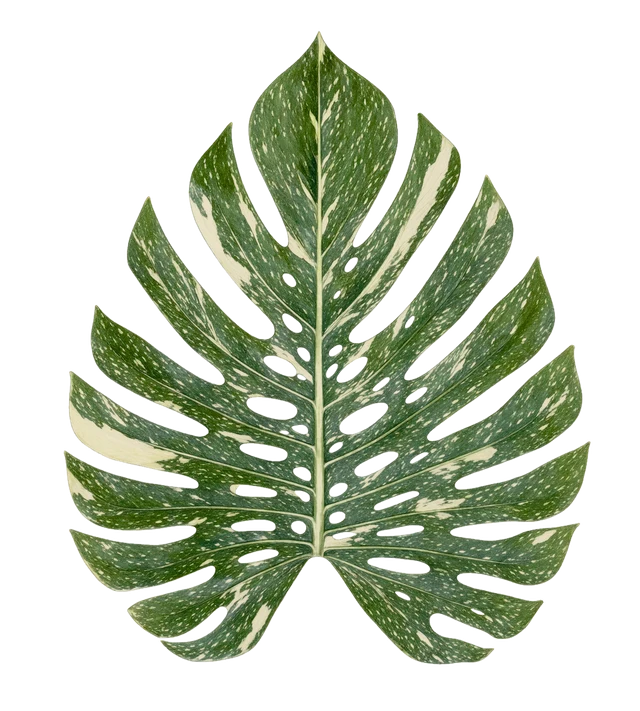 Thai ConstellationPrices today
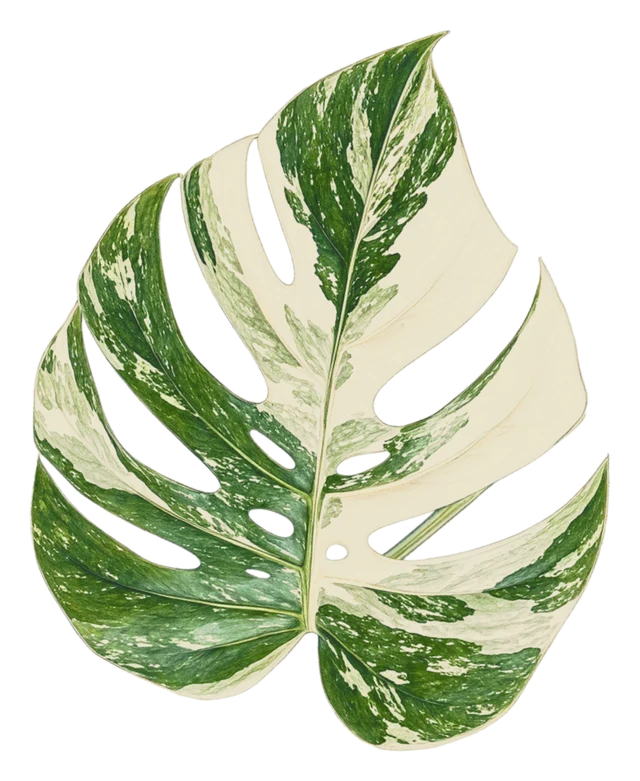 Albo VariegataPrices today
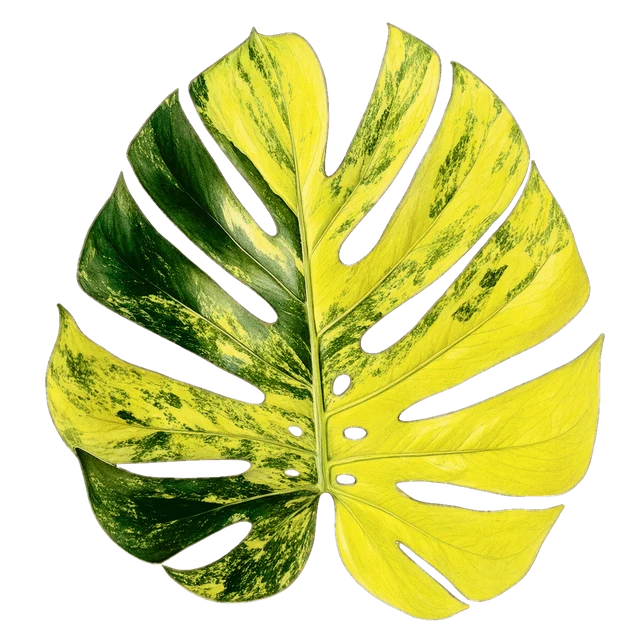 AureaPrices today
The evidence
| Form | As described in trade and patent texts |
|---|---|
| ‘Thai Constellation’ | mid to dark green with white or pale-yellow flecks and blotches17,22 |
| ‘Albo’ (also sold as ‘Albo Variegata’ or ‘Borsigiana Albo’) | white-variegated, from flecks and blocks to half-moon leaves, one half green and one white, up to almost or fully white leaves, with variegated stems; fully white leaves and plants of nothing but half-moons are called more uncommon49,50 |
‘Thai Constellation’
Its published tissue-culture route multiplies shoots from the buds but carries a small piece of callus along with each shoot, and at least one laboratory runs a callus route on purpose to induce mutation, which is where ‘Sumi1’ came from.51,21 None of the four published lab protocols for variegated aroid cultivars, ‘Thai Constellation’ among them, counts how many plantlets come out variegated; for Philodendron ‘White Knight’, regenerated from leaf-stalk pieces, most shoots came out green.52,51
The evidence
Of the lab protocols for four variegated aroid cultivars, ‘Thai Constellation’ among them, three did not score the regenerants’ variegation.52,51 On ‘White Knight’, regenerated from leaf-stalk pieces, most shoots had plain green leaves and only a subset was variegated, without a count.52
On ‘Thai Constellation’, single keepers report an occasional half-moon leaf, a few in a couple of decades, and on one old plant a half-white side shoot, one plant’s identity unverified.53,2,54
‘Albo’
‘Albo’ is white-variegated, from flecks and blocks to half-moon leaves, one half green and one white, up to almost or fully white leaves, and its stems are variegated too.C49,50 It reverts per growing point: a tip that switches to all-green leaves keeps making green ones, and less often a tip switches to all-white leaves, which brown or die.C54,55,49
The evidence
What is said about ‘Albo’ comes from retailer, blog and forum statements, without counts.49,50 On trade ‘Albo’, reversion is described per growing point: a shoot tip that switches to all-green leaves is described as staying green, and less often a tip switches to all-white leaves.54,55,49 Half-moon leaves and growing points turning all green or all white are described on it; a white cell line in the growing tip would give this picture whatever its cause, nuclear or plastid.49,55
All-green leaves on ‘Albo’ are blamed on too little light, on too much direct sun, or on neither; of two white-variegated plants of unnamed cultivar, one made an all-green leaf at a window without direct sun, the other whiter leaves at a very bright window, with the light not read at either.56,57,54
All-white ‘Albo’ leaves and cuttings are described as browning or dying and as unable to root on their own, and in non-aroid variegated plants, chlorophyll-free shoots likewise failed once they had to stand alone, while in petunia a white sector grew and flowered as long as it stayed attached.2,3,4
‘Albo’ is propagated by nodal cuttings, air layering and cutting back to a node; a node showing only green tissue is described as giving a green plant, and whether ‘Albo’ is tissue-cultured at all is disputed.2,57,50 For a reverted ‘Albo’ shoot, cutting back to a node with white in its stem is the remedy described; its outcome is put as odds, not a guarantee, and cutting off green shoots is also called useless.54,56
Sources for this section (57)
- Taylor, C. M., D. M. McCauley & L. L. Nackley (2026): “Illuminating Indoor Tropicals: Characterizing Photosynthetic Light Responses in High-value Houseplants”. HortScience 61(3):554-556 doi:10.21273/hortsci19169-25
- Chen (2026): “Monstera Albo vs Thai Constellation vs Mint: What You're Actually Buying”. The Plant Index, April 25, 2026 theplantindex.com
- Cortés-Olmos et al. (2025): “Response to In Vitro Micropropagation of Plants with Different Degrees of Variegation of the Commercial Gymnocalycium cv. Fancy (Cactaceae)”. Plants 14(7):1091 doi:10.3390/plants14071091
- Li (2005): “Observation of High-frequency Occurrence of Chimeral Adventitious Shoots in Tissue Culture from the Chimeral Tissues of Pelargonium zonale”. HortScience 40(5):1461-1463 doi:10.21273/hortsci.40.5.1461
- Rodriguez Ibanez (2001): “Musteranalysen an ausgewählten variegaten Formen der Araceae, Asteraceae, Ericaceae, Marantaceae und Rosaceae”. Dissertation (Dr. rer. hort.), Landwirtschaftlich-Gärtnerische Fakultät, Humboldt-Universität zu Berlin, oral examination 06.07.2001 doi:10.18452/14667
- Falcioni et al. (2026): “Chloroplast-Thylakoid Organisation Is More Important than Carotenoid Accumulation for Optimum Photosynthetic Quantum Yield and Carbon Gain in Variegated Epipremnum aureum”. Cells 15(6):514, PMC13026040 doi:10.3390/cells15060514
- Zhang, Fu (2023): “Physiological differences of green-leaf and variegated-leaf ivy (Hedera helix L.) cultivars”. Bangladesh J. Bot. 52(2):539-549, 2023 (June) Special doi:10.3329/bjb.v52i20.68219
- Khalekuzzaman et al. (2015): “Comparison of green and variegated foliage plant species based on chlorophyll fluorescence parameters under different light intensities”. Pak. J. Bot. 47(5): 1709-1715
- Takahashi & Kondo (1990/91): “各種グラウンドカバープランツの日照条件に対する適応性に関する実験的研究" / "Experimental Study on the adaptability of Ground Cover Plants Under Sunlight Condition”. Journal of the Japanese Institute of Landscape Architecture (造園雑誌) 54(5):161-166 doi:10.5632/jila1934.54.5_161
- Milić et al. (2023): “Contrasting Metabolisms in Green and White Leaf Sectors of Variegated Pelargonium zonale - An Integrative Transcriptomic and Metabolomic Study” doi:10.3390/ijms24065288
- Wijesingha Ahchige et al. (2024): “The variegated canalized-1 tomato mutant is linked to photosystem assembly”. Computational and Structural Biotechnology Journal doi:10.1016/j.csbj.2024.10.028
- Terao, H. et al. (1929): “A Vegetative Mutation and Maternal Inheritance of a White-Margined Variegation in Petunia” (ペチユニヤに於ける白縁緑心型斑葉の芽條攣異並に母親遺傳). Japanese Journal of Genetics (遺伝学雑誌) 4(2):86-90 doi:10.1266/jjg.4.86
- Tilney-Bassett, R. A. E. (1963): “The structure of periclinal chimeras”. Heredity 17(2):265-285 doi:10.1038/hdy.1963.30
- Li et al. (2017): “Physiological Characterization and Comparative Transcriptome Analysis of White and Green Leaves of Ananas comosus var. bracteatus”. PLOS ONE doi:10.1371/journal.pone.0169838
- Chen, Zhang & Wang (2009): “花烛叶色嵌合体不同生长阶段叶色性状的保持特征” (Characteristics of Leaf Color Maintenance during Different Growth Phases in Leaf Color Chimeras of Anthurium andraeanum cv. Sonate). 植物研究 (Bulletin of Botanical Research) 29(5):565-570 doi:10.7525/j.issn.1673-5102.2009.05.011
- Chen, Shao & Wang (2011): “花烛突变体叶色嵌合性状的分化特征与保持方法” (Differentiation characteristics and retention method of leaf color chimera feature of mutated plantlet of Anthurium andraeanum). 植物资源与环境学报 (Journal of Plant Resources and Environment) 20(4):8-12
- Hung, Anh (2024): “Monstera Plant Named 'HUTAMT41'”. US Plant Patent US PP36,063 P2, issued Aug. 6, 2024 (Appl. No. 18/445,611, filed Nov. 20, 2023)
- Pennisi, S.V., M.W. van Iersel & S.E. Burnett (2005): “Photosynthetic Irradiance and Nutrition Effects on Growth of English Ivy in Subirrigation Systems”. HortScience 40(6):1740-1745 doi:10.21273/hortsci.40.6.1740
- Vladimirova, S.V., D.B. McConnell, M.E. Kane and R.W. Henley (1997): “Morphological Plasticity of Dracaena sanderana 'Ribbon' in Response to Four Light Intensities”. HortScience 32(6):1049-1052 doi:10.21273/hortsci.32.6.1049
- Vladimirov, S. V. & McConnell, D. B. (1996): “Anatomical and Morphological Modifications of the Periclinal Chimera Dracaena sanderana 'Ribbon' in Response to Four Light Intensities”. HortScience 31(4):581, Abstract No. 095 doi:10.21273/hortsci.31.4.581d
- Ployphommas (2024): “Plant Patent PP35706 P2: Monstera deliciosa 'Sumi1'”. US Plant Patent PP35706 P2, granted 2024-03-26 (filed 2023-05-15, application US18/445,183)
- Rimland (2025): “Monstera plant named 'MKR-MTCM1'”. US Plant Patent USPP36561 P2, filed 2024-10-11, granted 2025-03-18, Google Patents full text patents.google.com
- Liang (2026): “Monstera plant named 'LONGPRIDEMO01'”. US Plant Patent US PP37,613 P2, Aug. 18, 2026 (Appl. No. 19/442,340, filed Jan. 7, 2026), Latin name given: Monstera deliciosa image-ppubs.uspto.gov
- Ferreira et al. (2018): “Molecular characterization of berry skin color reversion on grape somatic variants”. Journal of Berry Research 8(2018):147-162 doi:10.3233/jbr-170289
- Foster, T. (Toshi) M. (2018): “Attention sports fans! The far-reaching contributions of bud sport mutants to horticulture and plant biology”. Horticulture Research 5:44 doi:10.1038/s41438-018-0062-x
- Charlotte Pratt, J. Einset, and R. M. Gilmer (1972): “Reversion in Sports of 'Rhode Island Greening' Apple”. J. Amer. Soc. Hort. Sci. 97(3):292- doi:10.21273/jashs.97.3.292
- Park et al. (2023): “High-throughput discovery of plastid genes causing albino phenotypes in ornamental chimeric plants”. Horticulture Research 10(1):uhac246 doi:10.1093/hr/uhac246
- Weihe et al. (2009): “Biparental inheritance of plastidial and mitochondrial DNA and hybrid variegation in Pelargonium”. Molecular Genetics and Genomics 282(6):587-593 doi:10.1007/s00438-009-0488-9
- Hung et al. (2010): “Identification of a Mg-protoporphyrin IX monomethyl ester cyclase homologue, EaZIP, differentially expressed in variegated Epipremnum aureum 'Golden Pothos' is achieved through a unique method of comparative study using tissue regenerated plants”. Journal of Experimental Botany 61(5):1483-1493 doi:10.1093/jxb/erq020
- Cao, Deng et al. (2017): “A single gene controls leaf background color in caladium (Araceae) and is tightly linked to genes for leaf main vein color, spotting and rugosity” doi:10.1038/hortres.2016.67
- Dechkrong et al. (2024): “Mutation mapping of a variegated EMS tomato reveals an FtsH-like protein precursor potentially causing patches of four phenotype classes in the leaves with distinctive internal morphology” doi:10.1186/s12870-024-04973-1
- Malabarba et al. (2020): “New Strategies to Overcome Present CRISPR/Cas9 Limitations in Apple and Pear: Efficient Dechimerization and Base Editing” doi:10.3390/ijms22010319
- Kazemzadeh Bahnamirei et al. (2025): “Innovative in vitro shoot regeneration in variegated snake plant (Sansevieria trifasciata cv. Laurentii) through utilization of light exposed single-node rhizome tissue”. Scientific Reports doi:10.1038/s41598-025-23247-w
- Zhu, Y., T. Takemoto, S. Yazawa (1993): “Leaf Color of Plants Regenerated through In Vitro Culture from Variegated Leaf Segments of Caladium.”. (Japanese title: カラジウムの葉色別外植体の培養により得られた再生植物体の葉色の変異) doi:10.2503/jjshs.62.619
- Marcotrigiano, Bernatzky (1995): “Arrangement of cell layers in the shoot apical meristems of periclinal chimeras influences cell fate”. The Plant Journal 7(2):193-202 doi:10.1046/j.1365-313x.1995.7020193.x
- Skirvin, Janick (1976): “Tissue Culture-induced Variation in Scented Pelargonium spp.1”. J. Amer. Soc. Hort. Sci. 101(3):281-290 doi:10.21273/jashs.101.3.281
- Nabeshima et al. (2017): “Histogen Layers Contributing to Adventitious Bud Formation Are Determined by their Cell Division Activities” doi:10.3389/fpls.2017.01749
- Okuno et al. (2010): “Stability of variegation in plants propagated by tissue culture of three variegated cultivars of Farfugium japonicum (Asteraceae), a Japanese traditional ornamental plant” doi:10.5511/plantbiotechnology.10.0608a
- Beardsell and Norden (2004): “Ficus rubiginosa 'Variegata', a Chlorophyll-deficient Chimera with Mosaic Patterns Created by Cell Divisions from the Outer Meristematic Layer”. Annals of Botany 94(1):51-58 doi:10.1093/aob/mch114
- Korn (2013): “The concept of the eudicot shoot apical meristem as it applies to four Spiraea (Rosaceae), one Mentha (Lamiaceae) and one Euonymus (Celastraceae) cultivars based on chimeric analysis”. Annals of Botany 111(5):887-893, 2013 doi:10.1093/aob/mct054
- Rycyna et al. (2024): “Landscape and Fruit Evaluation of Three Privet (Ligustrum sp.) Cultivars in Florida”. Horticulturae 10(1):90 doi:10.3390/horticulturae10010090
- Smith, W.A. and M.H. Brand (2012): “'Summer Skies' Buddleja davidii”. HortScience 47(1):126-127 doi:10.21273/hortsci.47.1.126
- Tatebe (1968): “Genetic studies on the leaf variegation of Allium cepa L.” (タマネギのふ入り葉の遺伝研究). Journal of the Japanese Society for Horticultural Science 37(4):345-352 doi:10.2503/jjshs.37.345
- Xu et al. (2006): “Characteristics of Chimeras of Anthurium andraeanum from in vitro Mutation”. Chinese Bulletin of Botany 23(6): 698-702 doi:10.3724/cbb-t26-016
- Marcotrigiano, Morgan, Swartz & Ruth 1987, Histogenic Instability in Tissue Culture-proliferated Strawberry Plants, J. Am. Soc. Hort. Sci. 112(3):583–587
- Henny, Chen (2009): “Tropical Foliage Plant Development: Origin of New Cultivars”. UF/IFAS Extension publication ENH1092/EP356 (EDIS), University of Florida doi:10.32473/edis-ep356-2008
- Birdsey (ed.); Barthlott & Bogner; Lecoufle; Melim; Sodiro (reproduced) (1981): “AROIDEANA, Vol. 4, No. 4, October 1981” (complete issue). Aroideana 4(4):106-139, International Aroid Society, Inc
- Parrish, Kane, Deng (2023): “Morphological, cytogenetic and molecular characterization of new somaclonal variants in four caladium (Caladium × hortulanum) cultivars”. Ornamental Plant Research 2023, 3:1, article (Open Access, Maximum Academic Press) doi:10.48130/opr-2023-0001
- Goldwyn (2026): “Monstera deliciosa albo variegata care & propagation”. Web page bybrittanygoldwyn.com
- Knight (2026): “Monstera Albo Care Guide and Growing Tips”. Web page ourhouseplants.com
- Jing, Beleski & Vendrame (2023/2024): “Micropropagation and Acclimatization of Monstera deliciosa Liebm. 'Thai Constellation'”. Horticulturae 10(1):1 doi:10.3390/horticulturae10010001
- Kang & Sivanesan (2025): “Micropropagation of Philodendron 'White Knight' via Shoot Regeneration from Petiole Explants”. Plants 14(11):1714 doi:10.3390/plants14111714
- Garden.org forum users Matthewrkell, Gina1960, Hortica (2024): “Half Moon Thai”. G, Ask a Question forum, thread 183140 garden.org
- Patel (2026): “Why Monstera Albo Reverts to Green (Cell-Layer Reason)”. Ariumology, published 2026-08-13 ariumology.com
- Over Grown Team (2026): “The Monstera Albo: Is It Actually Worth the Price?”. Blog post, dated June 15, 2026. Character: retailer blog (plant shops with a collector cabinet, invites readers to the shops) over-grown.com
- Pflanzenfreunde forum users plnt et al. (2026): “Monsters variegata vergrünt”. Pflanzenforum, thread 4652 forum.pflanzenfreunde.com
- TerraFlora Global (2026): “Tracing the Origins of the Monstera Borsigiana Albo Variegata: A Beloved Aroid”. Blog post terrafloraglobal.com
Flowers and fruit
Large plants flower; potted plants indoors usually do not.C1,2,3 To get seed indoors, take pollen from one flower spike and place it on a second that opens later, on the same plant or on another in bloom at the same time.4,5 A flower spike is female first, by one to two days, and its stigmas stop before it sheds its own pollen.4,5 Keep the seed moist: it loses viability quickly once it dries, but kept moist it can be stored for several months.4
The evidence
One conservatory plant that had climbed about 12 m flowered and fruited regularly, and M. deliciosa is also reported to flower readily once it has reached a certain size.2,1 One fruit-crop account states, without giving a basis, that potted plants kept indoors, conservatories and greenhouses included, do not bloom or fruit in confinement.3 Both the flowering reports and this statement come without measured conditions.2,3
Since the stigmas stop before the same flower spike sheds pollen, selfing within one flower spike is described as impossible, yet in wild Monstera lentii some bagged flower spikes still set fruit.4,5 In wild Monstera lentii, 6 of 11 flower spikes closed to all visitors still set fruit, at about 10 % fruit set against 61.4 % under natural pollination.5
Grown outdoors as a fruit crop, plants from cuttings are said to begin bearing after 4–6 years, and a fruit takes 12–14 months from flowering to ripeness.6,3 Ripe fruit is described as edible only where the rind scales have loosened enough to flick off, and it ripens toward its tip over 5 or 6 days at room temperature.3 Some people report throat irritation even from ripe fruit, and hives and worse are reported after eating it, so eating it in quantity before one’s reaction is known is advised against.3 In Monstera, except M. obliqua, the ripe fruit sheds its cap of needle-bearing cells in large segments or all at once, exposing the seeds in the pulp.7
Among recorded hobby crosses, mostly in Anthurium and Philodendron, whether a plant flowers in cultivation limited crosses more than compatibility did.1
Sources for this section (7)
- Cedeño-Fonseca, Díaz Jiménez, Zuluaga & Blanco 2020, A comparison of Monstera deliciosa and M. tacanaensis, with comments on Monstera section Tornelia (Araceae), Aroideana 43(1&2):31–73
- Delendick, T. J. (1985): “Aroids at Brooklyn Botanic Garden”. Aroideana 8(1):5-12
- Morton (1987): “Ceriman”. In: Fruits of warm climates, pp. 15-17. Julia F. Morton, Miami, FL hort.purdue.edu
- Madison 1978, The Genera of Araceae in the Northern Andes, Aroideana 1(2):31–53
- Prieto, Cascante-Marin (2017): “Pollination by nitidulid beetles in the hemi-epiphytic aroid Monstera lentii (Araceae: Monsteroideae)”. Flora 231:57-64 doi:10.1016/j.flora.2017.04.010
- Crane, J. H.; Balerdi, C. F. (2005, revised 2016): “Monstera Growing in the Florida Home Landscape”. HS1071 / HS311, UF/IFAS Extension doi:10.32473/edis-hs311-2006
- Madison, M. (1979): “Protection of developing seeds in neotropical Araceae”. Aroideana 2(2):52-61
Pets
Monstera is poisonous to cats, dogs and small pets.C1,2 All parts of the plant irritate mouth and skin, and its tissues carry needle-shaped calcium oxalate crystals.C3,4,2 If pets chew it, rinse or wipe the affected area with cold water and watch their airway closely.C1 Take pets to the vet, and if you are not sure which plant they ate, bring the rest of it or a photo.C1
The evidence
M. deliciosa is listed among the arum family’s oxalate plants poisonous to dogs, cats and small pets, with mouth and skin irritation, swelling, drooling, vomiting, difficulty swallowing and possible throat swelling named as signs for the family.1 For an animal exposed to an oxalate plant, the first aid given is rinsing or wiping the affected area with cold water and close watching of the airway.1 For plant poisoning in pets in general, the step given is a visit to the vet, with the rest of the plant or a photo of it when the plant cannot be named.1
For M. deliciosa, all parts of the plant, the unripe fruit and the flower remnants on the ripe fruit are described as irritating mouth and skin, in accounts without cases or doses.3,4 Its crystals are also said to irritate the gut lining and the eye.3,4 Across the genus Monstera, these crystals are most abundant in the fruit and seed coat.2 For M. deliciosa itself, one work with one plant per light condition lists raphides in the midrib and leaf stalk in one place, and in another reports none in light and shade plants except a few needles in the leaf stalk.2 Of 166 cats treated at one emergency clinic for confirmed or suspected poisoning, two came after assumed M. deliciosa exposure, and both survived to discharge.5 In farm animals, M. deliciosa is cited as causing only light changes of the mouth lining.6
Sources for this section (6)
- Siroka (2023): “Toxicity of House Plants to Pet Animals”. Toxins 15(5):346 doi:10.3390/toxins15050346
- Madison 1978, The Genera of Araceae in the Northern Andes, Aroideana 1(2):31–53
- Morton (1987): “Ceriman”. In: Fruits of warm climates, pp. 15-17. Julia F. Morton, Miami, FL hort.purdue.edu
- Sulborska et al. (2016): “Rośliny toksyczne niebezpieczne dla oczu” [English title printed: "Toxic plants hazardous to eyes"]. Alergoprofil 2016, 12(1): 17-22
- Markert, Heilmann, Kiwitz and Dörfelt (2023): “A retrospective evaluation of confirmed and suspected poisonings in 166 cats between 2016 and 2020”. Veterinary World 16(9):1940 doi:10.14202/vetworld.2023.1940-1951
- Guimarães et al. (2019): “Toxicological and anatomical study of vegetative organs of Anthurium maricense Nadruz and Mayo (Araceae)”. Revista Agrogeoambiental 11(2):87–100 doi:10.18406/2316-1817v11n220191289
Telling it apart
The trade names ‘Ginny’, ‘Philodendron imbe Ginny’ and ‘dwarf Monstera pertusa’ all belong to Rhaphidophora tetrasperma, a climber of another genus.1 On a living leaf, M. deliciosa has a wide, raised midrib clearly paler than the blade; Rhaphidophora tetrasperma has a narrow midrib that is slightly sunken and about the colour of the blade.2,3 Warty leaf stalks do not identify M. deliciosa: some clones have smooth stalks, and smooth and warty plants grow side by side in the wild.4
‘Borsigiana’ is not a separate species but a name for smaller plants within M. deliciosa, whose mature clones differ fourfold in leaf size; some small plants sold under that name could be M. tacanaensis, a separate species that grows wild from southern Mexico to Panama.2,4
The evidence
For Rhaphidophora tetrasperma, the midrib’s width and colour rest on a single description.2,3 ‘Monstera minima’ is printed as a further name of Rhaphidophora tetrasperma.5
On an adult plant, M. deliciosa has no waxy bloom on stem or leaf stalks and holes of very unequal sizes, while M. tacanaensis has a bloom and few holes of similar size; a shaded or dry M. deliciosa also makes few holes, so the hole test alone can mislead.2,6 A young M. deliciosa resembles an adult M. tacanaensis, so these adult checks do not settle a young pot plant.2 The length of the joint under the blade is no reliable check between the two species, since the printed ranges disagree.2,4,7
On adult leaves and without flowers, a swollen joint directly under the blade points to Monstera, while Philodendron lacks it in all but very rare cases.8 A ‘pothos’ label names no genus: nursery plants sold as pothos in one country belonged to Epipremnum, Philodendron, Scindapsus, Rhaphidophora and Monstera, and none to Pothos.9 In a tree built from whole chloroplast genomes, M. deliciosa grouped most closely with M. adansonii among the species in that tree.10
Sources for this section (10)
- Boyce, P. (2004): “A Review of Epipremnum (Araceae) in Cultivation”. Aroideana 27:205-211
- Cedeño-Fonseca, Díaz Jiménez, Zuluaga & Blanco 2020, A comparison of Monstera deliciosa and M. tacanaensis, with comments on Monstera section Tornelia (Araceae), Aroideana 43(1&2):31–73
- Boyce (1999): “The Genus Rhaphidophora Hassk. (Araceae-Monsteroideae-Monstereae) in Peninsular Malaysia and Singapore”. Gardens' Bulletin Singapore 51:183-256 (1999)
- Madison (1977): “A Revision of Monstera (Araceae)”. Contributions from the Gray Herbarium of Harvard University, No. 207, pp. 77-97 (species descriptions 15-22) doi:10.5962/p.336443
- Siroka (2023): “Toxicity of House Plants to Pet Animals”. Toxins 15(5):346 doi:10.3390/toxins15050346
- Croat, T.B., Cedeño-Fonseca, M. & Ortiz, O.O. (2024): “Revision of Monstera (Araceae: Monsteroideae) of Central America”. Phytotaxa 656(1): 1-197 doi:10.11646/phytotaxa.656.1.1
- Engler & Krause (1908): “Araceae-Monsteroideae (with Additamentum ad Araceas-Pothoideas by A. Engler), in: A. Engler (ed.), Das Pflanzenreich IV. 23 B (Heft 37)”. Das Pflanzenreich, Heft 37 (IV. 23 B), Leipzig: Engelmann, issued 8 December 1908
- Madison 1978, The Genera of Araceae in the Northern Andes, Aroideana 1(2):31–53
- Akter et al. (2024): “Ornamental Pothos – A Taxonomic Dilemma”. Journal of Agroforestry and Environment 17(2): 17-22 doi:10.55706/jae1712
- Yun & Kim (2023): “The complete plastome sequence of Monstera deliciosa (Araceae), an ornamental foliage plant”. Mitochondrial DNA Part B 8(12) doi:10.1080/23802359.2023.2284415