Monstera deliciosa for beginners
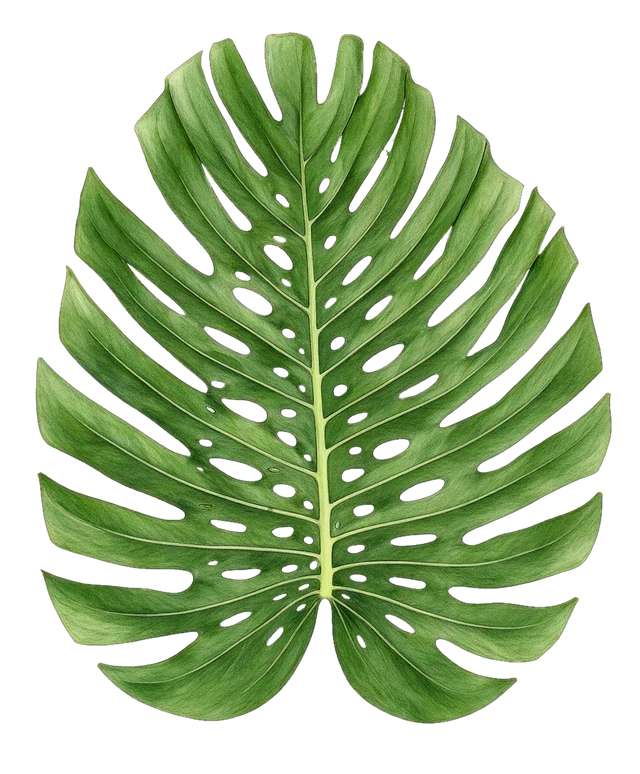
Monstera deliciosa comes from southern Mexico and Guatemala. Wild adult plants always carry leaves with holes, and a young plant gets there gradually, leaf by leaf.
At a glance
- Light
- Green leaves that unfold in strong light build their own protection; what burns is a sudden jump from shade into strong lightA
- Grow lamp
- Under a constant lamp, give a green plant 120–250 µmol/m²/s at the leaf, about 8–18 klx under white LEDsB
- Water
- Water when the mix has dried, not on a fixed schedule; overwatering rots M. deliciosa more often than drought doesC
- Warmth
- Keep it above 12 °C; warmer nights mean more growthC
- Mix
- A coarse, airy mix holds more air after watering, which guards against waterloggingC
- Pot
- Repot one size up when the roots reach the bottom and sides; it tolerates a tight pot far better than an oversized oneC
- Feeding
- Feed with a soluble mineral fertiliser rather than compostB
- Support
- Give it something to climb: attached to a support, a green plant makes larger leaves in bright light and keeps its aerial roots growingB
- Humidity
- Misting puts almost no water into the leafC
- Pets
- Poisonous to cats, dogs and small petsC
A measured directly · B indirect or transferred with good grounds · C one report, or from another plant
Light
Green leaves that unfold in strong light, even under a full-sun glasshouse peak, build their own protection and show no lasting damage. What burns is a sudden jump: a shade leaf hit by strong light is damaged and recovers slowly and not completely, so never move a plant from shade straight into strong light.
Move it in steps instead: days to weeks per step, not hours, and wait at each step until new leaves have unfolded in the new light. Under a grow lamp, give it 120–250 µmol/m²/s at the leaf, which is about 8–18 klx under white LEDs. More in the full guide
Watering and the mix
Water when the mix has dried, not on a fixed schedule.C Overwatering rots a Monstera more often than drought does, and root disease strikes most in the colder months.C In a fine mix, right after watering the air sits near the top and the bottom of the pot stays wettest; as the mix dries, air comes back all the way down. So buy a coarse, airy mix: it holds more air after watering, which guards against waterlogging.C For cuttings the recipe hardly matters: they grow equally well in very different mixes, peat-free ones included. Misting puts almost no water into the leaf.C More in the full guide
Pot
Keep it snug: repot one size up when the roots reach the bottom and sides of the pot, because it tolerates a tight pot far better than an oversized one.C More in the full guide
Warmth
Keep it above 12 °C; warmer nights mean more growth.C More in the full guide
Feeding
Feed with a soluble mineral fertiliser rather than compost: it gives taller plants with more and larger leaves. In dim light, feed adds nothing.C More in the full guide
A pole to climb
Give it something to climb: a green plant tied to an upright pole makes larger leaves in bright light, and its aerial roots keep growing. The clinging roots that grip the pole need contact to keep growing, and once the stem grows past the top, the new roots stop at about 1 cm. The long roots that hang down are feeding roots: they grow toward the soil and stay unbranched until they reach it. More in the full guide
How it grows
Holes come with age: the first leaves of a young plant are small and entire, and the next ones get holes near the midrib. The holes are laid down while the leaf is still rolled up, so unrolling only reveals them. Sun leaves carry far more hole area than shade leaves. How big the leaves finally get is partly set by the plant itself, not by care, since some plants make leaves four times the size of others. More in the full guide
What is normal
A yellow sheath along the leaf stalk that dries to papery brown remnants, leaving a scar on older leaves, is part of normal growth. Three swellings belong to an adult plant: the often curved joint right under the blade, a second swelling where the leaf stalk meets the stem, and the bud, a swelling above the node. Fast-growing new leaves often come out paler green between the veins and green up again later. A plant turned around at a one-sided window rearranges its leaves within about two weeks by bending at the stalk joints, so they shade each other less. More in the full guide
The variegated forms
A very white leaf is fed by the green rest of the plant.C Trouble starts when a leaf has no green at all, or when an all-white shoot has to stand on its own as a cutting.C On ‘Albo’, reversion runs per growing tip: a tip that switches to all-green leaves keeps making green ones, and less often a tip switches to all-white leaves, which brown or die.C
Each of the newer forms on record began as a single plant. A form that begins as one changed plant or shoot like these is called a sport.C Where the pattern is a mix of green and white within the cells, it sorts itself out as the plant grows, and a whole shoot can tip to all white or all green.C Where the pattern sits in whole cell layers, a cutting at a node carries it on with few off-pattern shoots.C ‘Thai Constellation’ leaves keep using light well past the point where green leaves level off. Give it the bright end of the range for green plants. More in the full guide
Propagation
Root it from a piece of stem with a node and its bud: put straight into a soil-based mix, such a cutting roots and grows within two months. Take a thick piece, because the thickest stem pieces survive best. More in the full guide
Pets
Monstera is poisonous to cats, dogs and small pets.C All parts of the plant irritate mouth and skin, and its tissues carry needle-shaped calcium oxalate crystals.C If your pet chews it, rinse or wipe the affected area with cold water and watch its breathing closely.C Then take it to the vet, and if you are not sure which plant it ate, bring the rest of the plant or a photo.C More in the full guide