 Fenestry
Philodendron hederaceum for beginners
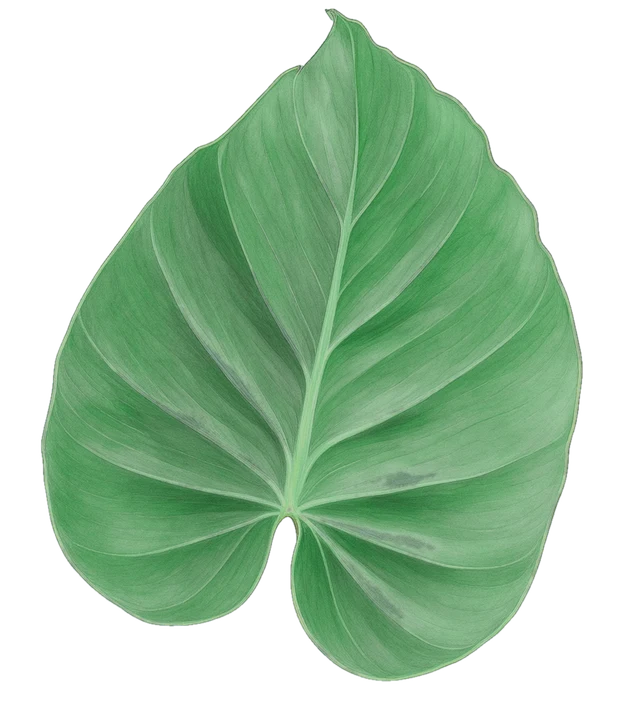
Heartleaf philodendron is a climber: in the wild it climbs the trunks of trees. Its adult leaf is broad and firm, with the rear lobes turned inward, and on a climbing stem in bright light each new leaf comes out larger than the last.
At a glance
- Light
- It keeps growing even in very dim light, only more slowlyA
- Grow lamp
- Give it 286–605 µmol/m²/s at the leaf; at 135 or less it makes a quarter of the growth or lessB
- Water
- Water when the mix has dried, not on a fixed schedule; a brighter spot uses more waterC
- Warmth
- Keep it above about 16 °C, warmer for faster growth; three days near 2 °C leave dead spots on its new leavesC
- Mix
- Use a peat-based mix with bark and perliteC
- Pot
- Repot when the roots reach the bottom and sides of the pot; a tight pot is tolerated much better than an oversized oneC
- Feeding
- Feed lightly: indoors about 1 g of a 14-14-14 fertilizer per 6-inch pot every 4 months in dim light, about 2 g in brighter lightC
- Support
- Let it climb: tied to a support in bright light, it made leaves of about three times the area of its first leaf, while a stem with nothing to touch kept small leavesA
- Humidity
- No need to mist or raise the humidity: it grew as well at 45 % humidity as at 99 %C
- Pets
- Poisonous to cats, dogs and small petsC
A measured directly · B indirect or transferred with good grounds · C one report, or from another plant
Light
In a room, it tolerates light from about 75 foot-candles (about 0.8 klx, thousand lux) at the plant, and 150 foot-candles (about 1.6 klx) or more keeps its leaf color and size.C Even in very dim light it keeps growing, only more slowly; more light gives more growth.
After a move to a dimmer spot, give it 4 to 6 weeks to settle in.
Under a grow lamp, give it 286–605 µmol/m²/s at the leaf (the light a plant uses, as a lamp or meter states it); in greenhouse light under shade cloth, 135 or less gave a quarter of the growth or less. Under white LEDs of 3000 to 5000 K (K is the lamp’s color temperature), about 30,000–40,000 lux at the leaf comes close to that range, while 15,000–25,000 lux reaches only its lower part.C
In full sun, give it moving air: in still air the leaves got yellow spots and burned edges and grew smaller, while in moving air they looked normal.C More in the full guide
Watering
Water when the mix has dried, not on a fixed schedule; a brighter spot uses more water.C
Skip misting and keep the leaves dry: it grew as well at 45 % humidity as at 99 %, and water standing on the foliage worsened Phytophthora leaf damage.C More in the full guide
Mix and pot
Use a peat-based mix (peat moss is the fibrous base of most potting soils) with bark and perlite (light white mineral grains).C A good mix leaves air after watering and still holds water.C For the bark and other chunky parts, choose coarse pieces: the finer the grade of a material, the less air and the more water it holds. Keep bark to about a quarter of the mix or less: more bark left the mix too little water, and the plants grew shorter.C
Repot when the roots reach the bottom and sides of the pot; a tight pot is tolerated much better than an oversized one.C More in the full guide
Feeding
Feed lightly: indoors about 1 g of a 14-14-14 fertilizer (equal shares of nitrogen, phosphorus and potassium) per 6-inch pot every 4 months in dim light, about 2 g in brighter light.C Dim here means about 0.8 to 2.4 klx (klx: thousand lux) at the plant around midday, and brighter means about 2.4 to 10.8 klx.C
Do not overfeed: it has a narrow best range of fertilizer; above it, quality fell steadily, and the roots suffered first. More in the full guide
Warmth
Keep it above about 16 °C, warmer for faster growth; three days near 2 °C leave dead spots on its new leaves.C Keep it out of frost: one night at about -3 °C left leaves and stems badly damaged.C Do not let days regularly go above 35 °C: quality and growth decline.C
If it got cold for a day, just bring it back into warmth; after several days near 2 °C, watch its new leaves for dead spots. Marks can first appear days after the cold has ended.C More in the full guide
Something to climb
Give it something to climb and tie the stem to it. In bright light, a stem tied to a smooth board made leaves nearly three times the area of its first leaf, while a stem with nothing to touch kept leaves at about the first leaf’s area.
Give the stem a support to touch: contact stimulates the aerial roots (roots that grow from the stem above the soil) and keeps them growing. On a bark-slab totem (a pole faced with bark), water the totem itself from above so the aerial roots attach, and keep the water off the leaves.C More in the full guide
Cuttings
Take single-node cuttings: a piece of stem with one leaf, the joint it grows from and 2.5 to 5 cm of stem.C Such cuttings rooted in every peat mix tried. A rooting hormone is not needed for cuttings to root: the same share rooted with or without a hormone dip. In a cool room, root the cuttings on bottom heat of about 24 °C; 29 °C gave no better rooting, only a longer shoot.
For a full pot, set several cuttings together: more cuttings per small pot gave a fuller pot, with leaf size and vine length unchanged. In warm air, pot cuttings right after cutting; cuttings left lying unplanted for six hours grew less. More in the full guide
The forms
‘Brasil’ has an irregular variegation (a pattern of two colors) running lengthwise along the leaf, in yellow-green to light-green on dark green, so its pale areas are pale green rather than white.C ‘Lemon Lime’ has heart-shaped leaves brilliantly marked by yellow.C ‘Frilly Philly’ is not variegated; its small lanceolate (narrow, pointed) leaves average 7.0 cm long and 1.5 cm wide.
If a variegated vine has turned solid green, every leaf it makes is green; cut it back to the last variegated leaf for a chance of bringing the pattern back, not a guarantee.C Take cuttings from patterned stretches of the vine, ideally from nodes (the joints the leaves grow from) with pattern right around the bud, not from a stretch that has turned solid green.C More in the full guide
Pets
Heartleaf philodendron is poisonous to cats, dogs and small pets.C If a pet has chewed it, rinse or wipe its mouth with cold water and watch its airway closely.C Signs include itching, burning, swelling, salivation and vomiting.C If you take the animal to a veterinarian, bring a piece of the plant or a clear photo of it.C If signs worsen, get emergency care promptly.C
The leaves contain needle-shaped crystals of calcium oxalate.C Rinse sap in the eyes with lukewarm running water for about a dozen minutes.C Wear gloves when you cut many cuttings: in some nurseries, workers who handled the plant daily developed a rash, mostly mild.C More in the full guide
What is normal
Small leaves on a stem with nothing to touch are normal for this plant: in bright light, a support to touch is what makes them larger (see Something to climb). Slow growth in a dim spot is normal: it keeps growing, only more slowly. Aerial roots, the roots that grow from the stem above the soil, are part of the plant: on a stem with nothing to touch they grow very slowly, and contact with a support keeps them growing. More in the full guide
When something looks wrong
Remove leaves with spreading water-soaked (wet-looking) streaks, and check the margins of older leaves first. Against citrus mealybugs (small sap-sucking insects), spray horticultural oil (a spray oil sold for plants) or insecticidal soap at 2 %: on a related climber it killed most of them. Look for mealybugs in the leaf axils (where the leaf stalk meets the stem) as well as on the leaves. Do not spray permethrin (an insecticide): even on plants without pests, four weekly sprays left it with less foliage, although the leaves showed hardly a mark. More in the full guide