 Fenestry
Philodendron hederaceum care guide
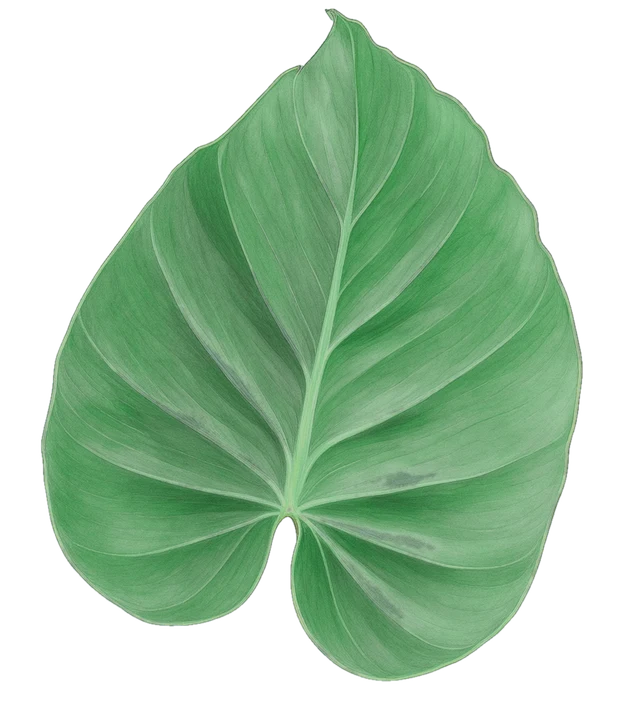
Heartleaf philodendron is a climber: in the wild it climbs the trunks of trees. Its adult leaf is broad and firm, with the rear lobes turned inward, and on a climbing stem in bright light each new leaf comes out larger than the last.
At a glance
- Light
- It keeps growing even in very dim light, only more slowlyA
- Grow lamp
- Give it 286–605 µmol/m²/s at the leaf; at 135 or less it makes a quarter of the growth or lessB
- Water
- Water when the mix has dried, not on a fixed schedule; a brighter spot uses more waterC
- Warmth
- Keep it above about 16 °C, warmer for faster growth; three days near 2 °C leave dead spots on its new leavesC
- Mix
- Use a peat-based mix with bark and perliteC
- Pot
- Repot when the roots reach the bottom and sides of the pot; a tight pot is tolerated much better than an oversized oneC
- Feeding
- Feed lightly: indoors about 1 g of a 14-14-14 fertilizer per 6-inch pot every 4 months in dim light, about 2 g in brighter lightC
- Support
- Let it climb: tied to a support in bright light, it made leaves of about three times the area of its first leaf, while a stem with nothing to touch kept small leavesA
- Humidity
- No need to mist or raise the humidity: it grew as well at 45 % humidity as at 99 %C
- Pets
- Poisonous to cats, dogs and small petsC
A measured directly · B indirect or transferred with good grounds · C one report, or from another plant
Light
In a room, it tolerates light from about 75 foot-candles (about 0.8 klx, thousand lux) at the plant, and 150 foot-candles (about 1.6 klx) or more keeps its leaf color and size.C Even in very dim light it keeps growing, only more slowly; more light gives more growth.
After a move to a dimmer spot, give it 4 to 6 weeks to settle in. A plant in a dimmer spot slowly needs less light to cover its own upkeep, so it settles in over those weeks. In the wild it grows in swampy, shaded sites and along creeks.C
Under a grow lamp, give it 286–605 µmol/m²/s at the leaf (the light a plant uses, as a lamp or meter states it); in greenhouse light under shade cloth, 135 or less gave a quarter of the growth or less. Under white LEDs of 3000 to 5000 K, about 30,000–40,000 lux at the leaf comes close to that range, while 15,000–25,000 lux reaches only its lower part.C
In full sun, give it moving air: in still air the leaves got yellow spots and burned edges and grew smaller, while in moving air they looked normal.C
The evidence
In whole plants moved from bright greenhouse light (up to 13,000 lux) to 27 µmol for 12 hours a day at 29 °C, without fertilizer, the compensation point (the light at which the plant’s carbon gain just equals its losses) fell from 33 to 15 µmol in 4 weeks and to 7 µmol in 15 weeks, as dark respiration dropped by 63 %. By week 4, 65 % of the 15-week change was done, and most of it came within 4 to 6 weeks. A single leaf, after six weeks at about 100 µmol, had a fitted compensation point of 56 µmol (n = 2-4). In potted pothos (Epipremnum aureum, cultivar not stated) moved after 45 days at 2 % of outdoor light (16-22 µmol only at 9:30-13:00) to natural outdoor light, the compensation point rose from 2.3 to 31.5 µmol within 45 days; there was one pair of curves per condition and no n, and the leaves had lost green from day 10 outdoors. In the same pothos the saturation point rose from 90 to 198.7 µmol within 45 days. Pothos kept outdoors made 31 new shoots in 90 days against 10 in indoor shade at 2 % of outdoor light, and 30 % more biomass after 30 and 60 days, although its leaves lost green; the number of plants is not stated.
In a growth chamber at 21/18 °C with feed every two weeks, plants at 10, 20 and 30 µmol for 12 hours gained 1.7, 2.2 and 3.3 g over 10 weeks. Under incandescent lamps at 270, 540 and 1,080 lx for 12 hours in 6 weeks, the internodes of heartleaf philodendron were longer, not shorter, at brighter light: 3.9, 4.3 and 5.3 cm. In a vertical garden with daylight plus a 4000 K LED for 16 hours at 21 °C, leaf area stayed the same when daily light rose from 0.1-0.3 to 1.1-1.7 mol per m² per day, at 23.3 against 25.2 cm², while the dry-matter share of the leaves rose from 10.8 to 13.7 %. Chlorophytum in the same trial gained 84 % leaf area over the roughly seven-fold rise in daily light at deep interior light, and the aroid was not climbing. In an office, green pothos gained dry mass in all three light zones over six months and none died: 13.20 g in the window zone, 7.20 g at a daytime mean of 15.2 µmol and 7.12 g at 5.2 µmol. A Florida advisory statement puts the interior minimum for most philodendrons at 75 foot-candles and says 150 or more keeps leaf color and size. In pothos (Epipremnum aureum, n = 3, 10-cm pots, 25 °C) held 120 days at each constant level under 12 h of fluorescent light, with outside light excluded by 90 % shade cloth, shoot fresh weight and leaf area per plant stopped rising above 60 µmol, while shoot dry weight still rose to 120 µmol and the chlorophyll-fluorescence ratio Fv/Fm fell at 120; single-leaf length and width did not differ at any level, so the area rise is more leaves on longer shoots. At 100 ft-c of cool-white fluorescent light in interior rooms, the grade of Dieffenbachia maculata ‘Camille’ rose with day length (3.2, 3.7 and 3.9 at 8, 12 and 16 h), while Aglaonema ‘Silver Queen’ did not respond; both are non-climbing aroids, the run lasted six months in 6-inch pots with 5 replications and a single light intensity, and the recommended minimum is 150 ft-c.
In greenhouse perlite culture under shade-cloth enclosures, rooted plants of 3 to 10 leaves in 15-cm pots, tied to a string, made 6.16 g dry weight at 700 µmol, 4.95 g at 333 and 1.18 g at 135 in a spring run, and 12.8, 9.0 and 1.0 g at 605, 286 and 44 µmol in an autumn-winter run; the figures are means over four nitrogen sources, with one enclosure per light level. Dry weight at 135 and 44 µmol was 24 % and 11 % of the middle level, and the plants stood 27.1 and 37 cm tall against 72.5 and 122 cm, while the two brighter levels differed only slightly. From the middle to the brightest level, dry weight rose by 24 % in the spring run and 42 % in the autumn-winter run. The leaves, taken as the mean of the 4th to 6th leaf, measured 68.9 to 82.9 cm² at 286 to 700 µmol and 22.9 to 26.9 cm² at 44 or 135 µmol. Across eight aroid datasets, brighter light gave slightly smaller single leaves above about 0.7 times the saturation of green leaves, while in the very dimmest light the direction reversed and leaves grew larger with more light; in heartleaf philodendron the 4th to 6th leaf was equally large from 286 to 605 µmol and small at 44 to 135 µmol. Single leaves of six Philodendron species and hybrid cultivars saturated their photosynthesis between 145 and 621 µmol, with a mean of 315 µmol.
A shadehouse series ran the other way: heartleaf philodendron stock plants, three rooted cuttings per 6-inch pot, cut back to the pot rim and shaded by polypropylene cloth, made 36, 33 and 30 nodes at light maxima of 1,500, 3,500 and 5,500 foot-candles in one run, and in another run had grade 4.0, 4.8 and 4.8 with vine length 66.4, 61.6 and 54.4 inches, with red-edge disease throughout. Light on the stock plants changed no cutting-crop grade, though the lowest of the three light levels gave the longest vines on the cuttings. In a Florida advisory table, nursery production light for P. scandens oxycardium is 1,500 to 3,000 foot-candles, against 3,000 to 6,000 for the self-heading P. selloum. ‘Frilly Philly’ pots with 15 cuttings fell from a rating of 4.8 after the greenhouse to 4.2 after 3 months at 25 µmol and 12 hours indoors, and pots with 10 cuttings from 4.3 to 3.7. ‘Green Princess’ philodendron (green, not variegated) plugs from tissue culture grew shorter and made less chlorophyll at 2.66 than at 3.66 mol of daily light, with a lower consumer quality ranking, over 24 weeks in a greenhouse under 30 % and 60 % shade boxes, n = 96 across eight fertilizer treatments; the light arms overlap between the two greenhouses, and a companion note of the same trial found no marketability difference with light.
The LED sentence above rests on the factor for white phosphor LEDs of 3000 to 5000 K, 64 to 74 lx per µmol, which turns the 15,000–25,000 and 30,000–40,000 lux bands into 203–391 and 405–625 µmol/m²/s. One white office LED, measured with a spectroradiometer, gave 0.01365 µmol per lux, about 73 lx per µmol. The factor depends mainly on color rendering: 71 to 74 lx per µmol at Ra 70, 69 to 72 at Ra 80 and 64 to 66 at Ra 90, while color temperature shifts it by only 2 to 3. White LEDs with a broad red phosphor above 620 nm put more light outside the eye’s sensitivity, so they read fewer lux for the same µmol. The rule of thumb 1,000 lx = 15 µmol (66.7 lx per µmol) overestimates a Ra 80 white LED by about 7 %; working values are 71 lx per µmol at Ra 80 and 66 at Ra 90. A lux meter’s own error of 10 to 20 % and uneven illumination of up to 30 % are larger than the spectral error of the conversion.
The lux bands come from heartleaf philodendron under 24-hour LED light for 14 days in a chamber in an apartment room in Sri Lanka at 24-28 °C: the plants stood tallest at 30,000-40,000 lux and second tallest at 15,000-25,000 lux, while the 5,000-10,000 lux group did not grow taller. The lux was measured 60 cm above the plants under ceiling lamps, so the light at the leaves was probably lower than the bands. None of the three bands caused severe stress: there were minor dry leaf tips at 15,000-25,000 lux and minor dark spots at 30,000-40,000 lux. One houseplant-light site gives its foot-candle scale as read at the leaf. In a pothos trial under white fluorescent light, lux read at the chamber center and lux read at the leaf surface were two different bases, and results on one cannot be placed on the other’s axis. Under a 60-W red/blue-dominated LED bulb, ‘Lemon Lime’ and ‘Brasil’ philodendrons grew taller (27.07 against 25.04 cm), with more stem weight, leaf area and chlorophyll, than under a 60-W white LED bulb over 120 days in an indoor vertical garden in Bangkok; the lux readings were identical under both bulbs, 11,831 lux at 12.00 and 7,592 lux at 16.00, so they probably followed the daylight and not the lamps.
A houseplant light scale converts foot-candles to µmol with one factor for daylight and white LED alike, PPFD about 0.2 × fc, which restates as 53.8 lx per µmol; this is what two pages of one houseplant-light site write. Applied to white LED light, that factor gives 36 % more µmol than one office LED measured with a spectroradiometer (73 lx per µmol), and against the white-LED band of 64 to 74 lx per µmol it overestimates the µmol of a white LED by 19 to 38 %. One US foliage-research group printed three different foot-candle-to-µmol factors, 0.143, 0.19 and 0.20 µmol per foot-candle, none from a paired measurement; the 0.143 and 0.19 are computed from printed pairs of µmol and foot-candles. A greenhouse light of about 2,500 foot-candles converts to about 358 to 500 µmol with those three factors. A reading of 19 to 22 klux comes to 249 to 407 µmol, a span that runs from 76.3 lx per µmol for a greenhouse table to 54 for sunlight, in advice for acclimatizing foliage microcuttings whose printed light sequence is inconsistent. A light-sensor maker’s conversion table lists 54 lx per µmol for sunlight, 74 for cool white fluorescent, 71 for metal halide and 82 for high-pressure sodium, with no line for white LED. A houseplant light scale in foot-candles rates 400 to 800 fc as growing nicely, 200 to 400 as acceptable and under 200 as just surviving, with plants growing extremely well near 1,000 fc; the scale comes from a reply to a reader’s comment and rests on one person’s uncalibrated observations, with no n.
Over up to 13 months in saran-shade cages in a Florida greenhouse, stock plants at 10, 40 and 70 % of full sun made smaller leaves in the oxycardium stock as light rose, and leaves of both stocks came out lighter in color. ‘Micans’ stems were shorter at 70 % of full sun, through shorter internodes. On a 91.5 cm totem in a Florida summer, rooted heartleaf philodendron cuttings grew to 50.6 cm at 40 % shade, 44.3 cm at 60 % shade and 40.9 cm at 80 % shade. In the four winter months of the same plants, stems were thicker at 60 and 30 % shade than at 90 %: 3.83 mm at 90 % against 4.26 and 4.35 mm. In a wind tunnel in midsummer sun (readings averaging 6,685 foot-candles at the maximum), a philodendron sold as P. cordatum in still air, standing outside the tunnel where the air was warmer and drier, had yellow spots on three leaves from day 7, marginal burn of young leaves from day 15 and burned spots on 9 of 29 leaves by day 45; at 4.4 mph it appeared normal, with burned spots on one leaf and slight yellowing, and at 3.2 mph it was more yellowed. In the same tunnel, leaves of the philodendron sold as P. cordatum grew smaller the less the air moved in full sun, and plants at higher air speeds were slightly more compact than shaded plants, with shorter internodes. After 7 weeks of full sun, the philodendron sold as P. cordatum held 28 mg chlorophyll per 100 g in still air against 61 in shade, and moving air raised it to 49 at 3.2 mph and 58 at 4.4 mph; the moving air was drawn through wet padding, so it was also cooler and more humid.
Sources for this section (37)
- McConnell et al. (2003): “Cultural Guidelines for Commercial Production of Interiorscape Philodendron”. UF/IFAS Extension ENH893 edis.ifas.ufl.edu
- Conover, Poole & Henley (1991): “Light and Fertilizer Recommendations for the Interior Maintenance of Acclimatized Foliage Plants”. CFREC-Apopka Research Report RH-91-7 mrec.ifas.ufl.edu
- Mascianica (1979): “The influence of nitrogen source and shade on the growth and quality of Philodendron oxycardium”. M.Sc. thesis, Iowa State University, Ames, Iowa, 1979 doi:10.31274/rtd-180813-8272
- Pennisi and van Iersel (2012): “Quantification of Carbon Assimilation of Plants in Simulated and In Situ Interiorscapes”. HortScience 47(4):468-476 doi:10.21273/hortsci.47.4.468
- Fonteno & McWilliams 1978, Light Compensation Points and Acclimatization of Four Tropical Foliage Plants, J. Amer. Soc. Hort. Sci. 103(1):52-56 doi:10.21273/jashs.103.1.52
- Pontes, Andrade & Alves (2010): “Flora da Usina São José, Igarassu, Pernambuco: Araceae” [English title printed: "Flora of Usina São José, Igarassu, Pernambuco: Araceae"]. Rodriguésia 61(4): 689-704 (2010) doi:10.1590/2175-7860201061410
- Grayum (1982): “The Aroid Flora of Finca La Selva, Costa Rica: A Lowland Wet Forest Locality”. Aroideana 5(2):47-59
- Anuththara et al. (2025): “An experimental study on the impact of interior lighting conditions on plant growth”. FARU Proceedings 2025, pp. 167-174 doi:10.31705/faru.2025.16
- Sharakshane, Anton (2018): “An easy estimate of the PFDD for a plant illuminated with white LEDs: 1000 lx = 15 μmol/s/m2”. bioRxiv preprint doi:10.1101/289280
- Nautiyal (1967): “Relationship between Light Intensity and Velocity of Air Movement on the Leaf Temperatures of Greenhouse Plants”. MS thesis, Kansas State University, Department of Horticulture, Manhattan, Kansas (advisor W. J. Carpenter)
- Carpenter & Nautiyal 1969, Light Intensity and Air Movement Effects on Leaf Temperatures and Growth of Shade-requiring Greenhouse Crops, J. Amer. Soc. Hort. Sci. 94(3):212–214 doi:10.21273/jashs.94.3.212
- Guo et al. (2010): “两种观赏植物对光照与遮荫的生理响应” [English: Physiological responses to lighting and shading in two ornamental plants]. 广东农业科学 (Guangdong Agricultural Sciences) 2010(12):67-70 doi:10.3969/j.issn.1004-874x.2010.12.024
- Blessington, T. M. & Link, C. B. (1980): “Influence of Ancymidol on Four Species of Tropical Foliage Plants under Different Artificial Light Intensities”. J. Amer. Soc. Hort. Sci. 105(4):502-504 doi:10.21273/jashs.105.4.502
- Heród, Malik (2022): “Effect of daily light integral on physiological and morphological parameters of indoor plants in vertical garden”. Acta Sci. Pol. Hortorum Cultus, 21(3), 121-130 doi:10.24326/asphc.2022.3.11
- Kodama et al. (2025): “オフィスにおける昼光導入と補助照明が木本植物の生育に及ぼす影響の実験的評価 [Experimental evaluation of daylighting and supplemental lighting effects on the growth of woody plants in workplace environments]”. J. Environ. Eng., AIJ (日本建築学会環境系論文集) 90(834):372-381, Aug. 2025 doi:10.3130/aije.90.372
- Kwon & Park (2015): “Effects of Light Intensity on Growth and Leaf Color of Indoor Foliage Plants”. Flower Res. J. 23(2):92-97 doi:10.11623/frj.2015.23.2.16
- Poole & Conover (1991): “Influence of Light Duration and Fertilization on Indoor Plant Quality”. CFREC-Apopka Research Report RH-91-15
- Brito et al. (2025): “Increasing leaf sizes of the vine Epipremnum aureum (Araceae): photosynthesis and respiration”. PeerJ 13:e19214 doi:10.7717/peerj.19214
- Taylor, C. M., D. M. McCauley & L. L. Nackley (2026): “Illuminating Indoor Tropicals: Characterizing Photosynthetic Light Responses in High-value Houseplants”. HortScience 61(3):554-556 doi:10.21273/hortsci19169-25
- Chase & Poole (1993): “Effects of Light Level and Nitrogen Fertilization on Growth of Heart-leaf Philodendron Stock Plants and Severity of Red-Edge Disease”. CFREC-Apopka Research Report RH-93-9
- Conover, C.A. & Poole, R.T. (1990): “Light and Fertilizer Recommendations for Production of Acclimatized Potted Foliage Plants”. University of Florida, IFAS, Central Florida Research and Education Center - Apopka, CFREC-A Research Report RH-90-1
- Henny, Chen & Mellich (2010): “Philodendron scandens ssp. oxycardium 'Frilly Philly'”. HortScience 45(5):830-831 (May 2010) doi:10.21273/hortsci.45.5.830
- Crosby, Manners, Griffis Jr. & Serrano 2023, Performance of Philodendron 'Green Princess' Grown Under Various Light Levels and Fertilizer Regimes, Proc. Fla. State Hort. Soc. 136:190–193 doi:10.32473/fshs.136.1.138481
- Sugano, Ishii & Tanabe (2024): “Adaptation of indoor ornamental plants to various lighting levels in growth chambers simulating workplace environments”. Scientific Reports 14:17424 doi:10.1038/s41598-024-67877-y
- Cheng, Darryl (n.d., accessed 2026-09-16): “Grow Light Strength Recommendations by plant” (Page 1) and "Bright Indirect Light 'Requirements' by Plant Type" (Page 2) houseplantjournal.com
- Onodera et al. (1999): “ガスセンサを用いた光環境下における Epipremnum aureum のホルムアルデヒド浄化率の導出” (Purification Rate of Epipremnum aureum for Formaldehyde in Light). IEEJ Trans. SM (Sensors and Micromachines) 119(11):532-537 doi:10.1541/ieejsmas.119.532
- Phonpho, Seesanong & Yoosukyingsataporn (2021): “Effects of artificial light in indoor vertical garden on growth of Philodendron Lemon Lime and Philodendron Brasil”. International Journal of Agricultural Technology 17(4):1547-1560
- Henny & Fooshee (1988): “Response of Anthurium 'Lady Jane' liners to different light and fertilizer levels”. Proc. Fla. State Hort. Soc. 101:304-305
- Conover & Henny (1995): “Lowering N and K rates improves anthurium growth and flowering”. Proc. Fla. State Hort. Soc. 108:5-10
- Poole, Conover (1991): “Light Intensity and Fertilizer Rate Affect Growth of Syngonium podophyllum 'Pink Allusion'”. CFREC-Apopka Research Report RH-91-17 web.archive.org
- Henny & Chen (2010): “Epipremnum plant named 'UFM10'” (US Plant Patent PP20,930 P2). US PP20,930 P2, granted 2010-04-13, Appl. No. 12/316,063, filed 2008-12-08
- Chen & Henny (2015): “Commercial Production of Ornamental Tropical Foliage Plants: Micropropagation”. UF/IFAS EDIS ENH1259 (EP520), original publication May 2015, reviewed July 2018, 4 pp doi:10.32473/edis-ep520-2015
- Anthura B.V. (2025): “Cultivation Guide: Anthurium pot plants”. Breeder/propagator cultivation brochure, 16 pages
- Apogee Instruments, Conversion: PPFD to Lux, web page (https://www.apogeeinstruments.com/conversion-ppfd-to-lux/), checked 2026-08-28
- Taylor, Joiner & Dickey (1959): “Nitrogen and Light Intensity Requirements of Some Commercially Grown Foliage Plants”. Proc. Fla. State Hort. Soc. 72:373-375
- Conover & Poole 1974, Influence of Shade and Fertilizer Source and Level on Growth, Quality and Foliar Content of Philodendron oxycardium Schott, J. Amer. Soc. Hort. Sci. 99(2):150-152 doi:10.21273/jashs.99.2.150
- Taylor, Joiner & Dickey (1958): “Preliminary report on the nitrogen-light intensity requirements of some commercially grown foliage plants”. Proc. Fla. State Hort. Soc. 71:434-438
Something to climb, and the aerial roots
Give it something to climb and tie the stem to it. In bright light, a stem tied to a smooth board made leaves nearly three times the area of its first leaf, while a stem with nothing to touch kept leaves at about the first leaf’s area, even when it was led upward. A smooth, flat board was enough as a support. Aroid vines (climbers of the arum family) left without a support can stay in the juvenile stage, the young form of the plant, indefinitely.C
On a bark-slab totem (a pole faced with bark), water the totem itself from above so the aerial roots attach, and keep the water off the leaves.C
Give the stem a support to touch: contact stimulates the aerial roots (roots that grow from the stem above the soil) and keeps them growing, while on a stem with nothing to touch they grow very slowly. In wild plants, an aerial root that has reached the soil and is cut dries back at the cut and grows a new tip beside it.
Wild Philodendron climbers keep root contact with the ground for life. In the wild, climbing aroids mostly stay low on their host tree.
The evidence
Rooted two-leaved cuttings grew upright either climbing a 120 x 5 cm wooden board coated with black polyethylene, each new internode tied on with a loop of insulating tape, or hanging free with the petiole of the uppermost leaf on a hook that was moved up with each new leaf, in a fiberglass greenhouse at about 50 % of sunlight and 15-34 °C, with 6 plants per treatment and the run done twice. By the 19th internode the final climbing leaf reached nearly three times the area of the first leaf, while free shoots stayed at about the first leaf’s area; the leaves were never touched, so the gain is a response to contact at the stems and aerial roots. This was one high light level, and in the pothos plants of the same experiment contact alone did not move leaf area under low light. Shoots kept free of support and led upward by a hook under the top leaf stalk still had leaves at about the first leaf’s area and very slowly growing aerial roots at 19 internodes. Climbing a board did not change the internode length or diameter of heartleaf philodendron compared with shoots free of support, whereas it shortened and thickened the internodes of pothos.
Seedling roots of Anthurium obtusum, on epoxy-resin replicas with seven roughness levels, held strongest on smooth resin (peeling force 0.11 N), weakest on the coarsest surface (0.05 N) and not at all on bare glass; root hairs glue on smooth surfaces and interlock on coarse ones. Field plants of heartleaf philodendron had a leaf area of 52.48 cm² near the ground and 176.50 cm² at 3 m height, but leaves on the ground and in the canopy also differ in light. A grower who tied a vining aroid (Monstera, Rhaphidophora or Philodendron) to a tree-fern totem reports that after new anchor roots formed, the stem and new leaves often increased rapidly in size. In wild Philodendron, Anthurium, Syngonium, Rhodospatha and Monstera, gaining a support leads to short internodes bearing well-developed leaves and thicker successive internodes, until the species’ maximum size is reached. In most Philodendron of the subgenus Philodendron the leaves change from juvenile to adult gradually as the plant climbs, with no abrupt switch, and the difference is less marked than in Monstera or Syngonium.
The bark-slab note comes from Florida production of P. oxycardium on 91.5 cm cypress-bark-slab totems in 24.5 cm containers under 40-80 % lath shade, where the plants needed overhead irrigation for their aerial roots to attach to the totem.
Aerial-root fresh weight per plant rose from about 1.6 g free to about 4.0 g climbing in the board-against-hook design, with a smooth polyethylene-coated board. In hanging pothos and Monstera obliqua the roots stopped soon after emerging, while in heartleaf philodendron free roots grew very slowly, so the contrast is smaller in absolute terms than in pothos. A second-hand citation of an earlier experiment on pothos (Epipremnum aureum), not available in full text, states that only upward-growing pothos vines respond to touch stimuli, while a hop plant on a 45-degree string responded fully to touch. In wild Philodendron radiatum on Barro Colorado Island, soil-rooted roots cut about 1.5 m above the ground dried back at the cut, and 87.7 % grew a new tip beside it; 82.5 % still had a growing tip after 212 days. The cut roots were established soil roots, the controls never-rooted aerial roots. In Costa Rican plants of Philodendron scandens, climbing stems bear distinct clinging roots from each segment and more widely spaced feeder roots that grow downwards and branch in the soil. Wild heartleaf philodendron has slender, numerous clasping roots on only one side of the node, against the thick, two-ranked clasping roots of P. fragrantissimum. Mature green aerial roots of the climbing aroid Rhodospatha oblongata lost water more slowly than their subterranean counterparts: 70.0 % of the water content remained after 24 h against 50.9 %. Aroid vines creeping on the ground keep short, thin aerial roots, which differentiate into feeder and clasping roots only after the shoot attaches to a support. In climbing Monstera, hanging stolons lack feeder roots and bear only a tuft of aborted anchor roots per node; after a stem loses contact with its substrate, the next internodes form fewer roots, which harden at about 1 cm.
A census of wild plants of three Philodendron species on Barro Colorado Island found that they kept root contact with the ground for life; with one possible exception no plant had lost every ground connection. One source reads this pattern as vines with lifelong ground contact, another keeps the hemiepiphyte concept and defines it by the replacement of the soil connection by other aerial roots; the ground contact itself is not disputed. In a census of 1,196 individuals of 17 climbing species on the same island, most small Philodendron radiatum and P. tripartitum had no ground contact, rising to 80-100 % in larger plants, while other Philodendron stayed near 100 % connected, except P. fragrantissimum, of which a quarter of the small plants grew epiphytically first. In a Mexican lowland rain forest at Los Tuxtlas, 90 % of 12 pooled climbing aroid species grew below 10 m on their host, at a mean height of 2.42 m, and larger hosts carried the more advanced stages.
Heartleaf philodendron hanging free instead of climbing kept about the area of its first leaf all the way to the 19th internode. Juveniles of large-growing Monstera, Philodendron, Rhodospatha and Syngonium landing on a shrub or other small support rarely persist: they stay juvenile, and their stems commonly fall free and return to the ground to seek a larger support. In wild climbing Philodendron, Anthurium, Syngonium, Rhodospatha and Monstera, losing the support leads to elongated internodes bearing reduced leaves and to decreasing stem diameter. In Syngonium and Philodendron fragrantissimum, a stem losing contact with its support switches to thin flagellar segments with reduced leaves; once they reach the ground and the next tree, growth returns to short internodes, a thicker stem and large leaves. Philodendron atobapoense grown outdoors in Queensland vines rapidly once it runs out of support: a plant put into a bromeliad house grew several stems many meters long. Shoots that dangle to the ground are common in some wild Philodendron: 35 % of P. rigidifolium, 34 % of P. alliodorum and 17 % of P. fragrantissimum had them, but none of P. radiatum.
Sources for this section (20)
- Steinitz, B. and Hagiladi, A. (1987): “Thigmomorphogenesis in Climbing Epipremnum aureum, Monstera obliqua expilata and Philodendron scandens (Araceae)”. J. Plant Physiol. 128(4-5):461-466 (1987) doi:10.1016/s0176-1617(87)80131-1
- Yu et al. (2025): “Diverse climbing strategies in aroid vines: functional adaptations and environmental drivers”. Frontiers in Plant Science 16:1692444 doi:10.3389/fpls.2025.1692444
- Conover & Poole 1974, Influence of Shade and Fertilizer Source and Level on Growth, Quality and Foliar Content of Philodendron oxycardium Schott, J. Amer. Soc. Hort. Sci. 99(2):150-152 doi:10.21273/jashs.99.2.150
- Cúndom & Cabrera 2004, Primera determinación de Phytophthora capsici, patógeno de filodendro (Philodendron scandens) en Argentina [First report of Phytophthora capsici, pathogen of philodendron (Philodendron scandens) in Argentina], Agricultura Técnica 64(4), Chillán, October 2004 doi:10.4067/s0365-28072004000400011
- Meyer & Zotz 2004, Do Growth and Survival of Aerial Roots Limit the Vertical Distribution of Hemiepiphytic Aroids?, Biotropica 36(4):483–491 doi:10.1646/1608
- Zotz et al. (2020): “Life forms in aroids - natural variability vs. terminological confusion”. Aroideana 43(1&2), pp. 315-333 archive.tropicalstudies.org
- Zotz et al. (2021): “Do secondary hemiepiphytes exist?”. J. Trop. Ecol. 37:286-290 doi:10.1017/s0266467421000407
- Bautista-Bello, López-Acosta and Zotz (2025): “Climbing aroids in a Mexican lowland forest”. Journal of Tropical Ecology 41(e16), 1-10 doi:10.1017/s0266467425100096
- Tay et al. (2022): “Holding on or falling off: The attachment mechanism of epiphytic Anthurium obtusum changes with substrate roughness”. American Journal of Botany 109(6):874-886 doi:10.1002/ajb2.16000
- Phillips 1988, Some Tips on Totems and Wire Hangers, Aroideana 11(1):22–24
- Ray, T.S. (1990): “Metamorphosis in the Araceae”. Amer. J. Bot. 77(12):1599-1609 doi:10.1002/j.1537-2197.1990.tb11400.x
- Croat (1997): “A revision of Philodendron subgenus Philodendron (Araceae) for Mexico and Central America”. Ann. Missouri Bot. Gard. 84(3):311-704 doi:10.2307/2992022
- Ray 1992, Foraging behaviour in tropical herbaceous climbers (Araceae), J. Ecol. 80(2):189–203 doi:10.2307/2261006
- Pontes, Andrade & Alves (2010): “Flora da Usina São José, Igarassu, Pernambuco: Araceae” [English title printed: "Flora of Usina São José, Igarassu, Pernambuco: Araceae"]. Rodriguésia 61(4): 689-704 (2010) doi:10.1590/2175-7860201061410
- Filartiga et al. (2021): “Root morphophysiology changes during the habitat transition from soil to canopy of the aroid vine Rhodospatha oblongata”. Annals of Botany 127(3): 347-360 doi:10.1093/aob/mcaa182
- Michael Madison (1977): “A Revision of Monstera (Araceae)”. Contributions from the Gray Herbarium of Harvard University, No. 207, 1977 doi:10.5962/p.336443
- Einzmann et al. (2024): “Climbing aroids in a Panamanian lowland forest: We should reconsider our categories”. Journal of Vegetation Science 35 (2024) doi:10.1111/jvs.13246
- Croat 1988/1990, Ecology and Life Forms of Araceae, Aroideana 11(3–4):4–55
- Riordan et al. (2023): “Differential Species Richness and Ecological Success of Epiphytes and Hemiepiphytes of Neotropical Araceae and Cyclanthaceae”. Plants (Basel) 12(23):4004 doi:10.3390/plants12234004
- Pascall 2003, Philodendron Look-Alikes, IAS Newsletter 25(4), December 2003, p. 3
Warmth
Keep it above about 16 °C, warmer for faster growth; three days near 2 °C in dark storage leave dead spots on its new leaves.C Indoors it does best at about 70 to 80 °F.C Keep it out of frost: one night at about -3 °C left leaves and stems badly damaged.C Do not let days regularly go above 35 °C: quality and growth decline.C
If it got cold for a day, just bring it back into warmth; after several days near 2 °C, watch its new leaves for dead spots. Marks can first appear days after the cold has ended.C
Get a boxed plant out of its box within two weeks: it held 14 days in a dark box without large loss, and after 28 days its quality was no longer acceptable. If you ship a plant, pack it cool, around 13 °C: in closed dark boxes the plants did best at 13 °C, nearly as well at 10 °C and worst at 19 °C. Dark storage at 25 °C without water did no harm over a few days: three, six and nine days left it at top quality.
The evidence
With the root zone held at 15.6 °C, heartleaf philodendron plugs in 6-inch pots still reached 87 % of the vine length of plants held at 23.9 °C in 13 weeks, and no injury was reported at 15.6 °C; the glasshouse was at 1,500 ft-c with an air minimum of 15.6 °C, and the run had 8 replications. The medium temperature is given as a maximum in the methods and as a minimum in the discussion. Cuttings from the stock plants grew alike whatever the stock’s medium temperature. A heartleaf philodendron wintered in a greenhouse with a 60 to 65 °F (15.6 to 18.3 °C) air minimum was rated adequate, and 65 °F was named as possibly worth the extra fuel; the four greenhouses held one temperature each over 68 days, with three feed levels. Production guidance for Philodendron in Florida gives 70 to 90 °F as the growing range and 70 to 80 °F as the interior temperature, with quality and growth declining when days routinely exceed 95 °F (35 °C) or nights fall below 65 °F (18 °C). A heat-sensitive Anthurium andraeanum cultivar, another aroid, got scorched leaf tips after three days at 38/33 °C (day/night), and a tolerant one showed tip scorch on young leaves only at 40/35 °C; the whole flowering plants stood in 12 h of light at 14,000 lux, RH 70-80 %, with 500 mL water per plant daily, in sequential steps on the same plants, with representative photographs only and no recovery phase. Heartleaf philodendron had established in the open landscape of a Thai plant collection through the hot, seasonally dry Pattaya summer, while the larger aroid collection stayed under greenhouse shade because it would not stand the hot, dry summers; this is one collection in one climate and one visitor’s account. Cold alone turned the new leaves of Philodendron tatei, a different species, white: leaves that formed during 30 days at 15 °C came out white, with chlorophyll degradation switched on.
At 2.2 °C the grade of dark-stored heartleaf philodendron fell to 4.6, 3.6 and 2.8 after 2, 3 and 4 days, and at 5.0 °C to 4.8 and 4.4 after 3 and 4 days; the damage was necrotic spots on and distortion of the new leaves, in whole potted plants in dark airtight coolers, graded 3 days after removal. The same plants kept the top grade (5.0) after 1 day at 2.2 °C, 2 days at 5.0 °C and 4 days at 7.8 °C. A second-hand citation records heartleaf philodendron severely injured at 5.5 °C for 2 days, where this series found 5.0 °C for 2 days harmless. In chilling-sensitive foliage plants of five genera (Spathiphyllum, Dieffenbachia, Dracaena, Caladium and Scindapsus pictus), chilled in the dark at 1.2 to 13 °C for 24 h to 8 days, marks first appeared up to two weeks after the cold ended and kept spreading for days; none of the sources reports damage that receded. The frost record is one natural freeze in South Florida foliage nurseries, where a heartleaf philodendron in an unheated nursery structure without overhead irrigation was listed with severe damage to leaves and stems after a night at an official 27 °F (about -3 °C); the structures were full sun or shade houses, and the 27 °F is the station temperature, not the plant’s. Philodendron domesticum survived weekly chamber steps down to 0 °C, but wilted after the return to 25 °C that followed 7 days at 0 °C. The appearance of Philodendron domesticum during the cold was not recorded, the 0 °C week was the sixth step so dose and step cannot be separated, and the researchers call the wilting permanent cold injury; the chamber ran at 350 µmol for 12 h, and the fate of the wilted plants is not stated.
In dark shipping boxes held 7 to 28 days and graded after two weeks of recovery, heartleaf philodendron graded 3.8, 4.0, 3.6 and 3.1 at 10, 13, 16 and 19 °C, with no chilling symptom named at 10 °C; a warm box shows as lower-leaf loss rather than chilling marks, and ethylene is the suspected cause at 19 °C. Held dark in closed cardboard boxes at 10-19 °C and 85 ± 10 % humidity, it lost no large amount of quality in 14 days and was commercially unacceptable after 28 days, with quality falling steadily with each extra week; quality was read two weeks after removal, so the loss is what remained, not what showed on arrival. Five microliters of ethylene per liter of air for three days at 23.5 °C made heartleaf philodendron drop over half its leaves in light and about 20 % in darkness, and at 1 µl/l no leaves dropped within three days, but leaves turned chlorotic; these series ran in glass chambers with air exchange every 40-45 min under 1.5 klx cool-white light for 12 h. Ethylene damage rose with temperature: at 10 µl/l for three days, 70 % of the leaves dropped at 16 °C and 100 % at 27 °C, while 5 µl/l for three days caused little loss at 16 °C. Heartleaf philodendron held at 27 °C in darkness for three days without ethylene showed no damage at all. Exposed to 2.5 µl/l of ethylene it turned chlorotic 3 to 7 days after leaving the chambers, and 5 µl/l for three days cut the following three weeks’ length growth from 20.9 to 7.2 cm and its dry mass from 4.0 to 1.8 g. Epinasty, a downward curl of the leaf blade from uneven growth, is a named ethylene disorder in potted plants, with intensity depending on how ethylene-sensitive the species is; this is a class statement from a secondary citation of a postharvest summary, with no aroid and no epinasty named, and yellowing of Aglaonema is the aroid disorder listed there. In four non-climbing aroid genotypes (Aglaonema, Anthurium, Dieffenbachia and Spathiphyllum), ethylene at 0.1-10 µL/L for 4 days in the dark yellowed leaves instead of dropping them, typically the older basal leaves, visible from the end of exposure to 8 days after it; the plants, n = 7 per genotype in 2-3 experiments, stood at 21 °C in the dark and then 14 d at 10 µmol, and leaf position and onset are given as ‘data not shown’.
Heartleaf philodendron kept its mature leaves and stems unchanged through 96 days of alternating 8 dark and 8 light days, or 24 dark and 24 light days, without leaf drop; the plants were pruned to 5 leaves in 0.5-l pots at 22 °C, 30 per treatment, with the light half of each cycle at 125 µE m⁻² s⁻¹ for 16 h a day. In those cycles the new shoots made about a third of the dry matter of the continuous-light control (2.52 and 2.40 g against 7.10 g) and had abnormal leaves, with 7.1 and 5.6 leaves against 12.1. In continuous darkness it still had all its leaves at day 48, then lost 35 % by day 72 and 52 % by day 96, and new-shoot growth stopped after 72 days. Three, six and nine days of full darkness at 25 °C without water left it at top quality (rating 5 a month later) with unchanged chlorophyll; the plants had grown for three months at up to 10 klx in 10-cm pots, and the dark storage was at 50 % humidity with 3 plants per step. A leaf kept in the dark yellows because the last step of chlorophyll synthesis needs light, so chlorophyll that is lost cannot be replaced until light returns; this is a class statement from standard chlorophyll biochemistry, with no aroid measured. Philodendron cordatum liners (as printed) in sealed, unwatered packages rated worse after 6 days in the dark than after 2 days before a 28-day display in one of five comparisons; the other four showed no separated difference. Aroid cuttings, tubers and plants shipped in plastic bags, with or without wet sphagnum, rotted whole shipments; cuttings traveled in barely damp sphagnum and foil or in newspaper, and potted plants wrapped pot and all in newspaper; this is one practitioner’s repeated experience, with genera not named, for unrooted cuttings, bare tubers and bare-root plants sealed in plastic, while a rooted pot plant is wrapped in newspaper, not plastic. Sealed in polyethylene packages without watering, ‘Philodendron cordatum’ liners (read as the trade heartleaf philodendron, an inference from the printed species name) kept quality 1.0-1.2 for up to 30 days in the package and 2.2-3.6 from 34 to 62 days; the liners stood in 7.6 × 7.6 cm polyethylene pots, grown 15-30 days under 50-60 % shade and drenched with ETMT and benomyl 24 h before packing, in a chain of dark 16 ± 1 °C, warehouse light of 525 lux and market light of 1,600 lux, with 54 handling treatments of 5 plants each. Cool white fluorescent shop light of 1,600 lux and warehouse light of 525 lux in that simulated marketing chain come to about 22-27 and 7-9 µmol, using factors of 74 and 60 lx per µmol; the photoperiod is not stated, so there is no daily sum.
Sources for this section (19)
- Poole & Conover 1995, Forecast: COLD! Do you know where your thermostat is set?, Ornamental Research News 2(12), December 1995, CFREC-Apopka
- Poole, R.T. (1991): “Effects of Medium Temperature and Magnesium Application Rate on Growth of Philodendron scandens oxycardium”. University of Florida, IFAS, Central Florida Research and Education Center - Apopka, CFREC-Apopka Research Report RH-91-18 mrec.ifas.ufl.edu
- Poole, R.T. and Conover, C.A. (1991): “Effects of Low Temperature Storage on Quality of Twenty-two Foliage Plants”. University of Florida, Central Florida Research and Education Center-Apopka, CFREC-Apopka Research Report RH-93-6 mrec.ifas.ufl.edu
- McConnell et al. (2003): “Cultural Guidelines for Commercial Production of Interiorscape Philodendron”. UF/IFAS Extension ENH893 edis.ifas.ufl.edu
- Biamonte (1977): “Observations of freeze injury in South Florida foliage nurseries”. Proc. Fla. State Hort. Soc. 90:120 (1977)
- Li et al. (2008): “Variation in Chilling Sensitivity among Eight Dieffenbachia Cultivars”. HortScience 43(6):1742 doi:10.21273/hortsci.43.6.1742
- Deng and Harbaugh (2006): “Evaluation of Caladium Cultivars for Sensitivity to Chilling”. HortTechnology 16(1):172-176 doi:10.21273/horttech.16.1.0172
- Conover, C.A. and Poole, R.T. (1984): “Influence of Temperature and Duration on Simulated Shipping of Small Potted Foliage Plants”. Proc. Fla. State Hort. Soc. 97:280-282
- Poole & Conover 1979, Influence of Shade and Nutrition during Production and Dark Storage Simulating Shipment on Subsequent Quality and Chlorophyll Content of Foliage Plants, HortScience 14(5):617–619 doi:10.21273/hortsci.14.5.617
- Shao et al. (2026): “Integrated Physiological and Transcriptomic Profiling Reveals Transcriptional Signatures of Heat Tolerance in Anthurium andraeanum”. Agronomy 2026, 16, 1891 doi:10.3390/agronomy16191891
- Croat 2012, Two Asian Gardens, The IAS Newsletter 34(2)
- Chen, Li, Xu et al. (2026): “Hybridization footprint and the mechanism of leaf color differences in Philodendron cultivars”. Horticulture Research 13(5):uhag041 doi:10.1093/hr/uhag041
- Gupta et al. (2016): “Assessment of photosynthetic potential of indoor plants under cold stress”. Photosynthetica 54(1):138-142 doi:10.1007/s11099-015-0173-7
- Marousky, F. J. & Harbaugh, B. K. (1979): “Interactions of Ethylene, Temperature, Light, and CO2 on Leaf and Stipule Abscission and Chlorosis in Philodendron scandens subsp. oxycardium”. J. Amer. Soc. Hort. Sci. 104(6):876-880 (1979) doi:10.21273/jashs.104.6.876
- Ferrante et al. (2015): “Post-production physiology and handling of ornamental potted plants”. Postharvest Biology and Technology 100 (2015) 99–108 doi:10.1016/j.postharvbio.2014.09.005
- Macnish, Leonard, Nell (2011): “Sensitivity of Potted Foliage Plant Genotypes to Ethylene and 1-Methylcyclopropene”. HortScience 46(8):1127-1131, 2011 doi:10.21273/hortsci.46.8.1127
- Biran & Kofranek 1981, The Influence of Sustained and Alternating Dark Periods on the Growth of Three Foliage Plants, J. Amer. Soc. Hort. Sci. 106(1):64-68 doi:10.21273/jashs.106.1.64
- Harbaugh, Wilfret & Marousky (1978): “Use of Sealed Polyethylene Packages for Marketing Potted Plants”. HortScience 13(6): 669-670 doi:10.21273/hortsci.13.6.669
- Madison, M. (1981): “Packing and Shipping Aroids”. Aroideana 4(2):68-69
Water and humidity
Water when the mix has dried, not on a fixed schedule; a brighter spot uses more water.C In a wet peat-based pot the top holds the most air and the bottom stays wettest, and drying brings air back.C
In a peat–perlite pot watered from below, the top layer can stay dry for hours, and salts collect there.
Skip misting and keep the leaves dry: it grew as well at 45 % humidity as at 99 %, and water standing on the foliage worsened Phytophthora leaf damage.C In high humidity, bacterial leaf spots showed as water-soaked (oily, dark green) streaks with wide yellowish halos.C Only its aerial roots changed in the humid air: fewer, but heavier.C Potted plants raise the humidity of a closed, barely ventilated room, and each extra pot adds less than the one before.C
The evidence
A wall of 66 ‘Brasil’ plants drip-watered five times a day developed root rot, while a rock-wool wall watered every 10 to 14 days did not; both stood in an office-type measurement room at 90 µmol for 8 h a day, and the walls differed in system and substrate, planting (washed bare roots against rooted slabs), irrigation frequency and open against covered surface, with the pathogen not identified. Young Philodendron ‘Hope’ liners, a tree philodendron, made the most shoot dry weight when watered daily and the least when watered every third day, in all four substrates and both irrigation methods, with no wilting seen; they grew in 800-mL pots in an open-sided greenhouse at 30/21 °C for 11 weeks, and within a frequency all plants received the same amount of water. Drier against moister growing medium did not significantly change stomatal conductance or transpiration of ‘Brasil’ in a chamber test at varying light and humidity. Per leaf area it lost less water than two other foliage plants beside it, and its leaf pores (stomata) stand little open compared with other climbing aroids. A well-watered heartleaf philodendron with 1,061 cm² of leaf transpired 19 g of water per day, 18 mg per cm² of leaf per day, at a midday underside conductance of 0.06 cm/s, in commercial stock in 10-cm pots in a double-poly greenhouse in Florida at a maximum of 270 µE m⁻² s⁻¹, a daily maximum of 31 °C and at least 65 % humidity in June. Per unit of leaf area it lost less water than Aphelandra (18 against 39 mg per cm² per day) and Brassaia (25) and was not separated from Maranta (21), and its whole pot lost about a third as much water per day as Aphelandra’s. At 80 µmol/m²/s in a chamber cuvette it had significantly lower stomatal conductance than Epipremnum ‘Enjoy’ and Syngonium podophyllum, and transpired 0.37 to 0.46 mmol/m²/s; the medium differed with the plant (Syngonium in peat; Epipremnum, Scindapsus and green P. hederaceum in hydroculture). The leaves carry stomata on both faces, 29 per mm² on the underside and 9 per mm² on the upper side.
Epipremnum aureum at 30 µmol had its highest leaf area at weekly watering (926.6 cm²) and lower at twice weekly (739.3) and every two weeks (706.1), the extremes not separated, while leaf water potential and survival did not differ; the pots were 10-cm, bottom-watered with 120 ml in one commercial substrate under 12 h of fluorescent light for 120 days, with 3 pots per treatment. Dieffenbachia amoena ‘Marianne’ beside it was damaged at both watering extremes: leaf area and shoot fresh weight at twice weekly were 43 % and 42 % of weekly values, and survival was 66.7 % at both extremes. At about 400 lx, Schefflera arboricola given the pot’s full field capacity weekly (750 cm³) reached 7.00 g shoot fresh weight against 18.4-21.3 g at 300-600 cm³, while at 5,100-9,100 lx both the driest and the wettest ends cost growth; the plants stood in sand : silt 1:2 in 25-cm pots, 18 pots per cell, for one year, in an office at 380-415 lx against a nursery and saran house at 5,100-9,100 lx, with the weekly volume, not the interval, varied and the position also bundling temperature, humidity and air. In Agastache rugosa, shading × irrigation interval (2, 4 or 6 days at a fixed 200 ml) mattered for plant height and inflorescence length only; frequent watering helped at 0 and 55 % shade, less at 35 %; the split-split-plot used shading of 0, 35 and 55 %, fertilization and irrigation interval in 81 pots of one fixed peat-perlite-vermiculite mix 5:3:2 in 2.4-L pots, with frequency and total water confounded (1200, 600 and 400 ml per 12 days). Potted golden pothos used more water as light increased, in 16.5-cm self-watering containers at 50, 100, 150 and 200 ft-c under 40-W cool-white fluorescent light for 12 h, in rooms at 70-80 °F and 50 ± 5 % humidity, for 180 days with 5 replications per light level. At 200 foot-candles a golden pothos in such a container drew 13,060 ml over 180 days, and its 550 ml reservoir needed refilling about every eight days; these figures belong to pothos in a self-watering pot. In ‘Brasil’, a yellow-striped cultivar, leaf transpiration rose with light between 40 and 260 µmol/m²/s, most strongly at 15 % relative humidity and less at 30 and 45 %, in a phytochamber with a leaf cuvette and an LED unit on medium-aged leaves of potted plants in hydroculture and peat, 12 h light. Tree philodendron seedlings (Philodendron selloum, a self-heading species) held for two months at 40 to 80 % of their estimated water use stayed smaller than fully watered plants and had not caught up two months after full watering resumed; they stood in 15-cm containers in an outdoor shade house at 63 % shade in Fort Lauderdale, 6 plants per treatment, with rain not excluded in four of six months and wilting not recorded. South Florida landscape advice for self-heading philodendrons, which are not climbers, says many withstand periodic drought but then show smaller leaves and an unhealthy appearance. In pot-grown golden pothos (Epipremnum aureum, cultivar not named, in a greenhouse with seven moisture levels from 20 to 80 %), chlorophyll a and b fell at every step as soil moisture rose from 30 % to 80 % (chlorophyll a 0.512 to 0.317 mg/g); the reading is a pigment, not a leaf symptom, and a moisture percentage without a water-holding capacity does not transfer between substrates. In golden pothos (Epipremnum aureum) over 30 days, leaf number and area matched the control at the moderate drought step while shoot and root dry weight were already lower (shoot 214.5 to 185.3 g); water and pot size were cut together, so the result says nothing about water alone; 9 plants per group, pooled, stood outdoors under shade netting at about 450 µmol in farm soil, in pots of 10 × 10 to 5 × 5 cm with 150 to 25 mL every two days. In a ponytail palm (Beaucarnea recurvata, a xerophytic non-aroid), light and potting medium acted as independent, additive effects on growth and on how often the plants needed watering: 39, 34 and 26 waterings in 43 weeks at 70, 50 and 27 % of full sun, and 28, 33 and 38 in media of 19, 16 and 10 % noncapillary porosity, with plant size confounded; n = 8 pots stood in an outdoor shadehouse. Petunia baskets refilled whenever weight fell to 50 % of maximum needed only 10 to 13 fertigations in 56 days across peat blends, while the applied solution (9.0-14.7 L) rose with shoot growth (r = 0.8); the petunias stood in 25.4-cm hanging baskets in peat blends with perlite, coir, aged pine bark and wood products at 15-60 %, in a 56-day greenhouse trial at a DLI of 24.8 mol m⁻² d⁻¹, n = 4 per blend. Phalaenopsis (an epiphytic orchid, non-aroid) in five finer media (four perlite-based, one fine composted bark) were watered every seven days or longer, and two of the media gave inferior roots in the first season; the hybrids were grown through two flowering cycles in a greenhouse at 230-410 µmol at noon, 20 replicates, five media × three fertility levels. Impatiens walleriana ‘Xtreme Scarlet’ leaves rolled at 5 % but not at 15 % substrate moisture although shoot water potential was already reduced at 15 %; in Viola the visible sign came first; the plants were 44 days old at onset, n = 8 per group, in a growth chamber at constant 55-60 % RH, 450 g substrate in 10 × 10 × 13 cm pots, with irrigation withheld. In Impatiens, four days of rewatering restored shoot water potential to control values, while fresh weight, leaf area and dry weight rose only 1.43-, 1.63- and 1.44-fold relative to still-stressed plants; irrigation was withheld from 35-37 % substrate moisture (9 days to 15 %, 20 days to 5 %), then the plants were watered back to optimal for 4 days.
In 4.5-cm peat propagation cells at container capacity (72 % volumetric water content), air content fell from 20 % at 0.5 cm depth to 1 % at 3 to 4 cm. Drying a plant-free peat cell from 72 % to 51 % water content raised air content from 1-20 % by depth to 24-29 % at every depth. In a uniform mix at rest after draining, water tension rises by 1 hPa for each centimeter of height, so the base is the wettest layer and the top the driest, whatever the material. In a peat column, drying cycles open the air phase that stays almost closed at container capacity. Under greenhouse tomato in a sawdust-peat mix, timer- or tensiometer-triggered irrigation raised substrate oxygen by about 2 percentage points over constant capillary wetting; the difference was gone on the last of four sampling dates. In one peat-based container mix (Metro-Mix 820), matric potential fell from -0.067 MPa at 0.20 m³ m⁻³ water content to -0.540 MPa at 0.10, so a small loss of water moves tension a long way. In an 80 % peat : 20 % perlite mix, hydraulic conductivity fell by a factor of 300 as water content dropped from about 36 to 28 %. The same water content stresses plants differently in different mixes: with 0 to 65 % coir in pine bark, the midpoint of the photosynthesis response of Hydrangea paniculata moved from 0.23 to 0.13 cm³ cm⁻³. A drought-adapted shrub held at eight sensor-set substrate water contents raised midday stomatal conductance from 0.03 to 0.66 mol m⁻² s⁻¹ as water content rose from 0.05 to 0.40 m³ m⁻³. Petunia (Petunia × hybrida ‘Brilliant Pink’) lost turgor at −25 to −47 kPa depending on substrate, beyond the −10 kPa end of the available-water definition used, so a retention curve does not show where a plant’s water runs out; the 27 units were read in pressure-volume curves during dry-down in peat-perlite-vermiculite mixes, and a second design used Heuchera americana in 60:40 peat:perlite at eight sensor-held contents, in a greenhouse. At a fixed low light of 16 µmol, poinsettia pots in a substrate with lower container capacity wilted earlier once watering stopped. In that poinsettia (Euphorbia pulcherrima ‘Prestige’) series, without watering at 16 µmol the plants in the lower-capacity coarse pine substrate (54.6 % against 64.6-65.9 %) reached first leaf droop at 5.6 days against 7.9-8.5, and full wilt at 8.4 against 10.5-11.0; n = 6 single plants per substrate, watered to near container capacity, under 10 h of cool-white fluorescent light at 26 °C and 300 mg L⁻¹ N. At 300 mg L⁻¹ N, shoot dry mass of the poinsettia (Euphorbia pulcherrima) was alike in all four substrates (48.2, 49.0, 43.3 and 47.7 g), yet the lowest-capacity substrate still wilted first. In unplanted rockwool-peat pots, container capacity exceeded the water actually held under irrigation by 24 %, and the water held ranked sprinkler ≥ trickle > flood-and-drain ≥ capillary mat. For a pot of Monstera, the 24 % gap between container capacity and the water held under irrigation, and the sprinkler-to-capillary-mat ranking, carry over from unplanted rockwool-peat pots as a direction only. In peat-based container mixes with about 20-30 % air-filled porosity, gas-phase oxygen stayed above 17 % at the measured depths under ordinary wetting: air-filled porosity of 0.20-0.32 cm³ cm⁻³ at 3 cm in sawdust-peat under tomato on four sampling dates, and plant-free peat-perlite pots 10.2 cm across in 5 runs. In a peat-perlite mix with 19 % air porosity at container capacity, Pelargonium (Pelargonium × hortorum) roots were 26.6 % longer at 80 % of container capacity than at 45 % (P = 0.005, n = 8): the wetter arm was the better one, in 10.2-cm pots (425 mL) in a greenhouse. Maples (five Acer rubrum and two A. × freemanii genotypes) flooded to the medium surface for 75 days first raised stomatal conductance by about 20 %, then closed their stomata over about 30 days, and all wilted, like droughted plants; they stood in perlite/vermiculite in a drainage-free outer container, n = 3 plants per genotype for conductance, in a greenhouse, a condition with no counterpart in a draining pot. Flooding containers to 2 cm above the rim for up to 118 days cut net assimilation and growth rate more than drought in four of five tree taxa (Acer rubrum ‘Franksred’, Magnolia virginiana, Nyssa sylvatica, Taxodium distichum and Asimina triloba), and 22 % of red maple and 33 % of black tupelo died; the 8-L containers stood in a glasshouse at 22 ± 6 °C and were harvested at day 118. A 4-5-day flood cut four-week survival of ornamental cherry seedlings (eight Prunus taxa in 2.3-L containers of pasteurized Metro Mix 500, outdoors in pools under shadecloth, n = 60 per taxon) to 84 % against 99 % in controls; the root pathogen Phytophthora cryptogea alone left 96 % and flood plus pathogen 76 %. In tomato (Solanum lycopersicum ‘Micro-Tom’ and ‘Omanda-3’) flooded 1 cm above the soil for 5 days in double pots of 5-gallon field soil in a greenhouse, drip water enriched to 10-20 mg L⁻¹ dissolved oxygen raised transpiration by 45-80 % against 5 mg L⁻¹ water; the root-zone oxygen itself was not recorded. Pythium group F colonized hydroponic tomato roots (Lycopersicon esculentum) more extensively at 5.8-7.0 % and 0.8-1.5 % dissolved oxygen than at 11-14 %, in a recirculating nutrient solution with n not stated. Raising dissolved oxygen of irrigation water from 4-6 ppm to 15-18 or 30-35 ppm avoided hot-season growth suppression in cyclamen (Cyclamen persicum), but under a 10 µmol display test their leaf counts collapsed while the 7-9 ppm group barely declined; the plants stood on a recirculating ebb-and-flow bench in peat : perlite : vermiculite 1:1:1 in 15-cm pots, with the display test at 10 µmol for 12 h at 20 ± 2 °C.
In soil with two root-rot fungi it showed no measurable harm: one did not worsen its roots, the other did not infect them. Heartleaf philodendron in soil infested with Pythium splendens showed no effect on root-rot rating, shoot weight or root weight after four months, although the fungus was frequently recovered from its soil and roots; tip and nodal cuttings, 5 plants per isolate and 5 controls. Pothos in the same trials lost root or shoot weight. A symptom-free heartleaf philodendron does not show that its mix is free of Pythium splendens: the fungus was recovered from the roots and soil of plants that stayed healthy. It showed no wilting, no root necrosis and no root infection six weeks after a heavy dose of the peace-lily root-rot fungus Cylindrocladium spathiphylli, which wilted Spathiphyllum with 73-76 % root infection; the plants were 6-8 months old in Metro Mix 500 at 20-32 °C, 10 plants per aroid. On heartleaf philodendron, Phytophthora capsici stayed a leaf disease: inoculating the stem base and crown gave no disease, and first leaf reactions came 36 hours after inoculating wounded leaves and 48 hours after unwounded ones. Dark or dead roots are not by themselves a rot diagnosis on an aroid: in Anthurium andraeanum solution culture, with 4 plants per box, leaving out calcium, magnesium, boron or phosphorus killed or darkened roots with no pathogen named; on heartleaf philodendron and pothos, calcium omission killed the root tips first. Advisory texts on Anthurium and on unnamed interior plants give wilting with adequate soil moisture as a root-rot sign (two of four sources), and in Pythium root rot the cortex of fine roots slips off, leaving a white vascular cylinder; the four independent compilations include none on a climbing aroid, and on pothos Pythium splendens root rot, infected roots often leave only the inner stele. A plant that has stopped making leaves while it looks healthy is not cleared of root loss: in hydroponic pepper and cucumber, Pythium root rot suppressed shoot growth, flowering and fruiting long before the leaves wilted or yellowed; no aroid is in the sources, and a pot on a shelf has neither the oxygen supply nor the root-temperature control of hydroponics. Documented disease smells of aroids come from bacterial soft rot of plant tissue: a rotten, fishy, foul or sour odor from mushy, water-soaked lesions on leaves, stems, stem bases or rhizomes of Dieffenbachia, Aglaonema, Calla and interior plants, with Syngonium and Philodendron appearing as hosts on lists. On pothos (Epipremnum aureum, 15-cm pots, 10-12 plants per treatment), two fosetyl-Al drenches begun 17 days after Pythium splendens inoculation ended with root weight not separated from never-inoculated plants; the drenches were 61 days apart and harvest came at 113 days, and the symptom state at the first dose is not stated, so this is not a cure of a seen rot; heartleaf philodendron developed no disease in this trial. In houseplant Monstera deliciosa, root and stem rot shows as wilting and flagging, a stem rotting at soil level and soft brown-to-black roots that pull away, and overwatering is named as the more frequent cause; this is an observation with photographs, with no n and no pathogen named. With a root pathogen present, the drier irrigation set point (28-30 % VWC) made the pathogen’s harm worse in two of three substrates per crop, and no substrate showed a significant worsening on the wet side, in tomato with Phytophthora capsici and chrysanthemum with Phytopythium helicoides in peat, pine bark or 40 % fiber : 60 % peat, 3.8-L pots, at set points of 45 % against 28-30 % VWC for 35 days. Wet roots causing wilting is not a property of the whole aroid family: taro (Colocasia esculenta ‘Taimo’ and ‘Daikichi’, flood-adapted crop aroids) on a continuous drip from the 2-3-leaf stage kept its stomata more open and its leaves 4.2-5.3 °C cooler than moist-upland pots, so a saturated root zone did not close its stomata; the pots held 18 L of humic andosol in a glasshouse, n = 5, 120-127 days after flooding began. In a Malesian rainforest-floor collection including the rheophytic, non-climbing aroids Bucephalandra and Schismatoglottis, grown in inorganic media standing in about 2 cm of water in a propagator with artificial lighting at 25-27 °C by day and 20-22 °C by night, no plant was lost to overwatering, while two taxa were lost to momentary dryness; there was no n and no control, and the root-zone oxygen was not recorded.
In a Hibiscus acetosella trial, the top layer of a peat-perlite pot stayed dry up to 20 h after subirrigation; in a bottom-watered or wick-fed pot a wet base does not mean a wet top. Under ebb-and-flow bottom watering, the salt level of a peat-perlite medium was 2 to 5 times higher in the top layer than in the middle or bottom layer at every nitrogen level, in New Guinea impatiens (mirrored in peace lily) over 77 days.
At 99 % relative humidity, aerial-root fresh weight of Philodendron scandens was 0.7 g against 0.02 g at 45 %, while its aerial roots fell from 24 to 11 in number and whole-plant dry weight did not differ between the two humidities; each humidity had one chamber, with 6 plants per species and 3 months after 1 week of acclimatization. For Philodendron, production guidance gives 60 to 100 % relative humidity within a 70 to 90 °F growing range, with no n, no method and no citation. On heartleaf philodendron infected with Xanthomonas, moderate humidity may show only pale brown leaf margins near the apex, while high humidity gives narrow water-soaked streaks from the margin with wide yellowish halos. Free water on the foliage was observed to worsen Phytophthora capsici leaf damage on nursery plants in high humidity. In closed, little-ventilated offices, 5 potted Boston ferns raised median relative humidity from 29.1 to 38.9 %, and 18 pots to 49.2 %; the offices were three north-facing rooms of 28.8-33.4 m³ in Canberra. The closed offices had lights and air conditioning off, the door shut and nobody inside, with Boston fern in three offices and E. aureum in one. Two living walls of 66 ‘Brasil’ plants each together evapotranspired 55 to almost 100 g per m² per hour, and the room with them stood at 40 to 60 % relative humidity against 20 to 40 % in the empty reference room; part of the fleece wall’s output was substrate evaporation. Calculated from chamber data on non-aroid spider plants and jade plants, raising a 22 m³ room by 10 relative-humidity points at two air changes per hour takes about 25 spider plants in 4-inch pots, while 20 jade plants would add only about 2.3 % to a 60 % relative-humidity room; the spider plants were under bright interior light (15 g/h per five plants at 25 % RH), and the jade figure applies primarily at night.
Sources for this section (55)
- Bucher et al. 2025, Evapotranspiration Performance of Vertical Indoor Greening—Influence of Indoor Climate Conditions on the Transpiration Performance of Tropical Ornamental Plants and Contribution of Greenings to Indoor Comfort in Offices doi:10.1155/ina/5562007
- Kwon, Jung, Park (2015): “Effects of Irrigation Frequency on Growth Responses of Indoor Foliage Plants”. J. Korean Soc. People Plants Environ. 18(5):379-385 doi:10.11628/ksppe.2015.18.5.379
- Conover, Caldwell & Steinkamp (1993): “Water Requirements of Three Foliage Plants in Self-Watering Containers Affected by Indoor Light Intensity and Plant Type”. CFREC-A Research Report RH-93-15 mrec.ifas.ufl.edu
- Yafuso et al. (2019): “Water and Air Relations in Propagation Substrates”. HortScience 54(11):2024-2030 doi:10.21273/hortsci14145-19
- Ferrarezi et al. (2015): “Subirrigation: Historical Overview, Challenges, and Future Prospects”. HortTechnology 25(3):262-276 doi:10.21273/horttech.25.3.262
- Kent, Reed (1996): “Nitrogen Nutrition of New Guinea Impatiens 'Barbados' and Spathiphyllum 'Petite' in a Subirrigation System”. J. Amer. Soc. Hort. Sci. 121(5):816-819 doi:10.21273/jashs.121.5.816
- Sheeran & Rasmussen (2023): “Aerial roots elevate indoor plant health: Physiological and morphological responses of three high-humidity adapted Araceae species to indoor humidity levels”. Plant, Cell & Environment 46(6):1873-1884 doi:10.1111/pce.14568
- Cúndom & Cabrera 2004, Primera determinación de Phytophthora capsici, patógeno de filodendro (Philodendron scandens) en Argentina [First report of Phytophthora capsici, pathogen of philodendron (Philodendron scandens) in Argentina], Agricultura Técnica 64(4), Chillán, October 2004 doi:10.4067/s0365-28072004000400011
- Harkness & Marlatt 1970, Effect of Nitrogen, Phosphorus and Potassium on Growth and Xanthomonas Disease of Philodendron oxycardium, J. Amer. Soc. Hort. Sci. 95(1):37-41 doi:10.21273/jashs.95.1.37
- UC Statewide IPM Program (adapted by Pittenger DR, Gay RC from Powell CC, Lindquist RK 1983): “Houseplant Problems”. UC ANR Publication 74172 (Pest Notes) ipm.ucanr.edu
- Karlsson (2021): “Houseplant Pests and Control”. University of Alaska Fairbanks Cooperative Extension Service, Publication PMC-10073 uaf.edu
- Jiang et al. (2024): “Effects of indoor plants on CO2 concentration, indoor air temperature and relative humidity in office buildings”. PLoS ONE 19(7):e0305956 doi:10.1371/journal.pone.0305956
- Klock-Moore, K.A. and Broschat, T.K. (2001): “Effect of Four Growing Substrates on Growth of Ornamental Plants in Two Irrigation Systems”. HortTechnology 11(3):456-460 doi:10.21273/horttech.11.3.456
- Barrett & Nell 1982, Evapotranspiration and Transpiration for Four Foliage Plants, HortScience 17(6):918-919 doi:10.21273/hortsci.17.6.918
- El-Bably & Amin (2014): “Effect of Different Irrigation Treatments on Growth and Development of Schefflera arboricola, (Hayata) Kanehira”. Egypt. J. Hort. 41(1):15-42 (2014) doi:10.21608/ejoh.2014.1352
- Park et al. (2025): “Effects of shading, fertilization, and irrigation on floral display and honey yield in Agastache rugosa in controlled pot culture”. Front. Plant Sci. 16:1679318 doi:10.3389/fpls.2025.1679318
- Fitzpatrick (1983): “Plant Growth Response to Water Rationing in a Container Nursery”. HortScience 18(2): 187-189 doi:10.21273/hortsci.18.2.187
- Fernandez 1978, Aroids as Landscape Plants, IAS Newsletter 2(9):5–6
- Huh and Lee (2022): “The Change of Chlorophyll Content and Chlorophyll Efficiency in Epipremnum aureum by Water and pH”. European Journal of Botany, Vol 1, Issue 2, September 2022, pp. 1-5 doi:10.24018/ejbotany.2022.1.2.12
- Abdulrazzaq et al. (2026): “The Ecological Significance of Ornamental Plants in Enhancing Air and Soil Quality and Promoting Drought Resilience”. Tikrit Journal for Agricultural Sciences 26(2):194-212 doi:10.25130/tjas.26.2.15
- Wang, Sauls (1988): “Influence of Light, Medium, and Fertilization on Growth and Acclimatization of Ponytail Palm”. HortScience 23(4):720-721 doi:10.21273/hortsci.23.4.720
- Dickson et al. (2022): “Evaluation of Peat Blended with Pine Wood Components for Effects on Substrate Physical Properties, Nitrogen Immobilization, and Growth of Petunia (Petunia ×hybrida Vilm.-Andr.)”. HortScience 57(2):304-311 doi:10.21273/hortsci16177-21
- Wang, Gregg (1994): “Medium and Fertilizer Affect the Performance of Phalaenopsis Orchids during Two Flowering Cycles”. HortScience 29(4):269-271 doi:10.21273/hortsci.29.4.269
- Đurić et al. (2020): “Morpho-Physiological and Molecular Evaluation of Drought and Recovery in Impatiens walleriana Grown Ex Vitro”. Plants 9(11):1559 doi:10.3390/plants9111559
- Fields, Criscione and Owen (2024): “Assessment of Substrate Physical Properties in Bark- and Peat-based Stratified Substrate Systems”. HortScience 59(12):1823-1827 doi:10.21273/hortsci18188-24
- Lemay et al. (2012): “Defining Irrigation Set Points Based on Substrate Properties for Variable Irrigation and Constant Matric Potential Devices in Greenhouse Tomato”. HortScience 47(8):1141-1152 doi:10.21273/hortsci.47.8.1141
- Chen et al. (2022): “Effects of Water Availability on Leaf Trichome Density and Plant Growth and Development of Shepherdia ×utahensis”. Frontiers in Plant Science 13:855858 doi:10.3389/fpls.2022.855858
- van Iersel, Chappell, and Lea-Cox (2013): “Sensors for Improved Efficiency of Irrigation in Greenhouse and Nursery Production”. HortTechnology 23(6):735-746 doi:10.21273/horttech.23.6.735
- Basiri Jahromi et al. (2020): “Optimizing Substrate Available Water and Coir Amendment Rate in Pine Bark Substrates”. Water 12(2):362 doi:10.3390/w12020362
- Jobin et al. (2004): “Impact of Two Hydrophilic Acrylic-Based Polymers on the Physical Properties of Three Substrates and the Growth of Petunia × hybrida 'Brilliant Pink'”. J. Amer. Soc. Hort. Sci. 129(3):449-457 doi:10.21273/jashs.129.3.0449
- Garland et al. (2012): “Influence of Substrate Water Content and Daily Light Integral on Photosynthesis, Water Use Efficiency, and Morphology of Heuchera americana”. J. Amer. Soc. Hort. Sci. 137(1):57-67 doi:10.21273/jashs.137.1.57
- Jackson, Wright, and Barnes (2008): “Pine Tree Substrate, Nitrogen Rate, Particle Size, and Peat Amendment Affect Poinsettia Growth and Substrate Physical Properties”. HortScience 43(7):2155-2161. 2008 doi:10.21273/hortsci.43.7.2155
- Elliott (1992): “Imbibition of Water by Rockwool-Peat Container Media Amended with Hydrophilic Gel or Wetting Agent”. J. Amer. Soc. Hort. Sci. 117(5):757-761 doi:10.21273/jashs.117.5.757
- Yafuso and Fisher (2017): “Oxygenation of Irrigation Water during Propagation and Container Production of Bedding Plants”. HortScience 52(11):1608-1614 doi:10.21273/hortsci12181-17
- Zwack, Graves, Townsend (1999): “Variation among Red and Freeman Maples in Response to Drought and Flooding”. HortScience 34(4):664-668 doi:10.21273/hortsci.34.4.664
- Nash and Graves (1993): “Drought and Flood Stress Effects on Plant Development and Leaf Water Relations of Five Taxa of Trees Native to Bottomland Habitats”. J. Amer. Soc. Hort. Sci. 118(6):845-850 doi:10.21273/jashs.118.6.845
- Jacobs, Johnson (1996): “Ornamental Cherry Tolerance of Flooding and Phytophthora Root Rot”. HortScience 31(6):988-991 doi:10.21273/hortsci.31.6.988
- Li et al. (2024): “Root-zone Oxygen Supply Mitigates Waterlogging Stress in Tomato by Enhancing Root Growth, Photosynthetic Performance, and Antioxidant Capacity”. SSRN preprint doi:10.2139/ssrn.4869636
- Sutton et al. (2006): “Etiology and epidemiology of Pythium root rot in hydroponic crops: current knowledge and perspectives”. Summa Phytopathologica 32(4):307-321 doi:10.1590/s0100-54052006000400001
- Maeda, Naka, Sumikawa and Goto (2009): “Effect of Dissolved Oxygen Concentration in Irrigation Water on the Growth and Postproduction Quality of Potted Cyclamen Using the Ebb & Flow System”. J. SHITA (植物環境工学, Journal of the Society of High Technology in Agriculture) 21(4):169-174, 2009 doi:10.2525/shita.21.169
- Kidney (1979): “Host range, virulence, and control of Pythium splendens Braun from Peperomia orba Bunt.”. Proc. Fla. State Hort. Soc. 92:355-358
- Schoulties & El-Gholl (1983): “Host range and pathogen specificity studies of Cylindrocladium spathiphylli”. Proc. Fla. State Hort. Soc. 96:282-284
- Chase, Brunk & Tepper (1985): “Fosetyl aluminum fungicide for controlling Pythium root rot of foliage plants”. Proc. Fla. State Hort. Soc. 98:119-122
- Nogueira, Haag, Mathes (1980): “Nutrição Mineral de Plantas Ornamentais. X. Nutrição de Anthurium andraeanum” doi:10.1590/s0071-12761980000100011
- Norman & Ali (2012): “Anthurium Diseases: Identification and Control in Commercial Greenhouse Operations”. EDIS PP292 doi:10.32473/edis-pp292-2012
- Weiland & Santamaria (2026): “Greenhouse Plants, Ornamental-Pythium Seed Rot, Damping-off, and Root Rot”. Pacific Northwest Plant Disease Management Handbook, latest revision March 2026 pnwhandbooks.org
- Ridings & Knauss (1977): “Pythium Root Rot of Pothos”. Plant Pathology Circular No. 178, June 1977
- Norman (2011): “Dieffenbachia Diseases: Identification and Control in Commercial Greenhouse Operations”. EDIS PP286 doi:10.32473/edis-pp286-2011
- Nelson, S. (2009): “Bacterial Leaf Blight of Aglaonema”. Plant Disease PD-64, Jan. 2009, College of Tropical Agriculture and Human Resources (CTAHR), University of Hawai'i at Mānoa
- UConn Home and Garden Education Center (2020): “Monstera deliciosa”. UConn Home Garden Education Office fact sheet homegarden.cahnr.uconn.edu
- Beaulieu et al. (2022): “Improving Containerized Nursery Crop Sustainability: Effects of Conservation-driven Adaptations in Soilless Substrate and Water Use on Plant Growth and Soil-borne Disease Development”. HortScience 57(6):674-683 doi:10.21273/hortsci16459-21
- Ikezawa et al. (2015): “Effects of Flooding on Photosynthesis in Eddo” (湛水処理がサトイモの光合成に及ぼす影響). Jpn. J. Crop Sci. (日本作物学会紀事) 84(2):150-154 doi:10.1626/jcs.84.150
- Lundquist, Sukri & Metali (2017): “How Not to Overwater a Rheophyte: Successful Cultivation of 'Difficult' Tropical Rainforest Plants Using Inorganic Compost Media”. Sibbaldia: The Journal of Botanic Garden Horticulture, No. 15, pp. 97-108 doi:10.24823/sibbaldia.2017.225
- McConnell et al. (2003): “Cultural Guidelines for Commercial Production of Interiorscape Philodendron”. UF/IFAS Extension ENH893 edis.ifas.ufl.edu
- Kerschen et al. (2016): “Evapotranspiration from Spider and Jade Plants Can Improve Relative Humidity in an Interior Environment”. HortTechnology 26(6):803-810 doi:10.21273/horttech03473-16
Potting mix and pot
Use a peat-based mix with bark and perlite; young plants from tissue culture grew better in peat than in coir alone.C For a totem of 3 ft or more, add 10 to 20 % coarse sand to the mix.C Water-storage gel does little: it changed a pot’s water holding only slightly, and the difference was gone after nine weeks.
A good mix leaves air after watering and still holds water; hobby recipes for Anthurium and Philodendron agree on that property and on no material.C Choose coarse pieces: the finer the grade of a material, the less air and the more water it holds. Keep bark to about a quarter of the mix or less: in potted foliage plants, more bark left the mix too little water, and the plants grew shorter and graded lower.C That limit matters because, with ordinary watering, growth followed the water a mix holds more closely than its air.C
The names of the ingredients do not fix how much air a mix holds. A peat-based mix does not stay as it was: over the months in the pot it loses structure, and its air-and-water balance drifts.
Repot when the roots reach the bottom and sides of the pot; a tight pot is tolerated much better than an oversized one.C Rooted cuttings in watertight aluminum pots made about half the growth of cuttings in clay or peat pots. A taller pot of the same fine peat-perlite mix drains to more air and less water.C
The evidence
For Philodendron the production medium is given as peat, pine bark, vermiculite and perlite, with 10 to 20 % coarse sand for totems of 3 ft and more, at pH 6.0 to 6.5 and soluble salts of 1 to 2 dS/m. ‘Lemon Lime’ plantlets of at least 5 cm grew most in 4 weeks in peat moss alone (+2.92 cm, +2.37 leaves) and least in coir alone (+1.44 cm, +1.30 leaves); they were plantlets from culture with 4-5 leaves, washed free of agar, set in a 28-hole tray, covered with nylon for 5 days and misted twice a day, with 3 repetitions. In a peat-based cutting mix, replacing the peat with 60 % cowpeat cut the root dry weight of heartleaf philodendron cuttings from 0.06-0.08 g to 0.03 g and root length to 49 cm, while shoot dry weight did not differ and every cutting rooted; pothos root dry weight did not change. The single-node cuttings stood in 72-cell plug trays in a shaded greenhouse at 200 µmol maximum, hand-watered 2-3 times a week without fertilizer for 2 months.
In three cutting trials, Philodendron erubescens cuttings rooted longest in pure coco coir, and pure perlite gave the shortest leaves and the lowest fresh weights among the pure substrates; the trials ran in a greenhouse without artificial lighting. Philodendron domesticum cuttings grew tallest in cocopeat (30.8 cm) and in peat moss with sand 2:1 (30.2 cm) and shortest in sand (19.5 cm), and more than half the cuttings were lost in every medium, in 10-cm pots over a 180-day winter in an unheated glasshouse. Rooted golden pothos cuttings in 8-cm pots without root-zone feed graded best in peat moss with sand 1:1 (4.88) and worst in pure vermiculite (1.50) after 3.5 winter months. In golden pothos cuttings rooted under mist in 12 compost-formulated mixes and a peat-bark control, root number at 14 days did not differ, while root length at 21 days ranged from 4.3 to 8.8 cm against 8.0 cm in the control. In Syngonium podophyllum liners, replacing 20 % of the peat in a peat-perlite mix with biochar or biochar plus compost raised air space from 9.06 to 13.76 and 16.36 % and gave larger plants with more root mass. In Syngonium podophyllum liners watered to avoid drought, changing the substrate (peat-perlite with biochar or biochar-compost, air space 9.06-16.36 %) changed how many leaves the plants made, not stomatal conductance or transpiration per leaf area; the liners came from tissue culture, in 4-L pots, n = 6, 35 % shade, with a weekly feed at 200 mg N L⁻¹ and watering as needed so that they never showed drought symptoms. In Syngonium podophyllum cuttings, replacing 25 % of the peat with olive-mill compost cost no foliage growth, but 50 and 75 % lowered leaf number and foliage fresh weight while root dry weight stayed level. In Dieffenbachia amoena ‘Tropic Snow’, a non-climbing aroid, growth peaked at 30 % peat replacement by peanut-shell/Azolla compost (height 32.66 cm), while 100 % gave the lowest height and fresh weight (25.95 cm, 43.17 g) without differing significantly from peat; the plants stood in peat:perlite 2:1 with 15-100 % replacement in a greenhouse for 5 months, n = 12, at 75-150 foot-candles, with container capacity below 55-75 % in every medium. Replacing up to 60 % of the peat in a peat:perlite 2:1 mix with composted peanut shells did not reduce Dracaena marginata growth, while 100 % replacement did (height 11.67 against 19.11 cm); the replacement steps were 0, 15, 30, 45, 60 and 100 % v/v in a 6 × 2 factorial with and without nutrient solution, three replications, 4 months in a greenhouse. In that peanut-shell series on Dracaena marginata, medium EC rose from 0.21 to 4.38 dS m⁻¹ as bulk density fell, so the failure at full replacement cannot be assigned to porosity alone; the plants were irrigated with distilled water. On an indoor green wall, a cocopeat-vermicompost mix with crushed perlite grew Syngonium and pothos 6.6-12.9 % more than the same mix with zeolite powder, averaged over humic-acid doses. Monstera deliciosa cuttings grew the same stem length and largest new leaf in each of eight 1:1:1 potting mixes over 58 days, three of them without peat; the unrooted cuttings stood in 6-inch plastic pots, misted for the first month, then watered three times a week and fed weekly, with n per mix not stated. Coconut coir dust in place of sphagnum peat held more water in each of three foliage mixes (480-692 against 342-575 % by mass) and gave Dieffenbachia maculata ‘Camille’ higher top grade and top mass, but not growth index or roots. An epiphytic Anthurium (‘Lady Jane’) had a marginally higher growth index and shoot dry weight in coir than in sedge peat. In one greenhouse comparison, peat/perlite (1:1) held 34.5 % air, 58.6 % water and 20.1 % easily available water by volume, against 48.1 %, 47.2 % and 13.4 % in coir dust/perlite (1:1). In a 5 bark : 4 organic : 1 sand mix kept eight months, the coir-based medium changed least in air space and water-holding, and the sedge-peat medium showed considerable reversal of both.
Finer grades of one material held less air and more water in plant-free series: pumice air-filled porosity fell from 38.7 to 13.5 %, ground rice hull from 33.5 to 4.0 %, pine from 30.2 to 22.1 %, across three materials and four independent groups. Particle size moves air-filled porosity and water-holding capacity in opposite directions, while total porosity moves less and not in one direction. Pine-bark aeration porosity was 45.02 % at a 3.35-mm grade and 7.97 % below 0.71 mm. In pumice, easily available water peaked in a middle grade: 1.07 % (4-8 mm), 4.76 % (0-8), 8.23 % (0-5) and 7.14 % (0-2 mm). In pine bark mixed with up to 65 % coir, total porosity stayed flat (69-81 %) while air space was 21 % at 65 % coir against 29-35 % in the lower-coir mixes. A fine distillation residue pushed a peat mix below a 10 % air-filled-porosity minimum from a 10 % share: 18.95 % in the control, 10.09 % at 5 %, 9.47 % at 10 %, 7.91 % at 20 %. For Monstera, Philodendron and Epipremnum, the finer-grade results transfer from plant-free determinations as substrate physics, not as a plant outcome. The bark and distillation-residue grade series (finer fraction, less aeration porosity) transfer to a climbing aroid in the same way, as substrate physics. The pine bark-coir and peat-biochar porosity results transfer to a climbing aroid in the same way, from two unplanted substrate series plus a third trial of the same program.
Peat-based mixes with melaleuca bark matched the standard only below 50 % bark by volume; above roughly 25-50 %, plant height and grade fell with excess air space and lost water-holding capacity, in Ficus benjamina, Dracaena marginata, Aglaonema commutatum ‘Fransher’ and Nephrolepis exaltata, in glasshouse and shadehouse with 4-5 replications. Peat-based media with the highest melaleuca bark share held 41.9-44.8 % water by volume and 17.7-24.6 % noncapillary pore space, against 59.4-64.2 % and 4.3-5.1 % in the standard peat:sand mix. Adding a coarse-pored component such as bark raised air-filled porosity and lowered water-holding capacity in independent datasets, while sand lowered air space in the two that tested it. For Monstera on a pole, the bark-share results (more bark: more air, less water-holding) transfer from plant-free determinations and non-climbing foliage plants as a direction only.
Two acrylic hydrogels changed a pot’s water holding little and in a substrate-dependent direction in Petunia, spider plant and Boston fern; differences in available water had gone after nine weeks and neither gel moved the wilting potential. The petunia design was a 3 x 3 factorial (Aqua-Mend 3 g L⁻¹, Soil Moist 2 g L⁻¹) with 27 units in a greenhouse; the spider plant and Boston fern had Agrosoke at 5 or 10 % of medium volume, with 11 plants in a shade house. Hydrogel particles recovered from pine bark held 25-55 times their dry weight at container capacity, against 317-372 times in free water.
Compost raised air-filled porosity from 4.38 to 6.03 % in one peat mix but gave 4.5-8.4 % against 18.2 % in a peat-bark control in another, so a component name does not fix a mix’s air space. A mix’s total porosity does not tell how much air it holds: in plant-free series total porosity stayed flat while air or water changed, and in one trial it rose while air content did not. Plant mass of Dieffenbachia maculata ‘Camille’ correlated with initial water-holding capacity (r = 0.77) and poorly with initial air-filled pore space (r = 0.22) across three foliage mixes made with coir or peat, over about 5 months with demand-led hand watering. In petunia, shoot dry mass followed plant-available water (r = 0.80) and not air-filled porosity (r = -0.33, not significant), in 3 substrates with 3 hydrogel levels and watering not limiting. Among eight artificial media for an indoor vertical garden, the most porous one (75.5 %) also held the most water (53.2 g) and lost the most 12 hours after watering (44 g against 26-33 g), so porosity alone does not tell water-holding; the plants were three non-aroid species, n = 5, in a shaded greenhouse at a fixed 93.4 µmol. Stepwise replacing a peat-pumice medium (75 % peat + 25 % pumice) with composted green waste raised air-filled porosity from 45.5 to 51.9 % and cut available water from 16.37 to 5.26 % in a plant-free water-release analysis; the pH rose across the series, with chlorosis in Photinia. In two nursery shrubs (Viburnum tinus and Photinia × fraseri) with watering withheld, the two most compost-rich media showed strong water stress after three days, while the peat-based medium (available water 16.37 % against 5.26 % at full compost) had barely changed; the 2.6-L pots, n = 5 per treatment per day, stood in a growth chamber at 1200 µmol and 16 h. In pot-media designs on ornamentals including the aroids Spathiphyllum and Aglaonema, the potting medium had a real effect on growth, and the effect differed by trait. In these designs the candidate properties varied together or lacked a physical reading, so the medium effect could not be assigned to one property. The direction of an irrigation effect depended on the medium in foliage plants in six potting media at two irrigation frequencies, so a potting mix cannot be rated as best without the watering it will get. In Pilea pubescens ‘Silver Tree’ and Dracaena sanderana in six commercial and site-mixed media, raising irrigation from twice to four times a week raised plant grade in every medium but one, yet lowered top fresh weight in three of six media; the plants grew in a shaded glasshouse at 215 µmol maximum, misted, with 5 replications and 3 cuttings per pot. Extra irrigation raised Dracaena sanderana top fresh weight from 57.8 to 80.2 g in a low-water-holding site mix, but not at all in four commercial media already at their maximum on the lower frequency. Raising irrigation from twice to four times a week raised Nephrolepis exaltata ‘Fluffy Ruffles’ height (40.3 to 45.6 cm), plant grade (3.2 to 4.4) and runner number (7.3 to 14.3) in all media, even the one with the lowest water-holding, in peat-based media with melaleuca in a glasshouse at 200 µmol maximum. Adding expanded shale raised first-harvest biomass of Verbena × hybrida ‘Blue Princess’ in dense yard-waste compost (17.91 to 21.36 g at 30 %) but lowered it in two pine-bark blends (23.23 to 17.24 g and 25.69 to 20.13 g); n = 16 in a greenhouse with controlled-release fertilizer applied once, and vinca fell with shale in all four blends, most in the two bark blends. Published ideal air-space figures for container mixes disagree: 20-30 % in one standard, 30-40 % in another, 10-20 % in several. One compiled table of recommended air space lists ivy, a climber, at 2-5 %, lily at 5-10 %, begonia at 10-20 % and rhododendron at 20-30 %. Foliage plants (Pilea pubescens and Dracaena sanderana) grew excellently in all commercial peat-based media with about 6 % air space, at the low end of a cited 5-30 % range, in a misted shaded glasshouse at 215 µmol maximum with two or four irrigations a week; in a second group Metro-Mix 220, 366Coir and 500 with 6.6, 5.3 and 6.5 % air space grew petunia and begonia on an ebb-and-flow bench. The one pine-bark mix inside the 20-25 % aeration band (22.00 %) was the best mix for none of three shrubs (azalea, Indian hawthorn and ligustrum); the best mixes sat at 9.50 and 8.50 %, in an outdoor container nursery over 7-9 months with physics n = 2. Five dated hobby recipes for Anthurium and Philodendron name the same property, a well-aerated mix that still holds moisture, and agree on no material; they come from club journals on three continents, with no comparison, no n and no air-filled porosity or water-holding figure. Monstera deliciosa rhizome pieces in soil + manure + rice husk (1:1:1) survived 67.78 % and rooted 6.98 cm, against 46.67 % and 1.23 cm in soil + manure + sand; the design used 180 rhizome pieces in three diameter classes in a greenhouse from October to January with watering every 2 days, and neither medium’s water content, porosity or bulk density was recorded; this is the propagation stage, not a potted plant. Lime sets a peat pot’s starting pH and settles within about two weeks: in sphagnum peat, 2.4-7.2 kg m⁻³ lime gave an initial pH of 3.5-6.1 and a final stable pH of 4.8-7.8 within 21 days.
Over seven months in pots, the share of particles above 1 mm fell by 38.0 % in pure peat and by 7.6 % in pure composted green waste. Peat-rich potting media lost structure and gained water-holding capacity over a seven-month pot crop of Calathea insignis, a plant of the Marantaceae. Over 14 weeks air space fell in peat-lite and fine pine (15.0 to 13.0 and 22.1 to 18.0 %) but not significantly in coarse pine; container capacity rose in all three, most in coarse pine (+10.3 points). In plant-free poinsettia pots, easily available water fell within nine weeks in all three media, for example from 22.0 to 14.9 % by volume in a pine bark mix. In six potting media pressed at 0, 0.1, 0.2 and 0.3 kg cm⁻², the main drop in air space came between 0 and 0.1 with almost none after; a site-mixed medium fell steeply while commercial Metro Mixes changed little. A vigorous root system lowers a peat-based mix’s total porosity within weeks; in begonia cores total porosity fell as root dry mass rose (r = -0.74, n = 20). In 7.6-cm peat-perlite-vermiculite cores, planted begonia had 5.9 % air space against 15.1 % in unplanted cores at day 28. One coir dust/perlite substrate under cut roses changed over 36 months: air content fell from 58.5 to 40.2 %, water-holding rose from 33.2 to 48.8 % and bulk density from 0.13 to 0.24 g cm⁻³. For a climbing aroid indoors, coir/perlite holding more air and less water than peat/perlite, and the 36-month loss of air in a coir/perlite substrate, transfer from Euphorbia and rose substrates as a direction only. Euphorbia × lomi (a succulent shrub, non-aroid) mother plants took up more water per day from peat/perlite than from coir/perlite under the same nutrient solution and tensiometer-set irrigation: 265.2 against 153.4 ml per day, 73 % more, in one greenhouse; light was neither stated nor varied, and irrigation was set by each substrate’s drainage, in sphagnum peat/perlite 1:1 against coconut coir dust/perlite 1:1. In an unplanted bench trial with fortnightly irrigation and intervening drying over 18 weeks, medium volume, water-holding capacity and bulk density were lower than at the first determination even after full rehydration, while noncapillary porosity rose; the drift depends on what is done to the pot.
Monstera deliciosa is stated to tolerate being pot-bound much better than being over-potted, with roots at the bottom and side of the pot named as the repotting trigger. Heartleaf philodendron cuttings in watertight aluminum 2½-inch pots made about half the growth of cuttings in used clay or compressed-peat pots over 16 weeks, and clay and peat pots did not differ. The greenhouse was whitewashed to exclude about 60 % of the light, with hand watering every other day or more often, in a 2 x 3 factorial design with 3 replicates of 10 plants. The peat pots carried a weak fertilizer, and the clay pots were used, with roots growing through many peat walls. Philodendron selloum, a self-heading tree philodendron, moved from 1-L pots into 3, 20, 50 and 90 L containers graded higher the larger the container, and its response to feed rate per liter was the same in every container size; these were outdoor production plants under 63 % shadecloth with daily overhead irrigation. Across 65 pot experiments on many species, each doubling of pot volume gave on average 43 % more plant dry mass; the compiled experiments held pot volumes from 5 mL to 1700 L, with no aroid among the plants.
The same peat-perlite mix (85:15) held more air and less water after draining in a 15.2-cm column than in a 7.6-cm column: air space 0.311 against 0.203 cm³ cm⁻³, container capacity 0.570 against 0.690. A shorter pot of a fine peat-based mix holds less air once drained than a taller pot of the same mix. In coarse bark and unprocessed bark, container capacity did not change with column height; fine bark lost container capacity (0.494 to 0.446) while its air space (0.416 to 0.372) did not separate. For one 0-2 mm pumice, the calculated air at container capacity rose from 6.3 % in an 8-cm container to 12.7 % in a 24-cm pot, while its water fell from 46.8 to 40.4 %. Container height and particle size interact: the better grade of the same material depends on container height. A potting mix can hold more water after draining in a shallow basin than in a 2-L bag. The 45-65 % water and 10-30 % air-space reference values were measured in a 7.6-cm-tall core; the same peat mix in a 15.2-cm core held about 0.1 cm³ cm⁻³ more air. For a climbing aroid in a pot of fine peat-perlite mix, the plant-free column result carries over as a direction only: a taller pot drains to more air and less water. For Monstera, Philodendron and Epipremnum, the pumice grade and container-height results transfer only as a direction, from Gypsophila, Rosa, Cucumis and Lactuca in hydroponic drip: a taller container gives more air at drainage. Rose (Rosa ‘Meigalpio’) containers with a coarse-bark lower stratum (> 12.6 mm) under finer bark had a larger growth index than uniform pine bark at 16 mm of water a day from day 83, with 20 % less fertilizer, but not at 12 mm; the liners of 10.2 cm stood in 11.3-L containers, n = 5, on an outdoor nursery pad, with the fertilizer all in the upper layer and the irrigation zones not replicated.
Sources for this section (59)
- McConnell et al. (2003): “Cultural Guidelines for Commercial Production of Interiorscape Philodendron”. UF/IFAS Extension ENH893 edis.ifas.ufl.edu
- Ninh Thị Thảo et al. 2023, Nhân giống in vitro cây Trầu bà vàng chanh (Philodendron hederaceum 'Lemon Lime') [In vitro propagation of Philodendron hederaceum 'Lemon Lime'], Vietnam Journal of Science, Technology and Engineering 65(12):64–69 doi:10.31276/vjst.65(12).64-69
- Jobin et al. (2004): “Impact of Two Hydrophilic Acrylic-Based Polymers on the Physical Properties of Three Substrates and the Growth of Petunia × hybrida 'Brilliant Pink'”. J. Amer. Soc. Hort. Sci. 129(3):449-457 doi:10.21273/jashs.129.3.0449
- Wang, Y.-T. and Boogher, C.A. (1987): “Effect of a Medium-Incorporated Hydrogel on Plant Growth and Water Use of Two Foliage Species”. J. Environ. Hort. 5(3):127-130 doi:10.24266/0738-2898-5.3.127
- McLain 1979, letter from Ayr, North Queensland, relaying an Anthurium potting-media Q&A, IAS Newsletter 3(4), April 1979
- International Aroid Society, ed. Bill Hemmer (1979): “IAS Newsletter, Volume 3, Number 8” (a club newsletter issue with one bylined article: Vince Sims, "Philodendron warscewiczii"; the rest is administrivia and one reprinted non-aroid health-warning article). International Aroid Society Inc. Newsletter, Vol. 3(8), August 1979, pp. 1-13 (unpaginated masthead + pp. "-2-" to "-13-")
- IAS Newsletter Vol 37, No 4 (December 2015): “The IAS Newsletter, Vol 37 No 4 - December 2015” (complete issue). IAS Newsletter 37(4):1-9, ISSN 2330-295X
- Gizas, Savvas (2007): “Particle Size and Hydraulic Properties of Pumice Affect Growth and Yield of Greenhouse Crops in Soilless Culture”. HortScience 42(5):1274-1280 doi:10.21273/hortsci.42.5.1274
- Buck, Evans (2010): “Physical Properties of Ground Parboiled Fresh Rice Hulls Used as a Horticultural Root Substrate”. HortScience 45(4):643-649 doi:10.21273/hortsci.45.4.643
- Jackson, Wright, and Barnes (2008): “Pine Tree Substrate, Nitrogen Rate, Particle Size, and Peat Amendment Affect Poinsettia Growth and Substrate Physical Properties”. HortScience 43(7):2155-2161. 2008 doi:10.21273/hortsci.43.7.2155
- Conover, Poole (1983): “Sedge Moss Peat, Solite, and Melaleuca quinquenervia as Potting Medium Components for Shadehouse Production of Foliage Plants”. HortScience 18(6):888-890 doi:10.21273/hortsci.18.6.888
- Conover & Poole (1983): “Utilization of Melaleuca quinquenervia as a Potting Medium Component for Greenhouse Production of Foliage Plants”. HortScience 18(6):886-888, 1983 doi:10.21273/hortsci.18.6.886
- Stamps & Evans (1997): “Growth of Dieffenbachia maculata 'Camille' in Growing Media Containing Sphagnum Peat or Coconut Coir Dust”. HortScience 32(5):844-847 doi:10.21273/hortsci.32.5.844
- Wilson, Stoffella, and Graetz (2001): “Evaluation of Compost as an Amendment to Commercial Mixes used for Container-grown Golden Shrimp Plant Production”. HortTechnology 11(1):31 doi:10.21273/horttech.11.1.31
- Chen et al. (2003): “Rooting Foliage Plant Cuttings in Compost-formulated Substrates”. HortTechnology 13(1):110-114 doi:10.21273/horttech.13.1.0110
- Zhang et al. (2013): “Composted Green Waste as a Substitute for Peat in Growth Media: Effects on Growth and Nutrition of Calathea insignis”. PLoS ONE 8(10): e78121 doi:10.1371/journal.pone.0078121
- UConn Home and Garden Education Center (2020): “Monstera deliciosa”. UConn Home Garden Education Office fact sheet homegarden.cahnr.uconn.edu
- Gruis & Joiner (1959): “Effect of various pots and rooting methods on the growth of Philodendron oxycardium and Peperomia floridiana aurea”. Proc. Fla. State Hort. Soc. 72:369-372
- Fields, Criscione and Owen (2024): “Assessment of Substrate Physical Properties in Bark- and Peat-based Stratified Substrate Systems”. HortScience 59(12):1823-1827 doi:10.21273/hortsci18188-24
- Li et al. (2009): “Cowpeat as a Substitute for Peat in Container Substrates for Foliage Plant Propagation”. HortTechnology 19(2):340-345 doi:10.21273/horttech.19.2.340
- Ördögh (2019): “The effect of substrates on different characteristics of Philodendron erubescens cuttings”. Review on Agriculture and Rural Development 8(1-2):53-59, ISSN 2677-0792 doi:10.14232/rard.2019.1-2.53-59
- Ghreeb, Khalil & Helal (2021): “Philodendron domesticum G. S. Bunting plant responses to potting media”. J. Product. & Dev. 26(3):491-512 doi:10.21608/jpd.2021.184827
- Helal 2005, Effect of potting media and foliar fertilization on Epipremnum eureum (sic) plant, J. Agric. Sci. Mansoura Univ. 30(12):7871–7883 doi:10.21608/jpp.2005.237929
- Zulfiqar, Younis, Chen (2019): “Biochar or Biochar-Compost Amendment to a Peat-Based Substrate Improves Growth of Syngonium podophyllum”. Agronomy 9(8):460 doi:10.3390/agronomy9080460
- Papafotiou, Kargas, and Lytra (2005): “Olive-mill Waste Compost as a Growth Medium Component for Foliage Potted Plants”. HortScience 40(6):1746-1750 doi:10.21273/hortsci.40.6.1746
- Khomami et al. (2019): “Reuse of peanut shells and Azolla mixes as a peat alternative in growth medium of Dieffenbachia amoena 'tropic snow'”. Int J Recycl Org Waste Agricult 8, 151-157 (2019) doi:10.1007/s40093-018-0241-7
- Mohammadi Torkashvand, Alidoust, Mahboub Khomami (2015): “The reuse of peanut organic wastes as a growth medium for ornamental plants”. Int J Recycl Org Waste Agricult (2015) 4:85-94 doi:10.1007/s40093-015-0088-0
- Jozay, Rabbani & Kazemi (2021): “The impact of humic acid solutions and types of growing media on some morphophysiological and biochemical features of Syngonium sp. and Pothos sp. plants in interior green wall conditions”. Plant Archives 21(Supplement 1):2240-2252 doi:10.51470/plantarchives.2021.v21.s1.370
- Poole & Waters (1972): “Evaluation of various potting media for growth of foliage plants”. Proceedings of the Florida State Horticultural Society 85:395-398
- Meerow (1995): “Growth of Two Tropical Foliage Plants Using Coir Dust as a Container Medium Amendment”. HortTechnology 5(3):237-239 doi:10.21273/horttech.5.3.237
- Fascella (2015): “Growing Substrates Alternative to Peat for Ornamental Plants”. Book chapter (Soilless Culture - Use of Substrates for the Production of Quality Horticultural Crops), Chapter 3, p.47-68 doi:10.5772/59596
- Michael Paul Richard (2006): “Effect of nursery media particle size distribution on container-grown woody ornamental production”. LSU Master's Theses, No. 40, Louisiana State University and Agricultural and Mechanical College doi:10.31390/gradschool_theses.40
- Basiri Jahromi et al. (2020): “Optimizing Substrate Available Water and Coir Amendment Rate in Pine Bark Substrates”. Water 12(2):362 doi:10.3390/w12020362
- Chrysargyris, Tzortzakis (2024): “Residues from Medicinal and Aromatic Plants after Distillation Can Be Used in Replace Some Peat in the Growing Media for Viola × wittrockiana Production”. Agronomy 14(1):187 doi:10.3390/agronomy14010187
- Dispenza et al. (2016): “Use of biochar as peat substitute for growing substrates of Euphorbia × lomi potted plants”. Spanish Journal of Agricultural Research 14(4):e0908, 11 pages doi:10.5424/sjar/2016144-9082
- Hummel et al. (2014): “Marigold and Pepper Growth in Container Substrates Made from Biosolids Composted with Carbon-rich Organic Wastes”. HortTechnology 24(3):325-333 doi:10.21273/horttech.24.3.325
- Evans and Vance (2007): “Physical Properties of Processed Poultry Feather Fiber-containing Greenhouse Root Substrates”. HortTechnology 17(3):301-304 doi:10.21273/horttech.17.3.301
- Francis J. Regulski, Jr. (1983): “Physical Properties of Container Media Composed of a Gasifier Residue in Combination with Sphagnum Peat, Bark, or Sand”. J. Amer. Soc. Hort. Sci. 108(2):186-189 doi:10.21273/jashs.108.2.186
- Fonteno, Bilderback (1993): “Impact of Hydrogel on Physical Properties of Coarse-structured Horticultural Substrates”. J. Amer. Soc. Hort. Sci. 118(2):217-222. 1993 doi:10.21273/jashs.118.2.217
- Jang, Kim, Lim (2013): “Selection of Artificial Media Suitable for the Growth of Foliage Plants for Indoor Vertical Garden”. Flower Research Journal 21(1):11-16 doi:10.11623/frj.2013.21.1.1
- Mugnai et al. (2007): “Evaluation of Composted Green Waste In Ornamental Container-Grown Plants: Effects on Growth and Plant Water Relations”. Compost Science & Utilization 15(4):283-287 doi:10.1080/1065657x.2007.10702345
- Kakoei, Salehi (2013): “Effects of Different Pot Mixtures on spathiphyllum (Spathiphyllum wallisii Regel) Growth and Development”. Journal of Central European Agriculture, 2013, 14(2), p.618-626 doi:10.5513/jcea01/14.2.1242
- Ibrahim, Mahmoud, et al. (2024): “Assessing biochar, clinoptilolite zeolite and zeo-char loaded nano-nitrogen for boosting growth performance and biochemical ingredients of peace lily (Spathiphyllum Wallisii) plant under water shortage”. BMC Plant Biology, 2024 doi:10.1186/s12870-024-05592-6
- Ratnabella, Hizqiyah & Cartono (2023): “The Effectiveness Of The Use Of Planting Media Pukcapedia On The Growth Of Ornamental Plants Aglaonema (Aglaonema butterfly L. var)" / "Efektivitas Media Tanam Pukcapedia Terhadap Pertumbuhan Tanaman Hias Aglaonema (Aglaonema butterfly L. var)”. BIOFARM Jurnal Ilmiah Pertanian 19(2):281-288, Oktober 2023, ISSN 0216-5430 / 2301-6442 doi:10.31941/biofarm.v19i2.3291
- Anjana, Fatmi, Singh (2017): “Effect of Different Potting Media in Different Potted Croton (Codieum variegatum) Varieties under Shade Net Condition in Allahabad, India”. Int.J.Curr.Microbiol.App.Sci 6(8): 3760-3764 doi:10.20546/ijcmas.2017.608.454
- Conover, Poole (1988): “Growth of Foliage Plants in Differentially Compacted Potting Media”. J. Amer. Soc. Hort. Sci. 113(1):65-70 doi:10.21273/jashs.113.1.65
- Sloan et al. (2010): “Performance of Ornamental Plants in Alternative Organic Growing Media Amended with Increasing Rates of Expanded Shale”. HortTechnology 20(3):594-602 doi:10.21273/horttech.20.3.594
- Schafer, Lerner (2022): “Physical and chemical characteristics and analysis of plant substrate”. Ornamental Horticulture v.28(2):181-192 doi:10.1590/2447-536x.v28i2.2496
- Goh & Haynes (1977): “Evaluation of potting media for commercial nursery production of container-grown plants. 1. Physical and chemical characteristics of soil and soilless media and their constituents”. New Zealand Journal of Agricultural Research 20(3):363-370 doi:10.1080/00288233.1977.10427348
- Ramadhanti, Suhartanto (2024): “Effects of Rhizome Size and Planting Media on the Viability and Vigor of Monstera (Monstera deliciosa) Seedlings" / Indonesian original title: "Pengaruh Ukuran Rimpang dan Media Tanam terhadap Viabilitas dan Vigor Bibit Monstera (Monstera deliciosa)”. Bul. Agrohorti, 12(1):136-141 (2024) doi:10.29244/agrob.v12i1.51662
- Argo, W.R. and J.A. Biernbaum (1996): “Availability and Persistence of Macronutrients from Lime and Preplant Nutrient Charge Fertilizers in Peat-based Root Media”. J. Amer. Soc. Hort. Sci. 121(3):453-460 doi:10.21273/jashs.121.3.453
- Fonteno, Cassel & Larson 1981, Physical Properties of Three Container Media and their Effect on Poinsettia Growth, J. Amer. Soc. Hort. Sci. 106(6):736–741 doi:10.21273/jashs.106.6.736
- Judd, Jackson, and Fonteno (2015): “Rhizometer: An Apparatus to Observe and Measure Root Growth and Its Effect on Container Substrate Physical Properties Over Time”. HortScience 50(2):288-294. 2015 doi:10.21273/hortsci.50.2.288
- Criscione, Fields & Stewart (2026): “Root development occludes pore spaces and enhances moisture retention in a sphagnum peat substrate”. SSRN preprint doi:10.2139/ssrn.6874853
- Wang, Gregg (1990): “Hydrophilic Polymers—Their Response to Soil Amendments and Effect on Properties of a Soilless Potting Mix”. J. Amer. Soc. Hort. Sci. 115(6):943-948. 1990 doi:10.21273/jashs.115.6.943
- Broschat (1981): “Effect of container size and fertilization rate on quality of three species of foliage plants”. Proc. Fla. State Hort. Soc. 94:113-114 (Florida Agricultural Experiment Station Journal Series No. 3333)
- Poorter et al. (2012): “Pot size matters: a meta-analysis of the effects of rooting volume on plant growth”. Functional Plant Biology 39(11):839-850 doi:10.1071/fp12049
- Yafuso et al. (2019): “Water and Air Relations in Propagation Substrates”. HortScience 54(11):2024-2030 doi:10.21273/hortsci14145-19
- Fields, Owen, Altland (2021): “Substrate Stratification: Layering Unique Substrates within a Container Increases Resource Efficiency without Impacting Growth of Shrub Rose”. Agronomy 11(8):1454 doi:10.3390/agronomy11081454
Feeding and water
Feed lightly: indoors about 1 g of a 14-14-14 fertilizer per 6-inch pot every 4 months in dim light, about 2 g in brighter light.C Dim here means 75 to 225 foot-candles at the plant (about 0.8 to 2.4 klx), measured at plant height around midday, and brighter means 225 to 1,000 foot-candles (about 2.4 to 10.8 klx); the amounts are for pots watered to saturation with little leaching.C A mix heavy in sand, perlite or bark may need slightly more.C At moderate light (about 274 µmol/m²/s), do not push it with a stronger feed: a stronger nitrogen solution changed no growth measure.
Do not overfeed: it has a narrow best range of fertilizer; above it, quality fell steadily, and the roots suffered first.
On a fresh mix that already carries a complete controlled-release fertilizer, skip a separate micronutrient product: none of three products at three rates raised growth or quality in 3 months.
Do not feed while a salt reading (conductivity, EC) is at 2 dS/m or more, and above 3 dS/m flush the pot with clear water.C If you measure the salts, water the pot as usual, let it drain and take a pour-through reading (clean water poured on the surface, then the conductivity of what drains out). In nursery production, the best-grown plants read about 1 to 1.5 dS/m by pour-through before they moved indoors, and at one feeding rate the reading moved fourfold over the year. With an EC probe in a peat-based pot, water the pot through to container capacity and read the probe within the hour, at the same depth each time. For a 1:2 slurry (the mix stirred into water), take the mix from below the top 2 cm of the pot and read the slurry within the first hours.
At its best feeding rates it reached high grades on tap water of pH 7.4. What raises the pH of the pot over weeks is the alkalinity of the water, not its pH. Water of about 95 to 112 mg/L alkalinity is fine for it. Avoid sodium-rich water: it cost a tree philodendron shoot and root dry weight within six weeks.
The evidence
For indoor heartleaf philodendron, feed category 1 is recommended at 75-225 ft-c and 2 at 225-1,000 ft-c: 0.9 and 1.9 g of 14-14-14 per 6-inch pot per 4 months, in pots watered to saturation with little leaching; sand-, perlite- or bark-heavy media may need slightly more than a medium of mainly organic components, and the light was read at plant height from 11:00 to 13:00. A feed ‘category’ number means two different amounts: production categories 1-5 are 10, 13, 16, 19 and 22 g N per ft2 per year and interior categories 1-4 are 2, 4, 6 and 8; heartleaf philodendron is production category 3. Production Philodendron is advised an N:P:K ratio of 3:1:2 or 3:1:3 at 3 lb N per 1,000 square feet per month, in a medium of peat, pine bark, vermiculite and perlite. For foliage plants in general, continuous liquid feeding is advised at 150 ppm N with 50 ppm P2O5 and 100 ppm K2O (N-P2O5-K2O 3:1:2) in soilless media, and 1:1:1 where the medium contains clay soil. At moderate light a heartleaf philodendron grew 4.59, 5.23 and 5.19 g dry weight as the solution was raised from 5 to 10 to 15 meq/L N, in coarse perlite with 250 ml of solution three times a week at 274 µmol (65 % shade of 784), 7 June to 6 September; the plants stood 80.0, 87.2 and 85.5 cm tall. On a 91.5 cm totem at 80 % shade, P. oxycardium reached 41.1, 38.5 and 40.4 cm at the three fertilizer levels, all one letter, while grade ranged 5.5, 4.9 and 5.9. In the second crop at 80 % shade the middle fertilizer level gave 46.0 cm and grade 5.4 against 35.8 cm and 3.2 at the lowest and 38.2 cm and 3.7 at the highest level. Osmocote grade of P. oxycardium on totems rose 2.2, 8.0, 9.4 across three levels at 40 % shade and 3.4, 6.4, 5.6 at 80 % shade; a liquid feed at 80 % shade and the highest level dropped to 1.6. Over four winter months, N at 90, 180 and 360 changed no growth measure (nodes, stem diameter, leaf area, stem length) of heartleaf philodendron stock plants. On compact heartleaf philodendron and pothos cultivars, the lowest rate tried grew a pot as well as the highest within 12 weeks. ‘Frilly Philly’ fed 2.0, 2.5 or 3.0 g Nutricote per 0.6-L pot differed in no size measure after 12 weeks (pulled-up height 23.8, 20.8 and 20.8 cm) and gave a saleable 10-cm pot plant. Pothos ‘Pearls and Jade’ fed 1.5, 2.5 or 3.5 g Nutricote per 0.6-L pot reached quality 4.4, 4.6 and 4.5, and 3.5, 5.0 or 6.5 g per 1.6-L pot gave 4.2, 4.2 and 4.6, with no difference between rates. In a household hydroponic unit, pothos at room light (PAR 1 µmol) showed no feed effect over 8 weeks, while from 20 µmol of added 12-h fluorescent light fed plants outgrew unfed ones. On a felt-system vertical garden wall in Bangkok, P. scandens ‘Medio pictum’ (as printed) scored 5.00 on a 0-5 growth score with a hydroponic formula and with 16-16-16 at 0.19 g per liter, with no significant difference at 32 weeks; the wall faced west on a 5th floor in partial shade at 9,237 lux, with a nutrient tank, pump and drain pipe, over 8 months (8 Feb to 6 Sept), with 8 plants per treatment.
In 15-cm pots, heartleaf philodendron graded 4.6 at 4.8 g Osmocote 19-6-12 per 3 months and 3.4 at 24.0 g after glasshouse production; grade fell linearly with rate, and every rate stayed at 3.4 or above. The best of the ten rates, 4.8 g of Osmocote 19-6-12 per 15-cm pot per 3 months, is a glasshouse production rate and not a room rate, and the root grade was already best at the lowest rate, 2.4 g. Root grade of glasshouse-grown plants was 4.9 at 2.4 g Osmocote per 15-cm pot and 3.1 at 24.0 g, falling linearly with the rate. The liners stood in 15-cm pots of Vergro Container Mix (Canadian peat : coarse vermiculite : perlite 2:1:1 plus starter charge) in a glasshouse at 1,500-2,000 ft-c maximum and 20-35 °C, then in rooms at 22 ± 2 °C with 12 h of cool-white light at 125 ft-c; replicates and test are not stated, and only trend columns are printed, with no two rates separated. After the move into rooms, heartleaf philodendron graded 4.7 at both 4.8 and 7.2 g per pot and 3.4 at 24.0 g, and root grade fell from 5.0 at 2.4 g to 3.4 at 24.0 g. All ten Osmocote rates gave acceptable plants; the rates of 4.8 and 7.2 g per 15-cm pot per 3 months gave the best quality in the glasshouse and after the move indoors. In 6-inch pots, heartleaf philodendron received high plant and root grades over a wide range of rates; both grades decreased gradually above 4.8 g per pot per 3 months. In the ten-rate Osmocote series on ten foliage plants, heartleaf philodendron was one of only two plants with a narrow requirement for fertilizer level. E. aureum ‘Marble Queen’ graded 2.4 at 2.4 g Osmocote and 4.3 at 7.2 g after 56 days in rooms, then stayed at 4.4 to 4.6 up to 24.0 g: a plateau, not an optimum. On controlled-release fertilizers in 15-cm pots, heartleaf philodendron reached 8.8-12.8 g dry weight in 18 cells against 7.2 g unfed (LSD 4.2), and 3.6-5.6 g against 1.8 g (LSD 3.1) in a second run. Against the unfed check, no cell fed 450 kg N ha-1 yr-1 exceeded it by more than the LSD in either run, while at 675 and 900 kg 14 of 24 cells did. Heartleaf philodendron grew satisfactorily at 22-44 klux with 675 kg N ha-1 yr-1 from several controlled-release products, given as one surface broadcast every 4 months at a third of the yearly rate. Precise 12-6-6 at 656 kg N ha-1 yr-1 gave 13.6 g and 4.5 g dry weight, against 9.6-12.8 g and 3.6-5.6 g in the 675 and 900 kg cells of the other products. Unfed Philodendron tatei ‘Congo’ stayed below every fed strength after 28 weeks: dry weight 2.72 g against 4.23, 4.52 and 4.80 g at quarter, half and full strength of a pot-plant solution, the fed strengths not separated. A Philodendron fed from a complete solution at a quarter, half or full strength grew larger than an unfed one over 28 weeks, and no fed strength separated from another. Philodendron selloum seedlings fed weekly in 15-cm pots grew no better at 700 than at 350 ppm N, worse above 700, and were greatly reduced at 1,700 ppm (N toxicity).
Pre-move pour-through leachate of heartleaf philodendron rose with the Osmocote rate from 0.33 dS/m at 2.4 g to 5.36 at 21.6 g (4.76 at 24.0 g) while its pH fell from 6.4 to 3.6. At one fixed rate of 4.8 g Osmocote per 15-cm pot, the pour-through EC read 3.89, 2.68, 1.93, 2.50, 1.71, 0.94, 2.00 and 1.04 dS/m on eight dates from August to May. The pour-through was taken every 4 weeks with tap water in 15-cm pots, in the glasshouse and then in rooms. Before the move indoors, pour-through EC of 1.04 and 1.46 dS/m with leachate pH 5.7 and 5.2 went with the best plants, those fed 4.8 and 7.2 g Osmocote per 15-cm pot. A pour-through leachate EC of about 2.0 millimhos/cm went with the Osmocote rate that gave the highest grades of the ten rates, and leachate well above it marked a feed rate beyond that one; the pour-through was taken when the medium was judged about 50 % saturated, with deionized water poured on the surface until about 50 ml of leachate, and this 2.0 equals the 17 April reading of the eight-date series above, so it is a date-bound value. The best rate was 4.8 g per 6-inch pot per 3 months, with grades falling gradually above it, in a glass greenhouse at 1,500 or 2,000 ft-c maximum and 68-95 °F, in 6-inch pots of Vergro Container Mix A with tap water of pH 7.4 and EC 0.3 millimhos/cm, top-dressed every 3 months at ten rates. Across ten foliage plants, pre-move leachate EC of attractive plants had a very wide range: 1.04-1.46 dS/m in heartleaf philodendron, 1.19-5.64 in ‘Marble Queen’ pothos and 0.21-1.31 in Dieffenbachia ‘Camille’. The Philodendron bulletin gives an interior-phase salt rule: do not fertilize at or above 2.0 dS/m, percolate the medium with water above 3.0 dS/m, to reduce potential leaf necrosis or root damage. The salt rule names no way of measuring, and the same 2 dS/m counts as low by pour-through or saturated extract and as very high in a 1:2 slurry. In 100 % pine bark without plants, pour-through salts read above the saturated extract at every moisture: 418, 578 and 621 ppm against 284, 316 and 454 ppm at 50, 76 and 102 % moisture. A drier bark pot read lower by both methods, not higher: at 50 % moisture the pour-through gave 418 ppm and the saturated extract 284 ppm, against 621 and 454 ppm at 102 %. These salt figures are ppm read on a conductivity bridge with no EC unit and no temperature, so they cannot be set on the dS/m scale without a TDS factor. From one peat-based pot with a pothos cutting, the four EC readings run in the order pour-through, saturated media extract, 1:2, 1:5, from highest to lowest, while pH did not differ by method. At constant salt in a peat-based substrate without plants, probes reading pore-water EC fell and probes reading bulk EC rose as water content rose from 0.03 to 0.55, with little change from 0.36 to 0.55. A coarse, bark-rich mix may hold less water at container capacity than the 0.35 this probe rule needs, so the rule is not shown to work there. In 15.1-cm peat-based pots under golden pothos, 1:2 salts of the top 0-2 cm differed from the layers below, lower in the two Fafard mixes and higher in the Vergro mix, while 2-5 and 5-8 cm agreed. A 1:2 slurry equilibrated for 0.5 to 6 hours kept its salt readings, but standing 5 to 6 hours lowered its pH. In unplanted peat-based pots kept near saturation, 200 mL of pour-through water gave higher salt readings than 250 mL or more in all three media; 250 mL was set as the minimum for 15.1-cm pots of these media.
In peat-sand-bark, heartleaf philodendron cuttings grew 38.8 cm on 100 % nitrate, 43.1 cm on 25:75 ammonium:nitrate and 44.8 cm on 100 % urea; the nitrogen source was judged not of great importance. The grade was 3.5 on 100 % nitrate against 4.5 on urea, in unrooted cuttings in 15-cm pots of peat : sand : bark 2:1:1 in a glasshouse at 200 µmol maximum, at 12.5 g N m⁻² month⁻¹ with 3N:1.7K and 6 replicates; vine length is the mean of the two longest vines. Leaf potassium of the cuttings fell from 3.5 % on 100 % nitrate to 2.0-2.2 % on 100 % ammonium, 100 % urea or 75:25 ammonium:nitrate; the 100 % urea arm still made the longest vines. The low-potassium arms still gave the best grades and height in this time of about 4.5 months in peat : sand : bark, and potassium nutrition may need monitoring where ammonium or urea nitrogen is used for long crops. Substrate pH at harvest fell as the ammonium share rose: 5.5 at 100 % ammonium and 5.4 at 75:25, against 6.5 at 25:75 and at 100 % nitrate; the urea arms stood at 5.8 to 6.1. No phytotoxicity was seen on cuttings fed 100 % ammonium or 100 % urea nitrogen for 4.5 months in peat-sand-bark. In perlite solution culture, nitrate gave heartleaf philodendron 7.86 g dry weight at 700 µmol against 5.33-6.06 g on other N forms, and ammonium plus nitrate 6.45 g at 333 µmol against 3.97-4.75 g; at 135 µmol all were alike. In the summer and autumn-winter experiments N form changed no weight (autumn-winter dry weight 8.4, 5.7, 8.1 and 8.2 g, one letter), and 100 % ammonium or urea at 15 meq/L showed no toxicity. An EU fertilizer label declares total nitrogen first, then nitric, ammoniacal and urea nitrogen in % by mass, so the ammoniacal share of the total can be read off the bottle. More nitrogen in the solution lowered leaf calcium of heartleaf philodendron: 2.25-2.83 % at 10 ppm N against 1.38-1.82 % at 120 or 300 ppm N; potassium had little effect on calcium. More nitrogen in the solution lowered leaf potassium: 4.12-6.31 % at 10 ppm N against 2.36-3.24 % at 300 ppm N. These are applied-solution ppm in P. oxycardium in a greenhouse peat-sand system, with tap water carrying 70-80 ppm Ca and 2-5 ppm Mg, in Experiment 4 with 18 treatments, 4 replicates and 6 plants per plot; mature leaf blades without necrosis were oven-dried at 60 °C. In heartleaf philodendron, 15 ppm P in the solution, giving 0.2 to 0.3 % leaf P, was adequate for growth, and growth was considerably reduced below 0.15 % leaf P. Growth rose with leaf potassium from 1.3 to 5.0 %. The relations were read from figures in a greenhouse peat-sand culture, with solution K at 0-285 ppm and P at 0-50 ppm, and no regressions are printed; light had a considerable effect on growth but did not appreciably affect nutrient concentration or disease incidence. Top fresh weight fell fivefold as leaf N rose from 1.5 to 2.6 %, and none of six experiments showed maximum growth above 1.5 % leaf N. Leaf weight peaked at 40-120 ppm N (best cells 243 and 237 g) and fell to 126-163 g at 300 ppm N. Good-quality leaf tissue of Philodendron oxycardium in Florida is given as N 2.0-3.0, P 0.15-0.25, K 3.0-4.5, Ca 0.5-1.5 and Mg 0.3-0.6 % of dry weight. These ranges describe plants that grew well and are not critical levels. The bands come from a compilation of published and unpublished Florida data, with n, leaf position, cultivar, medium, light and feed not stated, and they were not intended to establish critical nutrient levels. Leaf N of 1.9-2.3 % in heartleaf philodendron cuttings lay inside the 2.0-3.0 % good-quality range in seven of nine feeds, yet below the 2.5 % line that is given for Philodendron as low. On a fresh peat-bark-cypress mix with dolomite and a controlled-release NPK, heartleaf philodendron cuttings gained nothing from a micronutrient product mixed in at potting, in rooted single-eye cuttings, 3 per 4-inch pot, over 3 months. The mix was peat : pine bark : cypress shavings 2:1:1 with 7 lb dolomite and 10 lb Osmocote 14-14-14 per yd³, in a glass greenhouse at 3,000 ft-c maximum, with 6 pots per treatment. Irrigation water is advised to contain less than 1 ppm boron, and the advised rate to correct a boron deficiency is 1 gram per 1,000 square feet.
Heartleaf philodendron reached high grades at its best Osmocote rates when watered overhead as needed with tap water of pH 7.4 and EC 0.3 millimhos/cm; the water was background, not a factor. Alkalinity, not water pH or hardness, raises a pot’s pH over weeks: water at pH 9.3 with 87 mg HCO3-/L needed 15.8 fl oz of acid per 1,000 gal, water at pH 8.3 with 378 mg/L needed 68.6. A water pH of 9.7 did not carry into the pot: a peat-vermiculite-perlite mix watered with captured rain and runoff stood at a mean pH of 6.6, and with well water of pH 7.6 at 6.3. A Philodendron hybrid (‘Black Cardinal’), pothos and Syngonium grew the same on captured rain and runoff and on well water of 95.0 and 111.8 mg/L alkalinity, and all reached marketable size. In hibiscus, bicarbonate in the irrigation water raised medium pH and cut chlorophyll on newly formed leaves while medium EC stayed flat at 1.08-1.34 dS/m, so an EC reading does not show alkalinity. In pothos ‘Aureum’ and ‘Marble Queen’, pots with malformed young leaves rose with feed-solution pH: 5.3, 32.3 and 45.9 % at pH 4.8, 5.6 and 6.4 in ‘Aureum’, 7.7, 33.0 and 47.7 % in ‘Marble Queen’. Sodium-rich reclaimed water cost a tree philodendron shoot and root dry weight within six weeks: 10.66 and 10.57 g shoot against 11.97 g, and 14.91 and 14.82 g root against 20.83 g on tap water. At equal leachate EC, tree philodendrons on sodium-rich water grew less than on tap water, so an EC reading did not show the difference and an analysis of the ions did. Two waters of equal EC gave a tree philodendron different growth: a salt solution at EC 3.5 dS/m cost shoot and root dry weight where reclaimed wastewater of the same EC did not, and 28-65 % leaching changed neither. Acidifying alkaline well water to about pH 6.5 moved Anthurium and Alocasia to vigorous growth, while Meconostigma philodendrons showed not much, if any, difference.
Sources for this section (31)
- Conover, Poole & Henley (1991): “Light and Fertilizer Recommendations for the Interior Maintenance of Acclimatized Foliage Plants”. CFREC-Apopka Research Report RH-91-7 mrec.ifas.ufl.edu
- Mascianica (1979): “The influence of nitrogen source and shade on the growth and quality of Philodendron oxycardium”. M.Sc. thesis, Iowa State University, Ames, Iowa, 1979 doi:10.31274/rtd-180813-8272
- Poole & Conover (1990): “Leachate Electrical Conductivity and pH for Ten Foliage Plants”. Journal of Environmental Horticulture 8(4):166-172, December 1990 doi:10.24266/0738-2898-8.4.166
- Conover, Simpson & Joiner (1975): “Influence of micronutrient sources and levels on response and tissue content of Aphelandra, Brassaia and Philodendron”. Proc. Fla. State Hort. Soc. 88:599-602
- McConnell et al. (2003): “Cultural Guidelines for Commercial Production of Interiorscape Philodendron”. UF/IFAS Extension ENH893 edis.ifas.ufl.edu
- Yeager, Wright & Donohue 1983, Comparison of Pour-through and Saturated Pine Bark Extract N, P, K, and pH Levels, J. Amer. Soc. Hort. Sci. 108(1):112-114 doi:10.21273/jashs.108.1.112
- Scoggins & van Iersel (2006): “In Situ Probes for Measurement of Electrical Conductivity of Soilless Substrates: Effects of Temperature and Substrate Moisture Content”. HortScience 41(1):210-214 doi:10.21273/hortsci.41.1.210
- Huang et al. (2000): “Interpretation of soluble salts and pH of bulk solutions extracted by different methods”. Proc. Fla. State Hort. Soc. 113:154-157
- Conover, Poole & Steinkamp (1992): “Using the Pour Through Nutrient Extraction Procedure Production Regimes: Optimum Fertilizer Rates and Associated Leachate Electrical Conductivity Levels of Twelve Foliage Plants”. CFREC-Apopka Research Report RH-92-24
- Bailey & Bilderback (1998): “Alkalinity Control for Irrigation Water Used in Nurseries and Greenhouses”. NC State University Horticulture Information Leaflet #558, Revised 8/98 ces.ncsu.edu
- Chen et al. (2003): “Evaluation of Captured Rainwater and Irrigation Runoff for Greenhouse Foliage and Bedding Plant Production”. HortScience 38(2):228-233 doi:10.21273/hortsci.38.2.228
- Moore et al. (2022): “Increased Leaching Requirements Allow the Use of Source Water High in Salts for Plant Growth”. HortTechnology 32(6) doi:10.21273/horttech05104-22
- Conover, C.A. & Poole, R.T. (1990): “Light and Fertilizer Recommendations for Production of Acclimatized Potted Foliage Plants”. University of Florida, IFAS, Central Florida Research and Education Center - Apopka, CFREC-A Research Report RH-90-1
- Conover & Poole 1974, Influence of Shade and Fertilizer Source and Level on Growth, Quality and Foliar Content of Philodendron oxycardium Schott, J. Amer. Soc. Hort. Sci. 99(2):150-152 doi:10.21273/jashs.99.2.150
- Taylor, Joiner & Dickey (1958): “Preliminary report on the nitrogen-light intensity requirements of some commercially grown foliage plants”. Proc. Fla. State Hort. Soc. 71:434-438
- Henny, Chen & Mellich (2010): “Philodendron scandens ssp. oxycardium 'Frilly Philly'”. HortScience 45(5):830-831 (May 2010) doi:10.21273/hortsci.45.5.830
- Henny, Chen & Mellich (2009b): “'Pearls and Jade' Pothos”. HortScience 44(3):824-825 (June 2009) doi:10.21273/hortsci.44.3.824
- Yoon & Kim (2015): “Effect of Nutrient Supply on Plant Growth in Epipremnum aureum as Affected by Indoor Low Lighting” (Korean title: 광도와 양액농도가 Epipremnum aureum의 실내 생장에 미치는 영향). Flower Research Journal 23(1): 31-36 doi:10.11623/frj.2015.23.1.8
- Phonpho, Nuntagij, Saetiew (2017): “Effect of Hydroponics Nutrient Solution and Water-Soluble Fertilizer on Growth of Vertical Garden Plants” (Thai: ผลของสารละลายธาตุอาหารพืชแบบไฮโดรโพรนิกส์และปุ๋ยละลายน้ำต่อการเจริญเติบโตของพันธุ์ไม้ในสวนแนวตั้ง). วารสารเกษตรพระจอมเกล้า (Agritech Journal, KMITL) 2560 (2017): 35 (3): 1-8 (open access, ThaiJO) li01.tci-thaijo.org
- Sanderson et al. (1984): “Effect of Several Controlled-Release Fertilizers on the Growth of Four Foliage Plants”. Journal of Environmental Horticulture 2(3):77-81, September 1984 doi:10.24266/0738-2898-2.3.77
- Shim & Kwon (2010): “Growth Responses of Various Ornamental Foliage Plants to Nutrient Solution Strength” (Korean title: 양액농도에 따른 관엽식물의 생육반응). Journal of Bio-Environment Control 19(4):210-216 (Korean with English abstract)
- Haygood, Strider & Nelson (1982): “Influence of Nitrogen and Potassium on Growth and Bacterial Leaf Blight of Philodendron selloum”. Plant Disease 66:728-730 doi:10.1094/pd-66-728
- Conover, C. A. & R. T. Poole (1986): “Nitrogen Source Effects on Growth and Tissue Content of Selected Foliage Plants”. HortScience 21(4):1008-1009, Open Access doi:10.21273/hortsci.21.4.1008
- European Parliament and Council (2019): “Regulation (EU) 2019/1009 laying down rules on the making available on the market of EU fertilising products - Annex III, Labelling requirements (PFC 1 fertiliser labelling, tolerance rules)”. Official Journal of the European Union L 170, 25.6.2019, pp. 68-86 (Annex III)
- Harkness & Marlatt 1970, Effect of Nitrogen, Phosphorus and Potassium on Growth and Xanthomonas Disease of Philodendron oxycardium, J. Amer. Soc. Hort. Sci. 95(1):37-41 doi:10.21273/jashs.95.1.37
- Harkness & Reynolds (1964): “Effect of nitrogen and potassium nutrition on the Phytophthora leaf spot of Philodendron oxycardium”. Proc. Fla. State Hort. Soc. 77:475-480
- Poole, Conover & Joiner (1976): “Chemical composition of good quality tropical foliage plants”. Proc. Fla. State Hort. Soc. 89:307-308 (Florida Agricultural Experiment Stations Journal Series No. 220)
- Poole, Conover & Steinkamp (1991): “Symptoms of boron toxicity induced in foliage plants”. Proc. Fla. State Hort. Soc. 104:301-303
- Valdez-Aguilar & Reed (2006): “Comparison of Growth and Alkalinity-induced Responses in Two Cultivars of Hibiscus (Hibiscus rosa-sinensis L.)”. HortScience 41(7):1704-1708 doi:10.21273/hortsci.41.7.1704
- Mulderij & Hüner (1997): “INVLOED pH, Fe EN EC OP GROEI EN ONTWIKKELING VAN EPIPREMNUM” (Proef 005-2016). Proefstation voor Bloemisterij en Glasgroente, Vestiging Aalsmeer, Rapport 102, July 1997
- Garner 2013, A Simple Solution That May Just Bring Plants to Life, Aroideana 36:159–161
How it grows
Its wild range is Mexico, Central America, the West Indies and South America.C In the wild it climbs trees on long internodes (the stretches of stem between two leaves) and keeps root contact with the ground. The velvety variety starts with velvety leaves, often purplish beneath, that lie flat against the trunk on short stalks, and once the plant has climbed high up its tree the leaves turn smooth and semiglossy. The glossy variety, var. oxycardium, has glossy, firmer leaves from the start, green beneath. Wild adult leaves can grow well over 10 cm long.
Cut back to five leaves and kept in 16-hour light, it made about 12 fully expanded leaves on its new shoots in 96 days. Even plants cut back to the soil with every leaf removed, in greenhouse flats, regrew from their stems and roots. For a full pot, set several cuttings together: more cuttings per small pot gave a fuller, better-rated pot, with leaf size and vine length unchanged.
The evidence
Wild heartleaf philodendron (var. hederaceum) in Atlantic-forest fragments of north-eastern Brazil is described as a hemiepiphyte with internodes of more than 10 cm, in a species account and key of a flora of 18 Araceae based on vouchered wild plants. Wild heartleaf philodendron (as P. scandens) is named among the most widespread and successful hemiepiphytic vines, which are leafy along the whole stem with roots scattered and restricted to the nodes. Heartleaf philodendron (as P. scandens) begins life as an appressed climber on a trunk and later becomes scandent or even pendent. Of 31 Philodendron species at La Selva in Costa Rica, all but one terrestrial species and one rosulate epiphyte are lianas or appressed climbers. At that Costa Rican wet-forest station, hemiepiphytic aroids were with few exceptions most frequent on swamp soils; Philodendron alliodorum, the most frequent, grew on 55.8 % of swamp-forest trees against 26.3 % on residual soils. The velvety variety, var. hederaceum, occurs apparently throughout the species’ range of Mexico, Central America, the West Indies and South America; var. oxycardium is known only from the Gulf slope of Mexico, possibly also Jamaica.
Wild plants of the ‘micans’ form (var. hederaceum) have velvety, lustrous juvenile leaves, often purplish beneath, that give way to smooth, semiglossy leaves once the plant has climbed high up its tree; this is a field observation on wild climbing plants, without counts, ages or heights. In wild var. hederaceum the velvety juvenile blades seem to belong only to the earliest growth; once the plant has grown up high enough on the tree, the leaves become smooth and semiglossy. Juvenile leaves of wild var. hederaceum have short petioles and lie tightly appressed to the tree, more or less like the shingle leaves of Monstera. Var. oxycardium has glossy juvenile leaves, green beneath, and its leaves are firmer in texture and glossy in both the juvenile and adult forms; the two varieties are told apart only by their juvenile blades. Adult leaves of wild heartleaf philodendron are broadly ovate with inward-turned posterior lobes and firm, on petioles and internodes of about 10 cm or more. Their blades are more than 10 cm long as well, in herbarium and field material of Mexico and Central America. A Brazilian forest flora lists var. hederaceum among nine species without leaf heteroblasty, defined as a change in leaf form in uniform surroundings. Most members of subgenus Philodendron turn gradually from juvenile to adult leaves as the plant climbs, with no abrupt transition, and their leaf dimorphy is less pronounced than in Monstera or Syngonium. In climbing Philodendron and related genera, successive leaves are larger as the stem thickens on a support, and a shoot that loses its support makes longer internodes with smaller leaves. In Philodendron fragrantissimum, a change in growth mode at an internode diameter of about 1 cm alters the internode strongly and the leaf blade shape not at all. In wild Philodendron cabrerae the juvenile petiole is sheathed along about 80 % of its length against about half in the adult. In adult pothos (Epipremnum aureum) the leaf shape barely changes: the blade just gets bigger, with sporadic pinnation and hardly any perforations, while the change shows in foraging shoots and feeding roots.
One stem per 0.5-l pot was pruned back to 5 leaves once an average of 13 fully expanded leaves had developed; the 30 plants per treatment stood in a chamber at 22 °C and 60 % humidity with 16 h a day at 125 µE m⁻² s⁻¹ and made about 12 fully expanded leaves on their new shoots in 96 days. In pruned plants, new shoots became the main sink for sugars and the older leaves, stems and roots lost weight, while without growing shoots those organs gained 42 % in three weeks. On a string in perlite, heartleaf philodendron reached 76 cm and 9.7 leaves at 700 µmol in spring, and 139 cm and 16 leaves at 605 µmol in autumn-winter; the darkest levels gave 27 and 37 cm. Untreated climbing pothos made 1.074 new leaves a week over 120 days in a bright glasshouse in Buenos Aires under 50 % shade. A cultivated climbing Philodendron hybrid (‘Joepii’) made a new leaf about every five to six weeks in its early growth, while the wild clone made about five leaves a year over more than 30 years. In wild climbing aroids including Philodendron, non-flagellar shoot tips lengthened about 6.1 cm a month in open clearings and 1.4 cm a month in mature forest (flagellar shoots 17.4 and 4.4 cm).
Heartleaf philodendron cut back to soil level with every leaf removed grew new foliage from the stems and roots left behind; this was seen in Xanthomonas-affected plants in greenhouse flats of peat moss : sand 3:1, in experiments 4 and 6 with 6 plants per plot. In Philodendron outside section Pteromischium each shoot unit is one cataphyll (a scale leaf) plus one foliage leaf, stacked end to end, so the plant is highly branched in a hidden way. Golden pothos stock plants cut back to the pot rim three times in one greenhouse summer carried 18 to 21 vines at the third cut, about the count at the first cut (19 to 22). Young ‘Marble Queen’ pothos cut back to 4 inches produced as much foliage as uncut pots (392 against 358 g) and carried about twice as many blotched leaves (13.7 against 7.3). More cuttings per small pot gave a fuller, better-rated pot, with leaf size and vine length unchanged; this was measured on ‘Frilly Philly’ tip cuttings in 0.6-L pots with 2.5 g Nutricote per pot, in a greenhouse and then in an interior growth room at 25 µmol for 12 h at 24 °C, with 10 pots per treatment. In ‘Frilly Philly’, pots with 5, 10 and 15 tip cuttings rated 2.1, 4.3 and 4.8 for quality after 12 weeks and measured 15.0, 20.3 and 19.0 cm across. The same pots had the same largest leaf (6.6 to 7.0 cm long) and the same longest vine (12.0 to 12.5 cm) after 12 weeks.
Sources for this section (20)
- Croat (1997): “A revision of Philodendron subgenus Philodendron (Araceae) for Mexico and Central America”. Ann. Missouri Bot. Gard. 84(3):311-704 doi:10.2307/2992022
- Pontes, Andrade & Alves (2010): “Flora da Usina São José, Igarassu, Pernambuco: Araceae” [English title printed: "Flora of Usina São José, Igarassu, Pernambuco: Araceae"]. Rodriguésia 61(4): 689-704 (2010) doi:10.1590/2175-7860201061410
- Zotz et al. (2020): “Life forms in aroids - natural variability vs. terminological confusion”. Aroideana 43(1&2), pp. 315-333 archive.tropicalstudies.org
- Zotz et al. (2021): “Do secondary hemiepiphytes exist?”. J. Trop. Ecol. 37:286-290 doi:10.1017/s0266467421000407
- Biran & Kofranek 1981, The Influence of Sustained and Alternating Dark Periods on the Growth of Three Foliage Plants, J. Amer. Soc. Hort. Sci. 106(1):64-68 doi:10.21273/jashs.106.1.64
- Harkness & Marlatt 1970, Effect of Nitrogen, Phosphorus and Potassium on Growth and Xanthomonas Disease of Philodendron oxycardium, J. Amer. Soc. Hort. Sci. 95(1):37-41 doi:10.21273/jashs.95.1.37
- Henny, Chen & Mellich (2010): “Philodendron scandens ssp. oxycardium 'Frilly Philly'”. HortScience 45(5):830-831 (May 2010) doi:10.21273/hortsci.45.5.830
- Croat 1988/1990, Ecology and Life Forms of Araceae, Aroideana 11(3–4):4–55
- Grayum (1982): “The Aroid Flora of Finca La Selva, Costa Rica: A Lowland Wet Forest Locality”. Aroideana 5(2):47-59
- Riordan et al. (2023): “Differential Species Richness and Ecological Success of Epiphytes and Hemiepiphytes of Neotropical Araceae and Cyclanthaceae”. Plants (Basel) 12(23):4004 doi:10.3390/plants12234004
- Ray, T.S. (1990): “Metamorphosis in the Araceae”. Amer. J. Bot. 77(12):1599-1609 doi:10.1002/j.1537-2197.1990.tb11400.x
- Croat & Mines 2025, New species of Philodendron subgen. Philodendron from South America, Aroideana 48(2):1–123
- Boyce, P. (2004): “A Review of Epipremnum (Araceae) in Cultivation”. Aroideana 27:205-211
- Mascianica (1979): “The influence of nitrogen source and shade on the growth and quality of Philodendron oxycardium”. M.Sc. thesis, Iowa State University, Ames, Iowa, 1979 doi:10.31274/rtd-180813-8272
- Di Benedetto, Galmarini & Tognetti (2018): “New insight into how thigmomorphogenesis affects Epipremnum aureum plant development”. Horticultura Brasileira 36(3):330-340 doi:10.1590/s0102-053620180308
- Moonen 2022, The Story of Philodendron × joepii Croat, The IAS Newsletter 44(2)
- Benavides, Wolf & Duivenvoorden (2013): “Colonization of forest clearings and tree-fall gaps in lowland rain forests of Colombia by hemiepiphytic aroids: experimental and transect studies”. Journal of Tropical Ecology 29:123-130 doi:10.1017/s0266467413000047
- Madison (1978): “The Genera of Araceae in the Northern Andes”. Aroideana 1(2):31–53
- Poole & Conover (1993): “Yields and Growth of Cuttings from Five Stock Plants Grown in Four Maximum Air Temperatures”. CFREC-Apopka Research Report RH-93-5
- Steinkamp (1993): “Media Lime Rate and Pruning Affect Leaf Mottling of Epipremnum aureum 'Marble Queen'”. Proc. Fla. State Hort. Soc. 106:297-298 (open FSHS archive)
Propagation and tissue culture
Take single-node cuttings: a piece of stem with one leaf, the joint it grows from and 2.5 to 5 cm of stem.C Such cuttings rooted in every peat mix tried, also with part of the peat replaced. A rooting hormone is not needed for cuttings to root: the same share rooted with or without a hormone dip, though a dip of the hormone IBA gave longer roots. In a cool room, root the cuttings over a warm base of about 24 °C; 29 °C gave no better rooting, only a longer shoot. Stick a cutting straight into the small pot it will grow in: cuttings root there as well as in a bench.
In warm air, stick cuttings right after cutting; cuttings left lying unplanted for six hours grew less. Cuttings kept cool (10 to 18 °C) in a plastic bag for up to 12 days still made salable plants, but grew less the longer they lay. Cuttings kept in plain tap water, topped up weekly, added root, stem, leaves and mass.C Without dissolved oxygen in the water, cuttings formed no roots.C
Feed a mother plant for cuttings more generously than a plain pot plant, and the brighter it stands the more feed it needs to give cuttings the same number of nodes per vine.
Set tissue-culture plantlets in peat. Keep newly potted plantlets covered at first, for 5 days to two weeks, then open the cover.C Then lengthen any misting step by step and raise the light gradually.C
The evidence
All single-node cuttings of heartleaf philodendron rooted in every substrate from 0 to 60 % cowpeat in place of peat; the cuttings stood in 72-cell plug trays in a shaded greenhouse at 200 µmol maximum, hand-watered 2-3 times a week without fertilizer for 2 months. Philodendron and Scindapsus cuttings were traded as a single eye with its leaf and 1-2 in (2.5-5 cm) of stem. Stem cuttings of three variegated Philodendron taxa (P. pedatum variegated × P. squamiferum, Philodendron Paraiso Verde × P. squamiferum and P. billietiae variegated) kept in a closed, sensor-controlled greenhouse at 25 to 28 °C and 75 to 90 % relative humidity under LED light had longer leaves and more roots at days 21 and 28 than cuttings in an open greenhouse; the cuttings, with aerial roots, stood in 10-inch pots of chopped coconut husk, rain-tree leaves and perlite 1:1:1 with 5 g Osmocote 13-13-13 in a mean LED light of 1,203.25 lux for 12 h, with drip irrigation in Nakhon Nayok, Thailand; the open greenhouse at ambient conditions had no readings of its own, and light source, temperature, humidity and enclosure changed together.
Neither IBA nor NAA dips (0.5 or 1.0 g/L, 1 minute) raised the share of single-node cuttings that rooted (85.7-91.4 % against 85.7 %) or survived (91.4-100 % against 97.1 %) at four months; the cuttings were about 5 cm with one leaf from one clone of mother plants taller than 1 m, 35 per treatment, in an open-sided greenhouse with 25 % shading at 24.8 °C, with an ethanol control only. An auxin dip did not change the rooting rate of node cuttings of var. oxycardium either: ten treatments of 35 cuttings each with IAA, IBA and NAA showed no significant difference. An IBA dip of 0.5 g/L for 1 minute lengthened the longest root at four months (13.36 cm against 7.42 cm for the control); an NAA dip did not (7.48-7.62 cm). A 1-minute basal dip in IBA 0.5 g/L plus BA 0.1 g/L gave a root dry weight of 0.102 g against 0.059 g after the ethanol dip alone. The same dip gave a larger leaf area (25.44 cm²) than the ethanol-dip control (17.75 cm²); IBA alone (20.62) and BA alone (20.02) were not separated from either. Doubling the auxin dip gave numerically shorter shoots in both auxins: IBA 0.5 to 1.0 g/L 15.21 and 11.32 cm, NAA 0.5 to 1.0 g/L 11.89 and 8.51 cm; only IBA 0.5 and NAA 1.0 differ. In node cuttings of var. oxycardium, an auxin dip made larger shoots and leaves: shoot length reached 20.98 cm under IAA 320 against 11.32 in the control, and leaf length 9.34 and 9.37 cm under IAA 80 and 160 against 7.87. Leaves of cuttings dipped in IAA 80 or IAA 160 grew 9.34 and 9.37 cm long against 7.87 cm in controls, and IAA 160 gave the widest leaves (5.68 against 4.54 cm). Cuttings dipped in IAA 320 grew the longest and widest shoots (20.98 and 18.91 cm) against 11.32 and 10.77 cm in controls, with shoot fresh weight 9.14 against 4.56 g. IBA or NAA dips at 100-1500 ppm shortened the bud break of Philodendron oxycardium single-eye cuttings, from 17.4 mm at 0 ppm to 13.8-15.0 mm at 100-750 ppm and 9.8 mm at 1500 ppm, but not after a sucrose soak. In ‘Marble Queen’ pothos single-node cuttings, IBA raised root number and root length (P ≤ 0.001); the most roots and the longest roots came at 500 mg/L IBA and the fewest at 0 mg/L.
In a cool winter root zone, heating the medium to a 75 °F (23.9 °C) minimum raised the 7-week rooting grade of heartleaf philodendron cuttings from 2.1 to 2.8, and 85 °F (29.4 °C) gave 3.1, not separated from 75 °F, while stem length rose from 1.4 cm unheated to 2.1 cm at 75 °F and 4.2 cm at 85 °F, all three levels separated; the glasshouse stood at Apopka, with an unheated root zone of 60-75 °F, 50 % shade and heating cables under 4 in of 2 peat : 1 perlite. In a warm summer root zone only the 90 °F (32.2 °C) minimum raised the rooting grade: 2.8 unheated, 3.2 at 80 °F and 3.6 at 90 °F. Single-eye cuttings over a medium held at a 21 °C minimum reached a size for 3-inch pots sooner than cuttings in unheated medium, at each air minimum from 7.2 to 15.5 °C, under intermittent mist in Vergro Container Mix, with 10 plants per crop and date. They were ready for 3-inch pots in 9 weeks, against 12 weeks in unheated medium. Over a warm medium, air minima from 7.2 to 15.5 °C did not change the shoot length of the cuttings. Cuttings over a 21 °C medium scored 4.0 of 5 at a 45 °F (7.2 °C) air minimum and 4.0, 4.3 and 4.5 at 50, 55 and 60 °F, while cuttings in unheated medium scored 3.0 to 3.5. Each air level was one house, scored at harvest as plants for 3-inch pots with one mean per cell, no n for the score and no test, after 9 weeks over the 21 °C medium and 12 weeks in unheated medium; the single-eye cuttings were stuck unrooted under intermittent mist in Vergro mix. In a breeder’s production record, pothos ‘UFM10’ tip or eye cuttings formed first roots in about 20-25 days at 25-35 °C in summer and 21-28 days at 15-30 °C in winter.
Heartleaf philodendron cuttings in 2½-inch pots, in a glass greenhouse with about 60 % of the light excluded, could be stuck straight into the pot they would grow in: rooting in the pot was in no pot kind significantly worse than rooting in a bench and potting up, over 16 weeks in a sterilized peat rooting medium with 3 replicates of 10 plants per cell. In compressed-peat pots, cuttings rooted in the pot grew more than cuttings rooted in a bench and then potted, while in clay and aluminum pots the move cost nothing significant; this is a 2 × 3 factorial with 3 replicates of 10 plants per cell, 2½-inch pots and 16 weeks, and the peat pots also carried fertilizer, with roots growing through the wall into the bench; the cause named is transplant damage, since the roots were hard to transplant into small pots.
Pothos single-node cuttings left 6 h unplanted in warm air (27-35 °C) unfolded the first leaf nearly 2 weeks later in one experiment and grew smaller leaves in another; in the first experiment cuttings sat 2 h on a bench at 27 °C and 4 h at 34 °C, in the second 6 h at 30-35 °C and up to 380 µmol, with 4 replications of 5 plants. Unrooted heartleaf philodendron cuttings stored up to 12 days at 10-18 °C in plastic bags still gave salable plants, with less growth the longer they were stored; the cuttings came from tropical stock plants and were stored 4, 8 or 12 days at 50, 55, 60 or 65 °F, then went to a mist bench and 4-inch pots. Heartleaf philodendron cuttings left up to 7 days at ambient temperature are reported to initiate roots and shoots as well as or better than cuttings planted at once; the hottest season is the exception named for ‘Marble Queen’ pothos.
Pothos cuttings kept 56 days in plain tap water, replenished weekly, at 24 °C added root, stem, leaves and mass in all three lines tested; the cuttings had been pre-rooted one week in tap water and sat in 500-ml glass beakers under 12 h of light. Pothos single-node cuttings in floral foam standing in water began rooting sooner (first root at 16-18 days) and, in most cells, grew longer roots than in coir, while coir gave more and thicker roots. Pothos one-node cuttings with the cut end in liquid rooted within 30 days in 14 of 15 with IBA powder 0.01 %, 13 of 15 in aloe-vera gel and 5 of 15 in turmeric extract. One grower rooted Philodendron cuttings in rainwater inside a sealed humidity bag under a grow light; new roots appeared as early as 4 days in summer. Air layering is named as a commercial propagation route for Philodendron among large tropical foliage plants, and successful layering usually needs some stem wounding. Weeping fig cuttings (Ficus benjamina) in recirculating water at 0 mg/L dissolved oxygen formed neither callus nor roots in 38 days; at 2.5, 5.0 and 8.0 mg/L, 83.3, 88.0 and 100 % rooted. Weeping fig cuttings in unstirred, unmisted water at 7.5-8.0 mg/L began rooting on day 32 instead of day 13, and 50 % rooted instead of 100 %. Weeping fig cuttings held 21 days at 0 mg/L dissolved oxygen still rooted (32 %) within 17 days after oxygen was restored.
Cuttings from heartleaf philodendron stock fed 4, 8 or 12 g Osmocote grew plants graded 3.7, 4.5 and 4.7 (crop 1a) and 2.8, 4.0 and 4.0 (crop 2a); crop 2b, 3.0, 3.1 and 3.6, did not differ; the stock stood three rooted cuttings to a 6-inch pot in a shadehouse at 65-95 °F, and the plants carried red-edge disease throughout. A heartleaf philodendron kept as a mother plant for cuttings is fed at 8 to 12 g Osmocote 19-6-12 per 6-inch pot per 3 months rather than 4 g in nursery production, which gave higher-graded cutting crops in three of four harvests. The stock plants themselves graded alike at 4, 8 and 12 g Osmocote (4.5, 4.7 and 4.5), while their total vine length was 64.4, 65.6 and 52.0 in. Heartleaf philodendron pot crops graded best at 4.8 g Osmocote 19-6-12 per 6-inch pot per 3 months, while stock plants for cuttings did better at 8 or 12 g than at 4 g. The brighter the position of a mother plant, the more fertilizer it needed to give cuttings the same number of nodes per vine; most nodes came from 60 % shade stock at 12 g. Cuttings from stock given three N levels (90, 180 and 360) rooted alike; neither stock nitrogen nor shade changed rooting percentage, bud break or root quality. Stock plants cut back at maximum air temperatures of 86, 90, 93 and 97 °F showed no consistent effect on regrowth or on the rooting of their cuttings.
‘Lemon Lime’ plantlets of at least 5 cm with 4-5 leaves, washed free of agar, grew most in 4 weeks in peat moss alone and least in coir alone, and were covered with nylon for 5 days in a 28-hole tray. In the same 4-week trial, survival of ‘Lemon Lime’ plantlets was 100 % in peat moss alone and in the 1:1:1 mix, 89.6 % in peat moss : soil 1:1 and 70.4 % in coir alone. Philodendron plantlets from culture grew less in coir alone than in peat moss alone: ‘Lemon Lime’ (+1.44 against +2.92 cm in 4 weeks) and ‘Birkin’ (7.31 against 14.13 cm at 12 weeks). ‘Birkin’ plantlets of 3.0-3.5 cm with roots stood 2 weeks in closed cups, then open in a 25 °C room: survival was 100 % at 12 weeks in all four potting media. In P. scandens plantlets over three months in a greenhouse, peat moss : sand 3:1 gave the best survival and peat moss : sand 1:1 the weakest mix. Tube-grown Syngonium podophyllum ‘White Butterfly’ plantlets survived 8 weeks better in two fibric, low-density peat-vermiculite mixes (92.2 and 91.9 %) than in a denser fibric-mesic mix (87.8 %), and at 4 weeks the mixes did not differ; these were micropropagated plantlets after transfer, not established plants, 36 plants per treatment in 100-cm³ cells of 1 vermiculite : 3 moss peat (v/v) in a misted tunnel at 23 ± 1.5 °C. In current commercial practice, unrooted shoots from the multiplication stage of tropical foliage plants go straight into potting mix, where natural auxin levels start rooting; the laboratory or the buying nursery then acclimatizes them. Foliage microcuttings are potted into cell trays of premoistened peat mix at pH 5.8-6.1, kept under mist with the intervals lengthened as plants adapt, and given light raised step by step.
Sources for this section (27)
- Conover (1976): “Postharvest Handling of Rooted and Unrooted Cuttings of Tropical Ornamentals”. HortScience 11(2):127-128 doi:10.21273/hortsci.11.2.127
- Li et al. (2009): “Cowpeat as a Substitute for Peat in Container Substrates for Foliage Plant Propagation”. HortTechnology 19(2):340-345 doi:10.21273/horttech.19.2.340
- Lee et al. (2026): “Effects of Exogenous Auxin (IBA or NAA) and Combined Auxin-BA Dipping Treatments on Propagation Performance, Development, and Physiological Responses of Philodendron hederaceum Schott Stem Cuttings”. J. People Plants Environ. 29(2):191-208 doi:10.11628/ksppe.2026.29.2.191
- Poole & Waters 1971, Soil Temperature and Development of Cuttings and Seedlings of Tropical Foliage Plants, HortScience 6(5):463-464 doi:10.21273/hortsci.6.5.463
- Gruis & Joiner (1959): “Effect of various pots and rooting methods on the growth of Philodendron oxycardium and Peperomia floridiana aurea”. Proc. Fla. State Hort. Soc. 72:369-372
- Wang, Hsiao & Gregg (1992): “Antitranspirant, Water Stress, and Growth Retardant Influence Growth of Golden Pothos”. HortScience 27(3):222-225, 1992 doi:10.21273/hortsci.27.3.222
- Poole & Conover 1988, Storage of philodendron and pothos cuttings, Proc. Fla. State Hort. Soc. 101:313ff
- Pagar et al. (2026): “Comparative study of growth of money plants (Epipremnum ssp.) within aquaponics system and herbaceous stem cutting method”. International Journal of Advanced Biochemistry Research 10(1):1264-1268 doi:10.33545/26174693.2026.v10.i1p.7245
- Soffer, H. and Burger, D.W. (1988): “Effects of Dissolved Oxygen Concentrations in Aero-hydroponics on the Formation and Growth of Adventitious Roots”. J. Amer. Soc. Hort. Sci. 113(2):218-221 doi:10.21273/jashs.113.2.218
- Chase & Poole (1993): “Effects of Light Level and Nitrogen Fertilization on Growth of Heart-leaf Philodendron Stock Plants and Severity of Red-Edge Disease”. CFREC-Apopka Research Report RH-93-9
- Conover, Poole & Steinkamp (1992): “Using the Pour Through Nutrient Extraction Procedure Production Regimes: Optimum Fertilizer Rates and Associated Leachate Electrical Conductivity Levels of Twelve Foliage Plants”. CFREC-Apopka Research Report RH-92-24
- Ninh Thị Thảo et al. 2023, Nhân giống in vitro cây Trầu bà vàng chanh (Philodendron hederaceum 'Lemon Lime') [In vitro propagation of Philodendron hederaceum 'Lemon Lime'], Vietnam Journal of Science, Technology and Engineering 65(12):64–69 doi:10.31276/vjst.65(12).64-69
- Daoruang & Srirat (2026): “Micropropagation of Philodendron 'Birkin': Influence of Plant Growth Regulators, Temporary Immersion Bioreactor and Growing Medium”. Journal of Vocational Education in Agriculture 10(1):97-113, January-June 2026
- Chen & Henny (2015): “Commercial Production of Ornamental Tropical Foliage Plants: Micropropagation”. UF/IFAS EDIS ENH1259 (EP520), original publication May 2015, reviewed July 2018, 4 pp doi:10.32473/edis-ep520-2015
- Aksornniem et al. (2026): “A Comparative Study on The Growth of Hybrid Philodendron and Homalomena rubescens (Roxb.) Kunth Variegated Propagated by Stem Cutting Under Controlled Greenhouse and Natural Environmental Conditions to Support Crop Production for Farmers Toward Sustainable Agriculture” (Thai title printed first; English title as given). Srinakharinwirot University Journal of Sciences and Technology 18(1), January-June 2026, Article 260900, pp. 1-15, ISSN 2985-2641
- Lee et al. (2024): “Effects of Different Concentrations of Exogenous Auxins (IAA, IBA, and NAA) on Growth and Rooting Ability of Philodendron hederaceum var. oxycardium (Schott) Croat Stem Cuttings”. Journal of People, Plants and Environment 27(4):279-289 doi:10.11628/ksppe.2024.27.4.279
- Joiner & Wentzel (1959): “Rooting and bud growth responses of Philodendron oxycardium to various levels of 3-indolebutyric acid, naphthaleneacetic acid and sucrose”. Proc. Fla. State Hort. Soc. 72:375-377
- Attanayake et al. (2023): “Stimulatory Effect of Indole-3-Butyric Acid and Rooting Media on Adventitious Rooting in Epipremnum Aureum 'Marble Queen' Stem Cuttings”. Indonesian Journal of Applied Research (IJAR) 4(3):193-208 doi:10.30997/ijar.v4i3.360
- Bodnaruk, Mills & Ingram (1981): “Response of four foliage plants to heated soil and reduced air temperatures”. Proc. Fla. State Hort. Soc. 94:104-107
- Henny & Chen (2010): “Epipremnum plant named 'UFM10'” (US Plant Patent PP20,930 P2). US PP20,930 P2, granted 2010-04-13, Appl. No. 12/316,063, filed 2008-12-08
- Villafuerte et al. (2022): “Root organogenesis induction in Epipremnum aureum stem cuttings with plant biostimulants and synthetic rooting hormone”. bioRxiv preprint doi:10.1101/2022.07.28.501829
- Mathai 2023, Three Effective Steps to Propagate Aroids, The IAS Newsletter 45(3):21–23
- Broschat & Donselman (1983): “Effect of Wounding Method on Rooting and Water Conductivity in Four Woody Species of Air-layered Foliage Plants”. HortScience 18(4):445-447 doi:10.21273/hortsci.18.4.445
- Taylor, Joiner & Dickey (1958): “Preliminary report on the nitrogen-light intensity requirements of some commercially grown foliage plants”. Proc. Fla. State Hort. Soc. 71:434-438
- Poole & Conover (1993): “Yields and Growth of Cuttings from Five Stock Plants Grown in Four Maximum Air Temperatures”. CFREC-Apopka Research Report RH-93-5
- Abou Dahab et al. (2000): “Effect of different nutrient media on the growth of some Araceae family plants during in vitro rooting and adaptation stages”. J. Agric. Sci. Mansoura Univ. 25(7):4585-4898, July 2000 doi:10.21608/jpp.2000.259435
- Wang et al. (1993): “Vesicular-arbuscular Mycorrhizal Peat-based Substrates Enhance Symbiosis Establishment and Growth of Three Micropropagated Species”. J. Amer. Soc. Hort. Sci. 118(6):896-901 doi:10.21273/jashs.118.6.896
What is normal
In bright light, a stem with nothing to touch keeps leaves at about the size of its first leaf; a support to touch is what makes them larger (see Something to climb). Aerial roots, the roots that grow from the stem above the soil, are part of the plant: on a stem with nothing to touch they grow very slowly, and contact with a support keeps them growing. After many months at high nitrogen, the leaves come out darker. In the wild, the velvety first leaves of the velvety variety turn smooth once the plant has climbed high up its tree (see How it grows). Also in the wild, aerial roots that hang free in the air without reaching firm ground die off.
The evidence
In heartleaf philodendron stock plants kept up to 13 months in a saran-shade cage in a greenhouse in Gainesville, Florida, leaf color was generally darker at high nitrogen and lighter with more light, and the leaf area of P. oxycardium rose with nitrogen; the experiment had 4 replicate blocks, light was given only as a share of full sun, and its tables are unreadable, so only the text of the report carries the result. Over four winter months, nitrogen at 90, 180 and 360 (printed as pounds per acre in the text and as ppm in the tables) changed no growth measure of the stock plants: nodes, stem diameter, leaf area and stem length stayed alike; the plants stood in crocks in a 3 x 3 factorial with 90, 60 and 30 % shade, in a greenhouse frequently below 60 °F.
In wild Philodendron radiatum on Barro Colorado Island, none of the aerial roots hanging in the air without firm ground connection survived 212 days, while 98.9 % of the soil-rooted roots did; no medium, pole or humidity treatment was offered, and the death was put down to desiccation, which nobody checked.
Sources for this section (5)
- Steinitz, B. and Hagiladi, A. (1987): “Thigmomorphogenesis in Climbing Epipremnum aureum, Monstera obliqua expilata and Philodendron scandens (Araceae)”. J. Plant Physiol. 128(4-5):461-466 (1987) doi:10.1016/s0176-1617(87)80131-1
- Taylor, Joiner & Dickey (1959): “Nitrogen and Light Intensity Requirements of Some Commercially Grown Foliage Plants”. Proc. Fla. State Hort. Soc. 72:373-375
- Croat (1997): “A revision of Philodendron subgenus Philodendron (Araceae) for Mexico and Central America”. Ann. Missouri Bot. Gard. 84(3):311-704 doi:10.2307/2992022
- Meyer & Zotz 2004, Do Growth and Survival of Aerial Roots Limit the Vertical Distribution of Hemiepiphytic Aroids?, Biotropica 36(4):483–491 doi:10.1646/1608
- Taylor, Joiner & Dickey (1958): “Preliminary report on the nitrogen-light intensity requirements of some commercially grown foliage plants”. Proc. Fla. State Hort. Soc. 71:434-438
Diseases and pests
Compare the oldest leaf, the newest leaf and the root tips: in aroids short of one nutrient at a time, signs on older leaves pointed to nitrogen or magnesium, and signs on younger leaves or at the roots to sulfur, iron or calcium. A calcium shortage shows on the newest leaf while the old leaves stay healthy; with no calcium at all, the root tips died first and the newest leaf showed pale spots weeks later.
Check the margins of older leaves first for bacterial leaf spot, which Xanthomonas bacteria cause, and remove leaves with spreading water-soaked streaks. Cut every leafy stem of a plant spotted with Xanthomonas back to the surface of the mix: the regrowth stayed free of the disease. Take cuttings only from a mother plant without red-edged leaves, which show reddish-brown dead margins: the severity of red-edge disease on stock plants went with its severity on the plants grown from their cuttings.
Against citrus mealybugs, spray 2 % oil or 2 % soap: on a related climber one spray killed most of them within four days. In a greenhouse at a mean of 18 °C, six weekly sprays of either caused no visible injury on a climbing philodendron. Look for mealybugs in the leaf axils (where the leaf stalk meets the stem) as well as on the blades: two of three insecticide sprays killed fewer of them in the axils. Do not spray permethrin (an insecticide): on plants without pests, four weekly sprays cut the final fresh weight of the foliage at every rate tried, although the leaves showed hardly a mark.
Slow growth with yellowing can mean root mealybugs, which show as white cottony masses on the roots, and Philodendron is on the list of genera they often infest; unpot a new plant and inspect the root ball before it joins your other plants, and check it again over the next months: infestations can take 3 to 6 months to show.C A distinct yellowish striped mosaic on the new leaves only is how dasheen mosaic virus showed on heartleaf philodendron. Thickened, brittle new growth with stunted, downward-cupped leaf margins and no visible animal can be broad or cyclamen mite injury, and it can be mistaken for chemical injury.C Spider mites leave white flecks on the underside of the leaf, first near the veins.C
The evidence
The comparison of leaves rests on single-nutrient omission series of uneven strength: Caladium ‘Candidum’ (n = 5 x 2, confirmed in the tissue), Anthurium andraeanum (4 plants per box, no statistics) and taro (own hydroponics, no n), grown in sand culture, solution culture and hydroponics, with the position older or younger as printed and no leaf rank. Magnesium shortage showed first on older leaves in Caladium, Anthurium and taro, and nitrogen shortage on the oldest leaves in Anthurium and taro (Caladium: uniform, with leaf drop). Sulfur shortage showed first on younger leaves in Anthurium and taro, and iron shortage on younger leaves in Caladium and taro; Anthurium showed no iron sign in four years of omission. Calcium shortage showed first at the roots (root tips dying in pothos and heartleaf philodendron, root death in Anthurium, stunted roots in taro) or on the youngest blade. Pothos and P. scandens in solution culture are a fourth omission series and give the calcium position only; the positions are as printed, and the blade pictures agree far less. Manganese shortage showed first on old leaves in Caladium but on young leaves in taro and Spathiphyllum, and potassium shortage has no common position. In pothos, potassium shortage slowed growth first, then gave tiny leaves on short internodes and necrosis. The comparison names candidates, not a cure, and no feeding rate follows from it.
In single-leaf terminal shoot cuttings of heartleaf philodendron in static Hoagland solution without calcium nitrate, in a glasshouse with three replications of ten plants, the roots died at the tips first; two to six weeks later the uppermost leaf showed chlorotic spots and distortion, then the shoot tip died, while basal leaves stayed healthy for six months. The result is qualitative, with no tissue calcium printed, and it comes from a solution culture, not from a pot with substrate. An older cultivation statement, that calcium is mobile in philodendron and a shortage shows at the bottom, could not be reproduced there. Five severely calcium-deficient plants moved into complete solution formed new normal roots and lateral shoots, and five moved into fresh calcium-free solution showed no such recovery. Calcium is apparently not moved from old to young leaves in amounts that prevent deficiency in climbing aroids, so a shortage shows on the youngest leaf while basal leaves stay healthy; the sequence on heartleaf philodendron is qualitative with a recovery control, and on pothos it comes with leaf calcium by atomic absorption (n = 4-5), both in static solution culture in a glasshouse and both worded as ‘it seems’ and ‘apparently’. In pothos without calcium, the upper leaves held 0.192 % calcium against 1.71 % with calcium, and plants moved after four months to fresh calcium solution recovered completely; this was aerated static hydroponics (Hoagland No. 1 without Ca(NO₃)₂) at a glasshouse minimum of 20 °C, with n = 5 (without calcium) and 4 (with calcium) leaf samples. New leaves of hybrid philodendrons that come out slightly twisted or distorted are named as a calcium shortage sign in a bulletin whose evidence line cannot be traced.
In heartleaf philodendron in peat-sand solutions, a V-shaped chlorosis taken as magnesium shortage was corrected by a single magnesium sulfate application at 320 ppm Mg to all solutions; the flats were fed twice a week with nutrient solutions as the only water, the tap water carried 2-5 ppm Mg, and there was no tissue magnesium, no count and no before-and-after. Magnesium shortage in heartleaf philodendron is described as slowed growth with thin stems, short internodes and smaller leaves, and yellowish-green inverted-V markings on older leaves first, more often in winter; this comes from the introduction text of a research report, not from the outcome of a trial. In Philodendron as a genus, magnesium shortage is described as V-shaped yellowing on older leaves that spreads from where the petiole attaches out toward the leaf margin, with the midrib staying green. The older-leaf position agrees across four sources, the blade geometry does not. In 6-inch pots with irrigation water carrying about 15 ppm Mg, 0.5 or 1.0 g magnesium sulfate per pot did not change the vine growth of heartleaf philodendron, and no magnesium symptom was noted. The first mature leaf of Philodendron oxycardium on totems held foliar magnesium of 1.05-1.29 % on Osmocote and 1.37-1.62 % on MagAmp at 40, 60 and 80 % shade, all above the 0.25-0.50 % named adequate. Its foliar calcium fell with shade for MagAmp (0.98, 0.80, 0.77 %) and the liquid feed (1.54, 1.39, 1.17 %), while Osmocote stood at 1.34, 1.23 and 1.32 % at 40, 60 and 80 % shade. Light and magnesium were crossed only in non-aroids: strong light can aggravate magnesium deficiency in bean, and in magnesium-deficient Pinus radiata high light augments non-photochemical quenching, in statements from summary articles with no light level, leaf position or n. In magnesium-deficient bean primary leaves at about the same leaf Mg (0.064-0.071 %), chlorosis was slight at 100, severe at 250 and very severe at 580 µmol after 12 days, and shading part of a blade prevented interveinal chlorosis there; the bean plants stood in nutrient solution at 20 µM Mg in a growth chamber at 24/20 °C, 3 replicates. In red beet (Beta vulgaris) at sub-optimal but not deficient magnesium, 50 % shade gave about 1.3-2 times the chlorophyll of full light where magnesium was applied, but with no magnesium applied the two lights did not separate.
After soil drenches of a boron product, heartleaf philodendron showed marginal chlorosis, necrosis and brown lesions inside chlorotic spots on mature leaves, starting at the apex and spreading toward the base; the plants were salable ones in 8-inch pots in a glasshouse at 1,200 ft-c maximum and 65-95 °F, on Osmocote 19-6-12 as base feed, and the Solubor (20.5 % B) drenches fell on 29 Dec, 17 Jan, 5 Feb and 16 Mar, graded 26 Mar. More boron gave more necrosis. Heartleaf philodendron passed the ‘still salable’ necrosis grade 3 only at 160 mg B per 8-inch pot after four drenches (severity 4.3), while 40 to 120 mg gave 1.3 to 2.3. Boron toxicity needed one drench of a boron product in Aglaonema, two in pothos, three in Dieffenbachia, four in heartleaf philodendron and five in Ficus benjamina before symptoms were evident; the rates per drench differed between the plants, so the ranking counts drenches and is not a dose comparison. On heartleaf philodendron, added micronutrient products did not raise leaf iron (it fell) while manganese climbed, so an iron-like yellowing after such an addition would not by itself show an iron shortage; the run lasted 3 months in a peat-bark-cypress mix in a glass greenhouse at 3,000 ft-c maximum, on recently mature tissue, and no symptom was reported on the philodendron. Every micronutrient treatment left leaf iron below the unamended check (68-103 ppm against 168) while leaf manganese rose (127-405 ppm against 88), with 6 pots per treatment. Pothos cuttings in aerated water culture showed no deficiency or excess picture in 13 weeks with iron, manganese, zinc, boron, copper or molybdenum each withheld or in excess.
In Philodendron, nitrogen shortage is described as chlorosis together with reduced leaf size, without a named leaf position; in the nine-arm trial on heartleaf philodendron cuttings, leaf N lay at 1.9-2.3 % and leaf color was never an outcome. In Syngonium, yellowing of old leaves is attributed either to nitrogen shortage or to the medium running too dry, and the source does not separate the two. In landscape trees, shrubs and palms, nitrogen shortage is described as a uniform light-green to yellow color starting on the oldest leaves and spreading over the plant, with sparse, undersized but usually green new growth; two independent bulletins say so, and omission series add the same oldest-first picture in Begonia, Anthurium and taro. In Philodendron, leaf scorch on the tips of older foliage is attributed to sodium toxicity, and brownish margins of older leaves with the discoloration spreading toward the midrib to potassium deficiency; this comes from a grower guideline for interior plantings, with no n, method or citation for any pair. In Philodendron species in general, irregular necrotic patches at the leaf margins are attributed to water stress combined with high light, burned patches in the centers and tips to sunburn, and bronzed leaf edges to light or temperature too high. In Philodendron species in general, a wrinkled line dotted with chlorotic or necrotic spots in the basal part of the leaf lobe is attributed to liquid fertilizer drying in the unfurling leaf roll or to pesticide phytotoxicity.
On nursery heartleaf philodendron in the Cuautla area, Morelos, Mexico, observed over five years, necrotic water-soaked leaf spots with a chlorotic halo, whose dead tissue later dropped out and left holes, yielded a Xanthomonas campestris bacterium from 20 symptomatic leaf samples. Spraying healthy plants with 10⁵ CFU/mL of the isolate under a humidity chamber reproduced the leaf spots, and the bacterium was re-isolated. Xanthomonas entered heartleaf philodendron only through the marginal hydathodes (small pores along the leaf margin), and old green leaves were more susceptible than young ones; this stands as a stated result of two preliminary experiments with 600 plants each, with spray or swab inoculation of whole plants, old leaves, young leaves, leaf margins and blade centers, and the data were not printed. Infection usually became visible about 10 days after inoculation. Under moderate humidity the only sign of Xanthomonas on heartleaf philodendron may be pale brown leaf margins near the apex; under high humidity narrow water-soaked streaks run from the margin toward the center, turn brown with wide yellowish halos and can destroy the leaf. A pale brown margin near the tip of an older leaf does not separate this disease from other causes of brown margins. Bacterial leaf spots from Xanthomonas are angular and bounded by the veins in early stages, rather than round as in fungal spots or pesticide injury, and are typically most severe on the lower, older leaves. In some hosts downy mildews and foliar nematodes also give angular spots. Localized bacterial leaf spots on houseplants start as oily, water-soaked, dark-green spots, more visible from the underside, that turn tan, dark brown or black with a yellow border and can enlarge until the whole blade is affected. Xanthomonas strains from Philodendron were reclassified as X. euvesicatoria; sources disagree on whether they cause disease on aroids, and in one comparison of four aroid strains the Philodendron strain was very weakly pathogenic.
The step of checking older margins and removing spreading streaks is drawn from entry through the hydathodes and the higher susceptibility of older leaves; sanitation is named beside high nitrogen as what control ‘may include’. Xanthomonas leaf spot on heartleaf philodendron fell as leaf nitrogen rose in six experiments (35.0 % of leaves infected at a mean leaf N of 1.89 % against 16.1 % at 2.29 %), while growth fell five-fold from 1.5 to 2.6 % leaf N; the cuttings stood in flats of peat moss : sand 3:1, fed twice a week with nutrient solutions as the only water, in a greenhouse at Homestead, Florida, with 7-21 treatments and 3-4 replicates of 6-24 plants. Infection was high at leaf N below 1.6 % and, at least for leaf K above 3.6 %, low above 2.1 %. In one experiment, Xanthomonas disease below 10 % of its maximum came with growth of only 40-60 % of the maximum, and whether the growth loss is nitrogen itself or the salt of the high-nitrogen arms is not separated. Phytophthora leaf spots were most frequent under the 10 and 40 ppm N feeds (4.0-8.0 per 100 g in February, 5.2-11.6 in June) and fewest under 300 ppm N (0.5-1.7 and 0.0-1.9); these were one-eye cuttings in sterile peat flats, N 10-300 ppm x K 20-300 ppm, 12 treatments x 4 replicates, spray-inoculated with a Phytophthora close to P. nicotianae var. parasitica. Leaf weight peaked at 40-120 ppm N (up to 243 g) and fell to 126-163 g at 300 ppm N, the feed that gave the fewest Phytophthora spots. A lean feed did not lower Phytophthora leaf spot: the leanest feeds carried the most spots, and the fewest spots at 300 ppm N came with leaf weight back at the lean level.
Weekly sprays of cupric hydroxide (Kocide 101) plus Dithane M-45 begun before Xanthomonas inoculation cut heartleaf philodendron leaves unfit for propagation from 82.7 % to 6.8 % after 8 sprays and from 48.3 % to 3.3 % after 5; the plants stood in open slat-shed ground beds with overhead sprinklers plus rain, and the 82.7 against 6.8 % pair (Test 2) was read on the regrowth of the inoculated Test 1 plants, without a non-inoculated control. Every spray arm began before inoculation, and none started on plants that already had spots. Cutting every leafy stem of a Xanthomonas-spotted heartleaf philodendron back to the medium surface in greenhouse flats of peat moss : sand 3:1 removed the disease: the regrowth from the same roots and mix stayed free of it until it was inoculated again, seen over two experiments with no count of the plants checked. In Test 4, the one test with all three rates, Kocide at 1.5 and 2.0 lb per 100 gal (with M-45) did not differ and both beat 1.0 lb. Streptomycin sulfate (Agri Strep) at 200 ppm alone lowered Xanthomonas severity in every test, but less than copper plus Dithane M-45 in two of them. In a Philodendron hybrid with bacterial leaf and stem rot, Agrimycin at 200 ppm within 12 h of inoculation gave complete control; one 200 ppm spray at 24 h, with lesions showing, failed; a second 4 days later usually stopped spread. On naturally infected philodendrons with every completely rotted leaf removed first, Agrimycin sprays at 200 and 400 ppm every 4 or 8 days gave excellent control, 200 ppm every 4 days the best, with 40 severely infected plants per treatment and the species not stated.
Phytophthora capsici was confirmed by Koch’s postulates as the cause of leaf spots on nursery heartleaf philodendron, in two repeats with healthy controls. Its round water-soaked spots can sit anywhere on the blade, not only at the margin where Xanthomonas enters, and they turn light brown, with a moist translucent halo inside a chlorotic halo; under high humidity they spread over most of the blade and end in heavy defoliation. Inoculating the stem base and crown with Phytophthora capsici gave no disease, so it behaved as a leaf disease. Phytophthora parasitica leaf spot of heartleaf philodendron starts as irregular water-soaked spots of 2-20 mm within 3-5 days under high moisture, and turns brown with yellow halos under low moisture. It was worse in ground beds and near walkways where soil splashes; it infected stems of non-rooted cuttings placed in infested rooting medium, while roots of established plants did not appear to be attacked. Captan (2 lb), Daconil (1.5 lb) and Dithane M-45 (2 lb) per 100 gal, with no ground beds and mulched walkways, are recommended as foliage protectants against Phytophthora parasitica leaf spot of heartleaf philodendron, in a Florida circular that prints no interval or timing and no untreated check. Erwinia chrysanthemi strain R4, sprayed on unwounded heartleaf philodendron leaves, was still recovered from the leaves 150 and 180 days later, which shows carriage, not disease. Erwinia strain R4 was recovered from two leaves of five water-sprayed Philodendron selloum standing among inoculated plants under overhead irrigation, but not from water-sprayed plants behind a plastic screen. After wound inoculation with the P. selloum strain of Erwinia chrysanthemi, heartleaf philodendron formed no lesion beyond the wound at 2 × 10⁶ or 2 × 10⁸ cfu/mL or with undiluted cells, while P. selloum did from 2 × 10⁶. Free water left on P. selloum leaves after contamination with Erwinia raised blight, from 4.1 at 0 h to 5.0 at 6 h and 5.9-6.4 at 24-72 h on wounded leaves. The wetness was tested from 6 h upward, so a film that dries within minutes is not the tested condition; the seedlings were 3 months old in Metro-Mix 220 in 10-cm clay pots, spray-inoculated to runoff at 2 × 10⁸ CFU/ml and held in a vented mist chamber at 20-30 °C and ambient RH 60-100 %, with blight rated 5 days later on a 1-7 scale. Under mycelial-plug inoculation with a Phoma exigua isolate from Monstera deliciosa, heartleaf philodendron formed no lesion, while P. selloum and P. bipennifolium formed lesions of 5-20 mm. The same plug test gave lesions of 20 mm or more on P. scandens subsp. scandens, against none on subsp. oxycardium. After needle wounding under mist, Philodendron cannifolium and P. panduraeforme were highly susceptible to Pseudomonas cichorii, while P. selloum, P. hastatum and P. cordatum were resistant. Bacteria are not the only cause of water-soaked spots: cold irrigation water on Syngonium, an air/root-zone temperature mismatch on Syngonium and Dieffenbachia, and chilling on Dieffenbachia also give them, and airborne fluoride water-soaked Philodendron leaves before they turned necrotic. Airborne hydrofluoric acid gas caused interveinal and marginal yellowing at 2 and 10 µg/m³ on mid-aged and older leaves of heartleaf philodendron; the yellow areas became water-soaked, then necrotic, and dried to tan. Within Philodendron, airborne hydrofluoric acid damage ranged from none visible on ‘Red Emerald’ (low susceptibility) to high on ‘Panduriforme’; P. selloum was moderate, like heartleaf philodendron.
Red-edge disease shows on heartleaf philodendron as necrotic reddish-brown leaf margins; Xanthomonas campestris pv. dieffenbachiae was isolated from them, on naturally infected stock plants in a shadehouse with overhead water three times a week at 65-95 °F. Stock plants under the lowest light (1,500 ft-c maximum, 75 % shade) had significantly fewer leaves with red-edge symptoms than plants at 3,500 or 5,500 ft-c, in both experiments; light and natural infection were confounded with plant growth, with 5 pots per treatment. Osmocote 19-6-12 at 4, 8 or 12 g per 6-inch pot per 3 months did not change red-edge severity on stock plants or on plants grown from their cuttings. Severity on stock plants went with severity on the plants grown from their cuttings; this is observational, and control rests on pathogen-free plant material and sanitation. Heartleaf philodendron cuttings from stock given three nitrogen levels rooted alike: neither stock nitrogen nor shade changed rooting percentage, bud break or root quality.
Five days after one described spray date, oxamyl at 0.50 lb a.i./100 gal killed 91.9 % of citrus mealybugs on heartleaf philodendron, diazinon 87.2 % and acephate 77.3-78.5 % at 0.25-0.50 lb, against 17.8 % untreated; the plants were about 6.5 cm long in 10.15-cm pots, infested by overlaying infested coleus cuttings, after 2 weeks of build-up, with the one spray date at 28.9-30.0 °C in a shaded greenhouse, 10 plants per rate. At 5 days Knox out 2.0 FM killed 53.7-58.6 % and diazinon at 0.25 lb 66.9 % of citrus mealybugs on heartleaf philodendron, against 17.8 % untreated. Temik 10 G granules mixed into the soil killed 26.8 and 39.8 % of citrus mealybugs at 30 days, against 17.8 % untreated at 5 days. At 0.50 lb a.i./100 gal, oxamyl and acephate killed 92.16 and 93.58 % of citrus mealybugs on heartleaf philodendron leaves but 66.10 and 58.45 % at the axils, and diazinon 94.48 and 95.50 %. Survivors remained in every cell, and no second spray was counted. One spray of 2 % oil, 2 % soap or neem lowered live citrus mealybugs per Scindapsus pictus tip from 34 to 1, 42 to 9 and 34 to 11 in 4 days, against 44 to 47 untreated; the products were SunSpray UF oil, M-Pede soap and Azatin neem (0.16 fl oz/gal), on plants in 4-inch pots in a greenhouse at 21-24 °C and 55 % RH, one spray to runoff, 6 single-plant replications per treatment, with no count after day 4. Six weekly sprays of 2 % SunSpray UF oil, 2 % M-Pede soap or Azatin neem (0.16 fl oz/gal) left Philodendron bipennifolium without named injury; new nodes in a month (0.83-1.20) did not differ from untreated plants (1.20), in 10-cm pots in a glass greenhouse under 50 % shadecloth at a mean of 64 °F (18 °C) and 55 % RH, with no pests and 10 plants per cell.
Four weekly permethrin sprays cut the final fresh foliage weight of heartleaf philodendron at every rate (0.15, 0.3 and 0.6 g/L) although the leaves rated only 0.8, 0.3 and 1.0 of 10; the pots were 10 cm, in 3 Florida peat : 1 sand, in a greenhouse at 6-15 klx maximum and 21-37 °C, sprayed at 1900 L/ha with a spreader-sticker at 1 mL/L, 4 sprays at 7-day intervals, rated 2 weeks after the 4th spray, with no pests and 8 replications. Four weekly resmethrin sprays at 0.3, 0.6 and 1.2 g/L left heartleaf philodendron at ratings of 0.0, 0.1 and 0.8 of 10, not separated from untreated plants. On pothos, permethrin marked the leaves at the normal rate (1.5 of 10 at 0.15 g/L), resmethrin did not (0.6 at 0.3 g/L, not separated from untreated), and resmethrin reached 3.5 and 6.5 at 0.6 and 1.2 g/L. Four weekly sprays of 14 insecticides and miticides on plants without pests, at the recommended concentration, left heartleaf philodendron at grade 0 of 3 for every product. At twice the recommended concentration (0.9 lb a.i./100 gal) only propargite (Omite 30W) marked heartleaf philodendron: grade 2 of 3, leaf deformity. On pothos, propargite marked the leaves at the recommended concentration (grade 2 of 3, leaf deformity), and dimethoate and resmethrin marked them only at twice the concentration. In three weekly sprays of six products, only Plictran marked heartleaf philodendron at the recommended rate (grade 1 of 5, leaf deformity); at twice the rate Acarol and Pirimor reached grade 1 and Plictran grade 2. On golden pothos Orthene and Pirimor left no mark at one or two times the recommended rate, while Acarol, Omite and Zectran marked it at the recommended rate (grade 1 of 5) and up to grade 3 at twice. One 24-h sealed-bag exposure to a 20 % dichlorvos resin strip left heartleaf philodendron unmarked (index 0 of 10 at 3 weeks), while pothos scored 0.7 with marginal necrosis; no pests were on the plants, and one 6.3 × 15.9 × 0.7 cm strip hung sealed in a 25.4 × 70 cm polyethylene bag indoors at 20-22 °C. On non-aroid test plants a dichlorvos strip hung in a room-size chamber lowered a mealybug from 47 to 29 per leaf at 48 h and to 6 at 7 weeks, but did not suppress spider mite or aphid. Three sealed-bag dichlorvos exposures at 7-day intervals left spider mite at 0.8 against 33.4 per leaflet and mealybug at 4.7 against 81.2 per leaf 14 days after the third, on non-aroid hosts. In phytotoxicity rating tables 10 and 11 fungicides and bactericides were rated safe on Philodendron and none carried an unsafe code; they included Agri-Mycin, Captan, Daconil, Kocide 101, Manzate and Subdue, at rates, intervals and routes the tables do not state. Heartleaf philodendron showed no visible damage after a week of hypochlorite fumes (50 mL of 5.25 %) or one drench with 20 % of a 5 % sodium hypochlorite solution, which killed new growth of Homalomena ‘Emerald Gem’. Heartleaf philodendron showed no phytotoxicity from fosetyl-Al sprays at 2.4-7.2 g a.i./L or a 1.9 g a.i./L drench applied twice, nor from a single metalaxyl drench at 0.2 g a.i./L.
Naturally infected heartleaf philodendron with dasheen mosaic virus showed chlorotic streak, mosaic and/or distortion on leaves; on diseased plants only 55 of 147 leaves examined carried symptoms. Mechanically inoculated heartleaf philodendron became systemically infected with dasheen mosaic virus: a distinct yellowish striped mosaic confined to the upper (new) leaves, with no lesion on the inoculated leaf. Plants with dasheen mosaic virus symptoms had 38.6 % fewer leaves, 31.6 % smaller leaf index and 65.6 % shorter vines than symptomless plants after 6 months (21.8, 18.8 and 41.0 % after 9 months).
Two-spotted spider mite feeding leaves white flecks, first in small patches on the leaf underside near the base of the veins; leaves turn gray or bronze, webbing becomes abundant at high densities, and leaves drop early, as four compilations on houseplants and ornamentals describe it. Two-spotted spider mite was found on slides from ‘Hawaiian’, ‘Golden’ and ‘Marble queen’ pothos in Costa Rica: populations small or few at most plantings, high in a preliminary Tambor survey, low after an unnamed pesticide. No spider mites were found in 75 leaf samples of Philodendron cordatum (as printed) from two Costa Rican export plantings, while two-spotted spider mite was found on pothos plantings; the samples were taken from March to June, presence only, and each absence rests on one or two plantings. Florida breeding and nursery reports use ‘cordatum’ as a name for the heartleaf philodendron, while the Costa Rican entry prints P. cordatum with the authority (Vell.) Kunth, a different species. Broad and cyclamen mite injury shows as thickened, brittle new growth with stunted, downward-cupped leaf margins and no visible animal, as consensus compilations on houseplants describe it. Philodendron is on a list of genera frequently infested by root mealybugs, whose sign is slow growth with yellowing and white cottony masses on the roots; the list names Dieffenbachia, Epipremnum, Philodendron and Syngonium, and 3 to 6 months may pass before infestations are visible. Pin-point leaf spots of 0.5-2.0 mm, yellowish-green to tan, collapsed in the center, mostly on young leaves and the lower surface of heartleaf philodendron, were caused by the fungus Dactylaria humicola and resemble thrips injury. Weekly sprays of Benlate (0.5 lb), captan (1.5 lb), Daconil (1.0 lb), Dithane M-45 (1.5 lb) or Mertect (1.5 lb) per 100 gal were reported to control Dactylaria leaf spot of heartleaf philodendron, in a Florida circular with no untreated check, no efficacy figure and no time.
Sources for this section (61)
- Harbaugh (1986): “Visual Nutrient Deficiency Symptoms in Caladium x hortulanum Birdsey”. J. Amer. Soc. Hort. Sci. 111(2):248-253. 1986 doi:10.21273/jashs.111.2.248
- Nogueira, Haag, Mathes (1980): “Nutrição Mineral de Plantas Ornamentais. X. Nutrição de Anthurium andraeanum” doi:10.1590/s0071-12761980000100011
- Miyasaka, Hamasaki, de la Pena (2002): “Nutrient Deficiencies and Excesses in Taro”. Soil and Crop Management July 2002, SCM-4
- Hershey, D. R. & Merritt, R. H. (1987): “Calcium Deficiency Symptoms of Heartleaf Philodendron”. HortScience 22(2):311 (Note) doi:10.21273/hortsci.22.2.311
- Ku, C. S. M. & D. R. Hershey (1991): “Calcium Deficiency Symptoms of Epipremnum aureum”. HortScience 26(5):606 doi:10.21273/hortsci.26.5.606
- Harkness & Marlatt 1970, Effect of Nitrogen, Phosphorus and Potassium on Growth and Xanthomonas Disease of Philodendron oxycardium, J. Amer. Soc. Hort. Sci. 95(1):37-41 doi:10.21273/jashs.95.1.37
- Chase & Poole (1993): “Effects of Light Level and Nitrogen Fertilization on Growth of Heart-leaf Philodendron Stock Plants and Severity of Red-Edge Disease”. CFREC-Apopka Research Report RH-93-9
- Miller & Uetz (1998): “Evaluating Biorational Pesticides for Controlling Arthropod Pests and their Phytotoxic Effects on Greenhouse Crops”. HortTechnology 8(2):185-192 (ASHS journals PDF) doi:10.21273/horttech.8.2.185
- Pilitt & Neal (1980): “Control of citrus mealybug on coleus, wax plant and Philodendron, 1978” (item 318, Insecticide and Acaricide Tests 5:170, Ornamentals). Insecticide and Acaricide Tests 5:170 (1980), page from academic.oup.com
- Hamlen & Henley 1980, Synthetic Pyrethroid Insecticides, Resmethrin and Permethrin, for Tropical Foliage Plant Protection, HortScience 15(6):820-821 doi:10.21273/hortsci.15.6.820
- Hamlen (1977): “Finding those small but highly injurious pests on indoor plants”. Proc. Fla. State Hort. Soc. 90:86-89
- Tooyama (1975): “Indicator Plants for Dasheen Mosaic Virus”. Ann. Phytopath. Soc. Japan 41(5):504-505 doi:10.3186/jjphytopath.41.504
- UC Statewide IPM Program (adapted by Pittenger DR, Gay RC from Powell CC, Lindquist RK 1983): “Houseplant Problems”. UC ANR Publication 74172 (Pest Notes) ipm.ucanr.edu
- Karlsson (2021): “Houseplant Pests and Control”. University of Alaska Fairbanks Cooperative Extension Service, Publication PMC-10073 uaf.edu
- Colorado State University Extension (n.d.): “Houseplant pests”. CSU Extension, agbio IPM Pests fact sheet agsci.colostate.edu
- Quarles, W. (2021): “Pests of Indoor Plants” (special issue; contains "Least-Toxic Solutions for Indoor Plants–Plant Vampires", "Managing Mites on Cannabis", "Managing Fungus Gnats on Indoor Plants")
- Broschat, Donselman (1986): “Manganese Deficiency Symptoms in Spathiphyllum”. HortScience 21(5):1234-1235 doi:10.21273/hortsci.21.5.1234
- Chase & Poole (1991): “Effect of potassium and potting medium on growth of golden pothos”. CFREC-Apopka Research Report RH-91-14, University of Florida, IFAS
- McConnell et al. (2003): “Cultural Guidelines for Commercial Production of Interiorscape Philodendron”. UF/IFAS Extension ENH893 edis.ifas.ufl.edu
- Poole, R.T. (1991): “Effects of Medium Temperature and Magnesium Application Rate on Growth of Philodendron scandens oxycardium”. University of Florida, IFAS, Central Florida Research and Education Center - Apopka, CFREC-Apopka Research Report RH-91-18 mrec.ifas.ufl.edu
- Conover & Poole 1974, Influence of Shade and Fertilizer Source and Level on Growth, Quality and Foliar Content of Philodendron oxycardium Schott, J. Amer. Soc. Hort. Sci. 99(2):150-152 doi:10.21273/jashs.99.2.150
- Kobayashi, Tanoi (2015): “Critical Issues in the Study of Magnesium Transport Systems and Magnesium Deficiency Symptoms in Plants”. Int. J. Mol. Sci. 16(9):23076-23093 doi:10.3390/ijms160923076
- Tränkner, Tavakol & Jákli (2018): “Functioning of potassium and magnesium in photosynthesis, photosynthate translocation and photoprotection”. Physiol. Plant. 163:414 doi:10.1111/ppl.12747
- Cakmak & Marschner (1992): “Magnesium Deficiency and High Light Intensity Enhance Activities of Superoxide Dismutase, Ascorbate Peroxidase, and Glutathione Reductase in Bean Leaves”. Plant Physiol. 98(4):1222-1227 doi:10.1104/pp.98.4.1222
- D'Egidio et al. (2019): “Yield, Quality and Physiological Traits of Red Beet Under Different Magnesium Nutrition and Light Intensity Levels”. Agronomy 9(7):379 doi:10.3390/agronomy9070379
- Poole, Conover & Steinkamp (1991): “Symptoms of boron toxicity induced in foliage plants”. Proc. Fla. State Hort. Soc. 104:301-303
- Conover, Simpson & Joiner (1975): “Influence of micronutrient sources and levels on response and tissue content of Aphelandra, Brassaia and Philodendron”. Proc. Fla. State Hort. Soc. 88:599-602
- Mulderij (1998): “INVLOED SPOORELEMENTEN OP GROEI EN ONTWIKKELING VAN EPIPREMNUM” (Project 005-2016). Proefstation voor Bloemisterij en Glasgroente, Vestiging Aalsmeer, Rapport 160, December 1998
- McConnell, Chen, Everitt (n.d., cites Chen et al. 2005/2006): “Cultural Guidelines for Commercial Production of Interiorscape Syngonium”. UF/IFAS Extension ENH 993/EP244 edis.ifas.ufl.edu
- Broschat (2008): “Nutrient Deficiency Symptoms of Woody Ornamental Plants in South Florida”. ENH1098, University of Florida IFAS EDIS doi:10.32473/edis-ep362-2008
- UC Statewide IPM Program: “Common Nutrient Deficiency Symptoms”. UC IPM Home and Landscape page ipm.ucanr.edu
- Moya-Hernández, Rodríguez-Mejía, Espinosa Mendoza (2015): “Xanthomonas campestris pv. campestris causante de manchas foliares del filodendro (Philodendron scadens subsp. oxycardium) en Cuautla, Morelos, México" / "Xanthomonas campestris pv. campestris responsible of leaf spots in Philodendron (Philodendron scadens subsp. oxycardium) in Cuautla, Morelos, Mexico”. Revista Mexicana de Ciencias Agrícolas Vol. 6 Núm. 2, 15 febrero-31 marzo 2015, p. 391-397
- Ridge, G. and Munster, M. (Bugwoodwiki, North Carolina State University): “Xanthomonas species (Bacterial leaf spot on ornamentals)”. Bugwoodwiki, last modified 2014-12-16 wiki.bugwood.org
- Chuang, S.-C., D., S., Kunwar, L.M., A., A.M., A., M. (2025): “Xanthomonas spp. Infecting Araceae and Araliaceae: Taxonomy, Phylogeny, and Potential Virulence Mechanisms”. Biology 14(7):766 doi:10.3390/biology14070766
- EPPO Panel on Diagnostics in Bacteriology (2023): “PM 7/23 (3) Xanthomonas phaseoli pv. dieffenbachiae”. EPPO Bulletin doi:10.1111/epp.12957
- Constantin et al. (2015): “Genetic characterization of strains named as Xanthomonas axonopodis pv. dieffenbachiae leads to a taxonomic revision of the X. axonopodis species complex”. Plant Pathology doi:10.1111/ppa.12461
- Harkness & Reynolds (1964): “Effect of nitrogen and potassium nutrition on the Phytophthora leaf spot of Philodendron oxycardium”. Proc. Fla. State Hort. Soc. 77:475-480
- Knauss, Waters & Poole (1971): “The evaluation of bactericides and bactericide combinations for the control of bacterial leaf spot and tip burn of Philodendron oxycardium incited by Xanthomonas dieffenbachiae”. Proc. Fla. State Hort. Soc. 84:423-428
- Miller (1955): “Investigations with antibiotics for control of bacterial diseases of foliage plants”. Proc. Fla. State Hort. Soc. 68:354-358 (FSHS)
- Cúndom & Cabrera 2004, Primera determinación de Phytophthora capsici, patógeno de filodendro (Philodendron scandens) en Argentina [First report of Phytophthora capsici, pathogen of philodendron (Philodendron scandens) in Argentina], Agricultura Técnica 64(4), Chillán, October 2004 doi:10.4067/s0365-28072004000400011
- McRitchie & Ridings 1974, Phytophthora Leaf Spot of Philodendron, Plant Pathology Circular No. 148, Florida Dept. Agr. & Consumer Serv., Division of Plant Industry, November 1974
- Haygood, Strider & Echandi (1982): “Survival of Erwinia chrysanthemi in Association With Philodendron selloum, Other Greenhouse Ornamentals, and in Potting Media”. Phytopathology 72(7):853-859 doi:10.1094/phyto-72-853
- Haygood & Strider (1981): “Influence of Moisture and Inoculum Concentration on Infection of Philodendron selloum by Erwinia chrysanthemi”. Plant Disease 65(9):727-728 doi:10.1094/pd-65-727
- Kubota & Hirano (1995): “Occurrence of Leaf Spot on Monstera deliciosa Caused by Phoma exigua” (Japanese title: モンステラ斑葉病(新称)の発生). Proc. Kanto-Tosan Plant Protection Society 42: 123–126 doi:10.11337/ktpps1954.1995.123
- Wehlburg, Seymour & Stall (1966): “Leaf spot of Araceae caused by Pseudomonas cichorii (Swingle) Stapp”. Proc. Fla. State Hort. Soc. 79:433-435
- Chen (2016): “Chilling Injury in Tropical Foliage Plants: III. Dieffenbachia”. EDIS ENH1269/EP530 doi:10.32473/edis-ep530-2016
- Woltz and Waters (1978): “Airborne Fluoride Effects on Some Foliage Plants”. HortScience 13(5):585-586, 1978 doi:10.21273/hortsci.13.5.585
- Taylor, Joiner & Dickey (1958): “Preliminary report on the nitrogen-light intensity requirements of some commercially grown foliage plants”. Proc. Fla. State Hort. Soc. 71:434-438
- Neal et al. (1984): “Evaluation of chemical products against selected pests of greenhouse and outdoor ornamental crops, 1977-1982 /”. USDA Agricultural Research Service, Production Research Report No. 183, 56 pp., Issued August 1984 doi:10.5962/bhl.title.130926
- Hamlen & Henley (1976): “Phytotoxicity to tropical foliage plants of repeated insecticide and miticide applications under fiberglass-covered greenhouse conditions”. Proc. Fla. State Hort. Soc. 89:336-338
- Short & McConnell (1973): “Pesticide phytotoxicity to ornamental plants”. Proc. Fla. State Hort. Soc. 86:439-442 (FSHS)
- Hamlen & Henley (1979): “Pest Control and Phytotoxicity on Indoor Ornamental Plants with Dichlorvos Fumigation 1”. J. Amer. Soc. Hort. Sci. 104(1):136-138 doi:10.21273/jashs.104.1.136
- Chase (1992): “Phytotoxicity of Bactericides and Fungicides on Some Ornamentals - 1992 Update”. CFREC-Apopka Research Report RH-92-5, University of Florida, IFAS
- Chase, A. R. (1993): “Phytotoxicity of bactericides and fungicides on some ornamentals - 1993 update”. CFREC-Apopka Research Report, RH-93-13
- Poole & Henley (1992): “Reaction of Seven Foliage Plants to Sodium Hypochlorite Fumes or Drenches”. CFREC-Apopka Research Report RH-92-25, University of Florida
- Chase, Brunk & Tepper (1985): “Fosetyl aluminum fungicide for controlling Pythium root rot of foliage plants”. Proc. Fla. State Hort. Soc. 98:119-122
- Wisler et al. (1978): “Dasheen mosaic virus infections of philodendrons in Florida”. Proc. Fla. State Hort. Soc. 91:237-240 (1978)
- Ochoa & Vargas (1997): “ACAROS ASOCIADOS A Epipremnum pinnatum cv. AUREUM EN COSTA RICA” [English: MITES ASSOCIATED WITH Epipremnum pinnatum cv. AUREUM IN COSTA RICA]. Manejo Integrado de Plagas (Costa Rica) No. 46:34-43, 1997
- McColley & Miller (1965): “Philodendron improvement through hybridization”. Proc. Fla. State Hort. Soc. 78:409-414
- Poole & Waters 1971, Soil Temperature and Development of Cuttings and Seedlings of Tropical Foliage Plants, HortScience 6(5):463-464 doi:10.21273/hortsci.6.5.463
- Alfieri, S. A. Jr. and J. F. Knauss (1971): “Dactylaria Leaf Spot of Philodendron Oxycardium Schott”. Plant Pathology Circular No. 102, Fla. Dept. of Agr. and Cons. Serv., Division of Plant Industry, January 1971
The forms
Beside the standard green plant, ‘Brasil’ and ‘Lemon Lime’ are heartleaf philodendron cultivars grown commercially, and ‘Frilly Philly’ is a third form.C
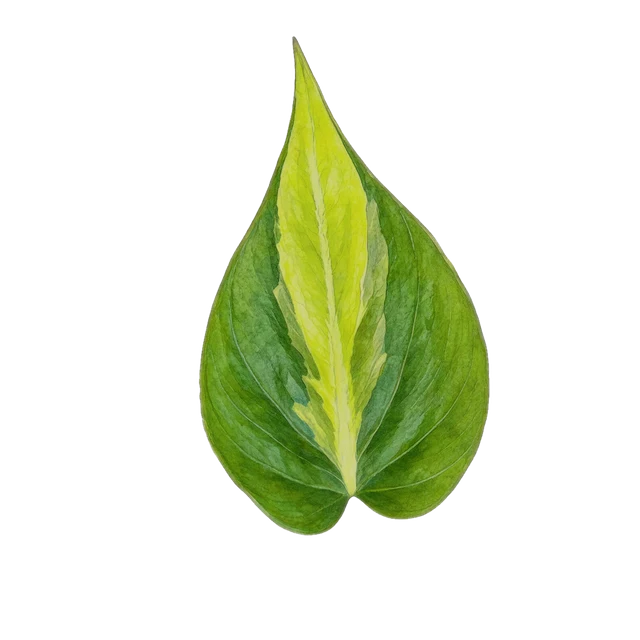 BrasilPrices today
The evidence
| Form | What the rows describe |
|---|---|
| ‘Brasil’ | irregular variegation running lengthwise along the leaf, yellow-green to light-green on dark green, with pale areas that are pale green, not white |
| ‘Lemon Lime’ | heart-shaped leaves brilliantly marked by yellow |
| ‘Frilly Philly’ | all green and not variegated, with small lanceolate leaves |
A breeders’ release note of 2010 from Apopka, Florida lists ‘Brasil’ and ‘Lemon Lime’ beside the standard green plant as cultivars grown commercially, in a one-sentence list with no sales figure.
How the forms arose
A sport is a spontaneous change in a single bud, not a way of propagating a plant.C ‘Brasil’ began as a single plant among an unnamed heartleaf philodendron selection found in Holambra, Brazil, during 1991, and was selected for its green and yellow-green variegated foliage, meaning leaves patterned in two colors.C ‘Frilly Philly’ is not variegated: it is an all-green mutant stem of the standard heartleaf philodendron, with small lanceolate leaves, found 9 months after one gamma-ray dose. Variegated plants whose pattern comes from a plastid mutation (a change in the cell parts that carry the green pigment) are kept by cuttings or division.C Whether a variegated pattern is built from layers of different tissue (a chimera) cannot be told from the leaf alone.C
The evidence
‘Brasil’ began as one founder plant in a controlled environment in Holambra, Brazil, according to the applicant’s statement in its plant patent; no test of the mutation was run, and the type of variegation was not determined. ‘Frilly Philly’ comes from a breeders’ description in a shaded greenhouse in Apopka: one mutant stem, with the number of irradiated vines not stated, kept as tip cuttings for 2.5 years and called stable, with no count.
A bud sport is a spontaneous event in a bud, not a propagation technique; in azalea, solid-color and variegated sports are inferred to sit in the outer layer because seed progeny do not carry them, in an overview of fruit-crop bud sports in grape and peach. A spontaneous bud sport of one Petunia plant had three sectors: ordinary green, white-margined variegated (anatomically a white-over-green periclinal chimera) and fully white.
In a screening of 23 variegated ornamental plants (20 species), one individual per plant, 14 carried a mutation in the plastid genome of the white tissue and 9 showed no plastid difference, and nuclear rDNA never differed between white and green; Syngonium, Epipremnum and Aglaonema were among the plants. All 14 plastid-mutant chimeras in that sample are kept by clonal propagation; this is a statement on how the plants are kept, not a test of seed transmission. In one variegated Syngonium podophyllum the white tissue carries a 14-bp deletion in the plastid gene rpoB (89 % of reads in white tissue, 24 % in green): a sectorial plastid chimera. A variegated Epipremnum aureum sampled was homoplasmic: its plastid genome was uniform, and the pattern showed yellowish sectors. In Dianella tasmanica and Heptapleurum ellipticum, the albino sectors carry a structurally rearranged plastid genome (228,878 against 157,736 bp in Dianella), and green and albino sectors both held a mixture of plastid types; two variegated and two green individuals of Dianella were sampled, one clonal stock each, with proportions inferred from read depth and no aroid in the sample, and the same cause gave a periclinal-like and a sectorial geometry.
Variegation is sorted into four classes: gene-pattern (Caladium, Dieffenbachia, Aglaonema), blister or reflective, transposon (inherited by seed) and chimeric (layer-based); the source is an unreferenced club-journal popularization with no measurement. Variegation mechanisms in plants fall into seven classes: chimerism, transposable elements, RNA silencing, plastid sorting-out (general and in plastome mutators), mitochondrial genome mutations and plastid-nucleus incompatibility. Class labels in print for aroid cultivars rest on no test or count: Monstera deliciosa ‘Variegata’, Epipremnum aureum ‘Golden Pothos’ and Alocasia macrorrhizos ‘Variegata’ are called transposon variegation, and E. aureum ‘Marble Queen’ mericlinal. Of the three chimera patterns, periclinal is called ‘generally one of the most stable’, mericlinal unstable or transitional and sectoral relatively unstable, in an unreferenced popularization on aroids. ‘Halo’, listed under Philodendron micans, is labeled a periclinal chimera in which the whole second cell layer (L2) is variegated; the label stands in an unreferenced popularization with no section of ‘Halo’.
In Monstera deliciosa ‘Variegata’ (3 growing points sectioned) the outer layer forms only the epidermis and the inner layer the whole leaf interior (mesophyll); Syngonium podophyllum ‘Variegata’ (7 growing points) showed the same two-layer build, and no trade cultivar was sectioned. In Anthurium andraeanum ‘Sonate’ the growing-point sections show a one-layer outer cover (tunica), so no second layer can be defined and all inner leaf tissue comes from the core (corpus).
Signs of a periclinal chimera: adventitious shoots sort into the component types, seed progeny are uniform and carry one layer’s type, roots and wounds give unlike shoots, and a single sign may not decide. In Saintpaulia ionantha, a pattern taken for a layered chimera (‘Tommie Lou’) proved purely genetic, and three other cultivars, genetically confirmed periclinal, needed layer-by-layer DNA typing. In Ficus rubiginosa ‘Variegata’, a periclinal chimera, every green patch in the white tissue borders a vein; a vein-bound pattern fits a periclinal chimera but points rather than decides. In Farfugium japonicum the cultivar shown chimeric by tissue culture has a clear boundary between variegated and green zones and the two non-chimeric cultivars an unclear one; the boundary is raised only as an indicator for discussion. The chimeric Farfugium cultivar kept its variegation stable all year, while the two non-chimeric cultivars faded in summer or from summer to winter, so seasonal stability does not identify a chimera. Philodendron ‘Birkin’ is called a spontaneous chimeric mutation from ‘Rojo Congo’, with white stripes that form a pattern you can feel, because the chlorophyll-free white cells expand less than the green cells; no genetic, histological or layer-resolved work exists on ‘Birkin’ itself.
In Caladium, uniform pale-yellow (lemon) against green leaf background follows one nuclear gene (selfing 248 lemon to 76 green, nine crosses 1:1, no maternal effect), and chimeras are not addressed. In Caladium, leaf background color is passed on by seed in simple Mendelian ratios: selfing gave 248 lemon to 76 green, crosses of two green parents gave only green, and reciprocal crosses showed no maternal effect. In tomato (Solanum lycopersicum), a variegation that segregates as one nuclear recessive trait left white sectors with 3.2 % of wild-type chlorophyll and plastids without thylakoids, and every selfed mutant seedling was variegated. In white clover (Trifolium repens), the white leaf mark is a structural, nuclear, non-chimeric trait with one major locus and six additive modifier QTLs; net photosynthesis did not decline with mark intensity (22.72 strongest, 20.99 none, µmol m⁻² s⁻¹), in an F3 mapping population of n = 500 with 33 and 34 individuals for gas exchange at 1,100 µmol in the chamber, the air-space structure being cited from elsewhere, without a reading of its own. In F2 progeny of reciprocal tomato crosses, a nuclear recessive variegation appeared in both directions in about a quarter of plants (43 of 203, 30 of 138): this type is passed on by seed. In Arabidopsis thaliana, loss of nuclear genes that stabilize the plastid genome (WHY1, WHY3, PolIB) rearranges plastid DNA and gives white and yellow sectors, and the trait is not maternally inherited; the mutant lines grew in a growth chamber, and the work uses no chimera framing. No reported cross showed seed reproducing a periclinal chimera’s structure: the white-over-green Pelargonium ‘Kathleen Harrop’ as mother gave 63 green, 0 white and 0 variegated seedlings, and a Chlorophytum chimera gave inner-layer offspring in all crosses. In reciprocal crosses with a green Petunia, the variegated or the white sector as mother gave only albino seedlings, never white-margined ones, and as pollen parent transmitted nothing; the change is placed in the plastids. Open-pollinated privet gave 4 white and 16 variegated seedlings of 20, read as plastids coming from both parents, and seed of Pelargonium chimeras gave ‘various proportions’ of green, variegated and white seedlings. Over 500 open-pollinated seedlings of the variegated Buddleja ‘Summer Skies’ contained not one variegated plant; chimeric segregation produced only white shoots that lack vigor and fail to develop. Seed of two green Pelargonium parents gave variegated seedlings, with proportions that depended on the cross direction: 5 bleached, 2 variegated and 23 green of 30 one way, 3, 8 and 2 of 13 the other. Seed of a Hosta japonica albomarginata plant (over one thousand sown) gave almost all green seedlings, some albinos and a few variegated ones, and the plant is typed as a plastid mixture, not as a chimera.
‘Brasil’
‘Brasil’ has an irregular variegation running lengthwise along the leaf, in yellow-green to light-green on dark green, so its pale areas are pale green rather than white.C It stays stable and comes true to type in successive generations.C ‘Brasil’ showed more variegation in the lower range of nursery light, while a variegated pothos lost most of its pattern after a move from the greenhouse into much dimmer light, ‘Marble Queen’ pothos kept it through three months in interior rooms, and a third was more patterned in brighter light, so light does not move the pattern the same way in every plant.C On a variegated vine that has turned solid green, every leaf it makes is green, and cutting it back to the last variegated leaf gives a chance of bringing the pattern back, not a guarantee.C Take cuttings from patterned stretches of the vine, ideally from nodes with pattern right around the bud, not from a stretch that has turned solid green.C
The evidence
The description of ‘Brasil’ is the applicant’s botanical description in its plant patent: plants in hanging baskets at Sebring, Florida, at about 1,500 to 2,000 foot candles, with RHS color codes only, no chlorophyll reading and the cell-layer type not determined. ‘Brasil’ is described as stable and as reproduced true to type in successive generations in the applicant’s wording, with no generation count, no plants per generation and no test. Plant patents on Epipremnum, Philodendron and Monstera cultivars call them ‘stable and reproduced true to type in successive generations’ in near-identical sentences; generations are counted in two of four, plants and off-types in none.
In low light ‘Brasil’ is described as developing more variegation; the plants described grew in hanging baskets at about 1,500 to 2,000 foot-candles, in one sentence of the applicant’s description at Sebring, Florida, with no light series and no measure of ‘variegation development’. Variegated pothos plants (Epipremnum aureum) moved from bright greenhouse light to 27 µmol lost most of their variegation within 4 weeks; these were whole plants, n = 10, in 7.6-cm pots, greenhouse-grown at up to 13,000 lx before the move, then under 27 µmol cool-white fluorescent light for 12 h a day at 29 °C without fertilizer, about 9 weeks from sticking, recorded as a side remark with no variegated area, leaf position or count. Golden pothos stock plants were more variegated at a shadehouse maximum of 5,000 foot-candles than at 2,000 or 3,500: mean color grade 2.8 against 4.4 and 4.1, where a lower grade means more variegated leaf. Pothos ‘Marble Queen’ kept its variegation colors and patterns through 3 months in interior rooms at 16 µmol and 24 °C. In the pothos cultivar ‘UF-Ea-0310’ the white sector could turn necrotic above 100 µmol, which ‘Marble Queen’ does not show. Pothos ‘Pearls and Jade’ showed no loss of foliar coloring after 3 months in an interior growth room at 25 µmol and 12 h a day. The all-green pothos ‘UF-Ea-0314’ turned dark green after 3 months in interior rooms at 16 µmol, against the plain green of its greenhouse description. After 3 months at 2 or 10 µmol, variegated golden pothos leaves had lower photosystem efficiency (Fv/Fm) than green leaves, and variegated plants survived 3 months at 2 µmol. In variegated golden pothos the chlorophyll reading (SPAD) rose with light, 28.04 / 30.42 / 31.08 at 2 / 10 / 20 µmol, and stayed below green leaves at every level (34.01 / 36.91 / 36.47). A variegated pothos (Epipremnum aureum f. variegata) under constant 24 h white LED light at 60, 120 and 180 µmol for 4 weeks grew tallest and heaviest at 180 µmol, at 20/18 °C and 75 % RH, with three replications of three plants; the plants stood in different growing facilities per intensity, so facility is confounded with intensity. In that variegated pothos (Epipremnum aureum) the chlorophyll reading (SPAD) was highest at 60 µmol (58.21) and lower at 120 and 180 µmol (52.76, 49.45), and its leaves turned lighter and yellower but stayed green at 180 µmol; the reading was taken on the central part of three tagged leaves, with green or white tissue not resolved. In Philodendron ‘Birkin’, full sun against 30 % shade for five months made no significant difference in leaf chlorophyll or in the hue, saturation or lightness of leaf color at treatment level. Whole-leaf color of heartleaf philodendron stock plants generally became lighter as light rose from 10 to 70 % of full sun and darker with more nitrogen, so a color reading on a variegated leaf can move without any change in the white share. In Hedera helix ‘Gold Heart’, a green-green-white chimera, variegated leaf area rose with light: 12 % at 3.2, 21 % at 5.4 and 31 % at 8.5 mol m⁻² per day; two other cultivars gained no significant variegation above 5.4. In the periclinal chimera Dracaena sanderana ‘Ribbon’, plants under 80 % and 91 % shade had a larger white leaf-area share than plants under 47 % and 63 % shade, and marginal growth was suppressed at the lighter levels. The change in white margin width of Dracaena sanderana ‘Ribbon’ occurred early in leaf development, during lamina formation, and is attributed to differences in how much each growing-point layer contributes.
A vine or growing point of white-variegated Monstera deliciosa ‘Albo’ can turn to solid green leaves, after which every leaf it makes is green; this comes from 13 web texts (retailer and hobby blogs, forum threads), mostly repeated statements and a few single-plant observations, with no count of reverted shoots and no light value. White-variegated Monstera deliciosa is sold as ‘Albo’, ‘Monstera variegata’ or ‘half moon Monstera’; in the texts that use the last two names the plants described are not called ‘Albo’. Keepers of ‘Albo’ give too little light or too much direct light as the reason a vine turns green; one text adds that light cannot create variegation or restore a lost white lineage. To bring white back, keepers of ‘Albo’ cut green growth back to the last variegated leaf or to a node that gave balanced variegation, and call the outcome odds, not a guarantee; no outcome was counted. In Philodendron ‘Birkin’, half leaves, whole leaves or whole shoots reverted to the purple color and altered leaf shape of the parent cultivar ‘Rojo Congo’, on several plants of one 72-plug tray. Of 9 Monstera deliciosa ‘Variegata’ plants raised from nodal cuttings of variegated plants, 8 stayed variegated or sectorial, 1 ended white with green guard cells and none turned green. In cuttings of Monstera deliciosa ‘Variegata’ from a finely mosaic leaf area, 9 plants over 168 internodes sorted out slowly: 5 stayed variegated, 3 sectorial stayed sectorial, 1 turned white from internode 14 and none turned green. Sectorial chimeras rarely persist because their layers get out of line, and mericlinal chimeras are somewhat unstable and resolve into solid or periclinal shoots. A bud sport can revert through a second mutation at the same gene: in two peach revertants the plant stayed a periclinal chimera with a still-mutant outer layer, and in grape loss of a jumping gene restored color. In surveyed ornamental green-white-green chimeras (no aroid) the usual changes are duplication of the white middle layer (more white) or of the green outer layer (toward all green); an inner layer breaking through was seen in only one cultivar. In three-layered chimeras of ornamental dicots, where the first layer mostly forms only the epidermis, mutations confined to the third layer are least stable and revert easily, whereas a second-layer mutation invariably gives a conspicuous white leaf margin. About 1 in 100 shoots of Ficus rubiginosa ‘Variegata’ revert to all green, through early displacement of the middle layer (L2). In field-grown periclinal chimeras a white-edged Mentha gave 12 branches turning all white and 1 all green out of 87 non-flowering mosaic branches, and Euonymus ‘Silver King’ 14 all white and 1 all green out of 711. Variegated privet (Ligustrum sinense ‘Variegatum’) in the field had a branch green to its base in 20, 60 and 80 % of plants (5 plants per site) within 21 months, the first reversion one month after planting. Forcing latent buds raised the share of reverted fruits in one apple sport from 2 % to 27 % but barely in another (7 % to 10 %): whether it raises reversion depends on the sport. In a transgenic chrysanthemum chimera, 9 of 12 stem cuttings whose stem carried layer-mixed tissue grew shoots back to the original outer-layer-only make-up within four to seven months, and the change sat at a node in all 4 located cases. In grape berry-color sports the gray variants carry the color-gene deletion only in the inner layer L2 and the white variants across the whole growing point; layer displacement is read as the route in three of six varieties. A Pelargonium hybrid clone kept vegetatively for over 20 years sorted out almost completely to dark green leaves (5 of 6 samples with a single plastid type), while three sister clones stayed variegated. A citrus periclinal chimera propagated only by grafting held its mutant phenotype for 17 years with no reversion reported. Removing all green leaves of an unstable mericlinal shoot releases the axillary buds of its variegated leaves, bending it into a half-moon arch adds to this, and the resulting periclinal shoots are isolated by cuttings.
Keepers choose ‘Albo’ cutting nodes by the white around the bud, since a node showing only green tissue will produce a green plant, though white around the bud cannot show the bud’s inner cells with certainty; the 13 web texts rest on single plants or an uncounted few, no outcome of a node choice was counted, and the texts contradict one another on tissue culture. In the periclinal Pelargonium ‘Rober’s Lemon Rose’, stem cuttings kept the pattern in 15 of 15, root cuttings in 0 of 29, petiole cuttings in 0 of 31 and callus-derived plants in 1 of 166. Root cuttings of a white-over-green Spiraea chimera gave only green shoots in all 4 surviving plants (10 cuttings); a plant from a root cutting differing from one from a stem cutting marks a periclinal chimera. At a second Spiraea chimera, 77 shoots from 203 exposed roots were all aurea and 1,233 of 1,237 leaf-callus shoots were aurea (the inner layer’s color); 29 of 31 callus plants then formed no green sport. Stem cuttings of six synthesized Nicotiana chimeras kept the pattern: four arrangements showed no atypical leaf in 24 plants each, two arrangements sectored in 3 and 4 of 24 plants, in 7 of 144 plants overall. The 13 web texts say that all-white leaves and cuttings of M. deliciosa ‘Albo’ brown and die and that a fully white cutting will not root on its own. A cutting from the fully white sector of the Petunia sport died soon after being cut, because it could no longer assimilate, while a cutting from the variegated sector rooted readily and gave a variegated plant; attached, the white sector grew and flowered. In two-layered white-over-green chimeras of Chamaecyparis, Juniperus, Thuja and Spiraea, pure white shoots are not self-supporting or not hardy, so all long-term growth comes from branches of the green shoots. In the periclinal Sansevieria ‘Laurentii’, nodal rhizome segments and apical-meristem explants gave 100 % true-to-type shoots, callus-derived shoots only 65 % (50 % from explants not exposed to light). Over 200 leaf cuttings of the periclinal Sansevieria ‘Laurentii’ gave about 1 % fully variegated plants; a reversed-V cut leaving only the variegated margin ends did not raise the share. On Sansevieria ‘Laurentii’ explants combining a node with the terminal meristem, true-to-type shoots fell from 83.3 % at 1 mg/L BA to 76.6 % at 3 and 50 % at 6 mg/L, while shoot number rose. In Cymbidium mutants, assumed periclinal types were reproduced in the next vegetative generation in 50.0 to 83.3 % of selections, assumed mericlinal types in 0 to 100 %, and the assumed sectorial type in 25.0 to 50.0 %. A Cymbidium line first selected as yellow narrow stripe (assumed mericlinal) segregated when regenerated from its rhizome, and the yellow broad-stripe type selected from it became stable only in the fifth vegetative generation. Plants of two Saintpaulia chimeras (Concord, Monique) that had already separated into the outer-layer or inner-layer type stayed single-colored through a second round (80 of 80, 30 of 30, 70 of 70, 80 of 80). In two of three Saintpaulia chimeras, plants from the outer (epidermal) layer alone were smaller than plants from the inner layers (‘Monique’ 11.6 against 16.3 cm); a weaker-growing outer layer is proposed as the reason a chimera stays stable.
‘Lemon Lime’
‘Lemon Lime’ has heart-shaped leaves brilliantly marked by yellow.C A young tissue-culture plant may make several all-green leaves before its pattern shows: in ‘Birkin’ the white appeared about six weeks after planting.C
The evidence
‘Lemon Lime’ is a heartleaf philodendron whose heart-shaped leaves are described as brilliantly marked by yellow, in one qualitative sentence of a tissue-culture report on the cultivar called Trầu bà vàng chanh, with no count, no measurement and no pattern or cell-layer type. ‘Lemon Lime’ shoots on BA plus α-NAA media were described as fairly uniform and of a characteristic yellow-green color, as a qualitative remark on media with BA 1.0 mg/L + α-NAA 0-0.2 mg/L, with no count of off-color shoots and the variegation type not determined. ‘Lemon Lime’ plantlets of at least 5 cm grew most in 4 weeks in peat moss alone (+2.92 cm, +2.37 leaves) and least in coir alone (+1.44 cm, +1.30 leaves).
In the Philodendron ‘White Knight’ protocol, adventitious shoots from petiole explants on 20 µM 2-iP + 5 µM NAA split during the rooting phase, most shoots having normal green leaves and a subset variegated leaves, and green and variegated plantlets both acclimatized at 100 %. For two variegated Philodendron sports, the found plant went straight into meristem culture and the patented clone was picked among the regenerants after growing them in a greenhouse. Tissue-culture plugs of Philodendron ‘Birkin’ made several entirely green leaves first; the white variegation appeared about six weeks after planting and grew with maturity. After one shoot of the climbing Philodendron ‘Ring of Fire’ went through meristem culture, its leaves became variegated on hormone-free medium; this was one shoot from a 0.2-0.5 mm meristem, with no replicate and the variegation status of the donor plant not stated.
‘Frilly Philly’
‘Frilly Philly’ is not variegated; its small lanceolate leaves average 7.0 cm long and 1.5 cm wide, where the standard heartleaf philodendron has heart-shaped (cordate) leaves averaging 12 cm long and 8 cm wide. Its vines make secondary side branches as they mature. A little more or less slow-release fertilizer (2.0, 2.5 or 3.0 g per small pot every 3 months) made no difference to its size.
The evidence
The leaf size of ‘Frilly Philly’ comes from a breeders’ release note with no n or protocol, from a shaded greenhouse in Apopka: uniformly green leaves (RHS 137A) on a cultivar from a single gamma-ray mutant stem. The 12 x 8 cm figure for the standard plant is the breeders’ own comparator in the same description. ‘Frilly Philly’ vines make secondary side branches as they mature, a trait the breeders say no other heartleaf philodendron shows. ‘UFM1’ is a green cultivar with much smaller, narrower leaves than its parent, selected as a single branch mutation about 1 year after heartleaf philodendron cuttings were treated with gamma rays, in the applicant’s wording of a plant patent; the printed characters match ‘Frilly Philly’, but no document prints that the two are one clone.
‘Frilly Philly’ fed 2.0, 2.5 or 3.0 g Nutricote per 0.6-L pot differed in no size measure after 12 weeks (pulled-up height 23.8, 20.8 and 20.8 cm) and gave a saleable 10-cm pot plant; the cuttings were 1-tip cuttings of 3-5 cm in Fafard 2 Mix (55 % peat, 25 % perlite, 20 % vermiculite), in a propagation chamber to 80 µmol and then a shaded greenhouse to 125 µmol at 15-34 °C, with 5 replications, no unfed arm and hand watering. The same pots, with 10 tip cuttings each and 5 pots per rate, had the same largest leaf (6.6, 6.2 and 6.5 cm long) after 12 weeks.
Sources for this section (66)
- Henny, Chen & Mellich (2010): “Philodendron scandens ssp. oxycardium 'Frilly Philly'”. HortScience 45(5):830-831 (May 2010) doi:10.21273/hortsci.45.5.830
- Acosta 2002, US Plant Patent PP12956 P2 'Brasil'; Keil 2025, US Plant Patent PP36881 P2 'EM0003'; Henny & Chen 2010, US Plant Patent PP20916 P2 'UFM1'
- Ninh Thị Thảo et al. 2023, Nhân giống in vitro cây Trầu bà vàng chanh (Philodendron hederaceum 'Lemon Lime') [In vitro propagation of Philodendron hederaceum 'Lemon Lime'], Vietnam Journal of Science, Technology and Engineering 65(12):64–69 doi:10.31276/vjst.65(12).64-69
- Foster, T. (Toshi) M. (2018): “Attention sports fans! The far-reaching contributions of bud sport mutants to horticulture and plant biology”. Horticulture Research 5:44 doi:10.1038/s41438-018-0062-x
- Park et al. (2023): “High-throughput discovery of plastid genes causing albino phenotypes in ornamental chimeric plants”. Horticulture Research 10(1):uhac246 doi:10.1093/hr/uhac246
- Nabeshima et al. (2017): “Histogen Layers Contributing to Adventitious Bud Formation Are Determined by their Cell Division Activities” doi:10.3389/fpls.2017.01749
- DuVal 2024, Variegation – One of the Biggest Trends of Aroid Collectors in Recent Years, The IAS Newsletter 46(3):5–8
- Terao, H. et al. (1929): “A Vegetative Mutation and Maternal Inheritance of a White-Margined Variegation in Petunia” (ペチユニヤに於ける白縁緑心型斑葉の芽條攣異並に母親遺傳). Japanese Journal of Genetics (遺伝学雑誌) 4(2):86-90 doi:10.1266/jjg.4.86
- Zhou, R. et al. (2024): “Leaf variegation caused by plastome structural variation: an example from Dianella tasmanica”. Horticulture Research 2024, article uhae009 doi:10.1093/hr/uhae009
- Ma, Zhou, Liu & Zhou 2025, Complex plastome structural variation caused by intermolecular and intramolecular recombination accounts for leaf variegation in Heptapleurum ellipticum, Plant Diversity doi:10.1016/j.pld.2025.09.003
- Yu et al. (2007): “Variegation mutants and mechanisms of chloroplast biogenesis”. Plant, Cell and Environment 30(3):350-365 doi:10.1111/j.1365-3040.2006.01630.x
- Frank, Chitwood (2016): “Plant chimeras: The good, the bad, and the 'Bizzaria'”. Developmental Biology 419:41-53 doi:10.1016/j.ydbio.2016.07.003
- Rodriguez Ibanez (2001): “Musteranalysen an ausgewählten variegaten Formen der Araceae, Asteraceae, Ericaceae, Marantaceae und Rosaceae”. Dissertation (Dr. rer. hort.), Landwirtschaftlich-Gärtnerische Fakultät, Humboldt-Universität zu Berlin, oral examination 06.07.2001 doi:10.18452/14667
- Xu et al. (2006): “Characteristics of Chimeras of Anthurium andraeanum from in vitro Mutation”. Chinese Bulletin of Botany 23(6): 698-702 doi:10.3724/cbb-t26-016
- Marcotrigiano (1997): “Chimeras and Variegation: Patterns of Deceit”. HortScience 32(5):773-784 doi:10.21273/hortsci.32.5.773
- Beardsell and Norden (2004): “Ficus rubiginosa 'Variegata', a Chlorophyll-deficient Chimera with Mosaic Patterns Created by Cell Divisions from the Outer Meristematic Layer”. Annals of Botany 94(1):51-58 doi:10.1093/aob/mch114
- Okuno et al. (2010): “Stability of variegation in plants propagated by tissue culture of three variegated cultivars of Farfugium japonicum (Asteraceae), a Japanese traditional ornamental plant” doi:10.5511/plantbiotechnology.10.0608a
- Griffis Jr., Manners, Bennett & Tuncay 2022, Unusual Variegation Pattern in Philodendron 'Birkin' Related to Leaf Chlorophyll Content and Leaf Color, Proc. Fla. State Hort. Soc. 135:187–190
- Cao, Deng et al. (2017): “A single gene controls leaf background color in caladium (Araceae) and is tightly linked to genes for leaf main vein color, spotting and rugosity” doi:10.1038/hortres.2016.67
- Dechkrong et al. (2024): “Mutation mapping of a variegated EMS tomato reveals an FtsH-like protein precursor potentially causing patches of four phenotype classes in the leaves with distinctive internal morphology” doi:10.1186/s12870-024-04973-1
- Kuo et al. (2024): “Genetics and plasticity of white leaf mark variegation in white clover (Trifolium repens L.)”. Annals of Botany 134:949-957 doi:10.1093/aob/mcae129
- Lepage, E., E. Zampini, N. Brisson (2013): “Plastid Genome Instability Leads to Reactive Oxygen Species Production and Plastid-to-Nucleus Retrograde Signaling in Arabidopsis” doi:10.1104/pp.113.223560
- Tilney-Bassett, R. A. E. (1963): “The structure of periclinal chimeras”. Heredity 17(2):265-285 doi:10.1038/hdy.1963.30
- Smith, W.A. and M.H. Brand (2012): “'Summer Skies' Buddleja davidii”. HortScience 47(1):126-127 doi:10.21273/hortsci.47.1.126
- Weihe et al. (2009): “Biparental inheritance of plastidial and mitochondrial DNA and hybrid variegation in Pelargonium”. Molecular Genetics and Genomics 282(6):587-593 doi:10.1007/s00438-009-0488-9
- Fonteno & McWilliams 1978, Light Compensation Points and Acclimatization of Four Tropical Foliage Plants, J. Amer. Soc. Hort. Sci. 103(1):52-56 doi:10.21273/jashs.103.1.52
- Reyes, Chase & Poole (1990): “Effect of Nitrogen Level and Light Intensity on Growth of Epipremnum aureum”. Proc. Fla. State Hort. Soc. 103:176-178 journals.flvc.org
- Patel (2026): “Why Monstera Albo Reverts to Green (Cell-Layer Reason)”. Ariumology, published 2026-08-13 ariumology.com
- Goldwyn (2026): “Monstera deliciosa albo variegata care & propagation”. Web page bybrittanygoldwyn.com
- Over Grown Team (2026): “The Monstera Albo: Is It Actually Worth the Price?”. Blog post, dated June 15, 2026 over-grown.com
- Chen (2026): “Monstera Albo vs Thai Constellation vs Mint: What You're Actually Buying”. The Plant Index, April 25, 2026 theplantindex.com
- Hansoti (2016): “Epipremnum Plant Named 'HANSOTI14'”. US Plant Patent PP27,117 P3, granted Aug. 30, 2016
- Bellinger (2005): “Philodendron plant named 'Variegated Sport #1'”. US Plant Patent No. US PP16,150 P2, granted Dec. 6, 2005 (filed Sep. 24, 2004, Appl. No. 10/949,946), Int. Cl. A01H 5/00, US Cl. Plt./381
- Hung, Anh (2024): “Monstera Plant Named 'HUTAMT41'”. US Plant Patent US PP36,063 P2, issued Aug. 6, 2024 (Appl. No. 18/445,611, filed Nov. 20, 2023)
- Chen & Henny (2025): “Two New Cultivars of Pothos (Epipremnum aureum)”. HortScience 60(11):2004-2006 doi:10.21273/hortsci18915-25
- Henny, Chen & Mellich (2009b): “'Pearls and Jade' Pothos”. HortScience 44(3):824-825 (June 2009) doi:10.21273/hortsci.44.3.824
- Chen et al. (2025): “Epipremnum plant named 'UF-Ea-0314'” (US Plant Patent PP36,701 P2). US PP36,701 P2, granted 2025-05-20, Appl. No. 18/968,358, filed 2024-12-04
- Khalekuzzaman et al. (2015): “Comparison of green and variegated foliage plant species based on chlorophyll fluorescence parameters under different light intensities”. Pak. J. Bot. 47(5): 1709-1715
- Lee et al. (2021): “Chlorophyll Fluorescence and Growth Evaluation of Ornamental Foliage Plants in Response to Light Intensity Levels under Continuous Lighting Conditions”. Flower Res. J. 29(3):153-164 doi:10.11623/frj.2021.29.3.05
- Griffis Jr. et al. (2022): “Commercial Production Recommendations for Philodendron Birkin' Grown in a Central Florida Greenhouse”. Proc. Fla. State Hort. Soc. 135:181-186, 2022
- Taylor, Joiner & Dickey (1959): “Nitrogen and Light Intensity Requirements of Some Commercially Grown Foliage Plants”. Proc. Fla. State Hort. Soc. 72:373-375
- Taylor, Joiner & Dickey (1958): “Preliminary report on the nitrogen-light intensity requirements of some commercially grown foliage plants”. Proc. Fla. State Hort. Soc. 71:434-438
- Pennisi, S.V., M.W. van Iersel & S.E. Burnett (2005): “Photosynthetic Irradiance and Nutrition Effects on Growth of English Ivy in Subirrigation Systems”. HortScience 40(6):1740-1745 doi:10.21273/hortsci.40.6.1740
- Vladimirova, S.V., D.B. McConnell, M.E. Kane and R.W. Henley (1997): “Morphological Plasticity of Dracaena sanderana 'Ribbon' in Response to Four Light Intensities”. HortScience 32(6):1049-1052 doi:10.21273/hortsci.32.6.1049
- Vladimirov, S. V. & McConnell, D. B. (1996): “Anatomical and Morphological Modifications of the Periclinal Chimera Dracaena sanderana 'Ribbon' in Response to Four Light Intensities”. HortScience 31(4):581, Abstract No. 095 doi:10.21273/hortsci.31.4.581d
- Naomi (House Plant Authority) 2026, Half Moon Monstera: The Ultimate Guide, web page, houseplantauthority.com/half-moon-monstera/
- feey Store (2022): “Warum das Weiss der Monstera variegata braun wird und wie du dem vorbeugen kannst”
- Pflanzenfreunde forum users plnt et al. (2026): “Monsters variegata vergrünt”. Pflanzenforum, thread 4652 forum.pflanzenfreunde.com
- Foliage Factory (2026): “Variegated Plants: Myths, Science, and Stunning Foliage Explained”. Foliage Factory plant-care blog foliage-factory.com
- Korn (2013): “The concept of the eudicot shoot apical meristem as it applies to four Spiraea (Rosaceae), one Mentha (Lamiaceae) and one Euonymus (Celastraceae) cultivars based on chimeric analysis”. Annals of Botany 111(5):887-893, 2013 doi:10.1093/aob/mct054
- Rycyna et al. (2024): “Landscape and Fruit Evaluation of Three Privet (Ligustrum sp.) Cultivars in Florida”. Horticulturae 10(1):90 doi:10.3390/horticulturae10010090
- Pratt, Einset & Gilmer 1972, Reversion in Sports of 'Rhode Island Greening' Apple, J. Amer. Soc. Hort. Sci. 97(3):292–297 doi:10.21273/jashs.97.3.292
- Aida et al. (2020): “Chimerism of chrysanthemum stems changes at the nodes during vegetative growth”. Plant Biotechnology 37(3):373-375 doi:10.5511/plantbiotechnology.20.0519a
- Ferreira et al. (2018): “Molecular characterization of berry skin color reversion on grape somatic variants”. Journal of Berry Research 8(2018):147-162 doi:10.3233/jbr-170289
- Zhang, Zhu, et al. (2025): “A Study on the Cell Layer Patterns of a Citrus Periclinal Chimera Reveals β‐Cryptoxanthin Regulation in Citrus Fruits”. Advanced Science doi:10.1002/advs.202503177
- Datta, S. K. (2025): “Plant chimera and its management for the floriculture industry”. Journal of Floriculture and Landscaping 11:1-10 doi:10.25081/jfcls.2025.v11.9568
- Skirvin & Janick 1976, Tissue Culture-induced Variation in Scented Pelargonium spp., J. Amer. Soc. Hort. Sci. 101(3):281-290 doi:10.21273/jashs.101.3.281
- Marcotrigiano, Bernatzky (1995): “Arrangement of cell layers in the shoot apical meristems of periclinal chimeras influences cell fate”. The Plant Journal 7(2):193-202 doi:10.1046/j.1365-313x.1995.7020193.x
- Hilder (2023): “What's the difference between a Monstera Thai Constellation and Monstera Albo Variegata?”. Blog post, dated January 22, 2023, by Duncan Hilder theplantrunner.com
- Kazemzadeh Bahnamirei et al. (2025): “Innovative in vitro shoot regeneration in variegated snake plant (Sansevieria trifasciata cv. Laurentii) through utilization of light exposed single-node rhizome tissue”. Scientific Reports doi:10.1038/s41598-025-23247-w
- Dolati, Abasabad, Seyfi, Alizadeh & Khoshhal Sarmast 2023, Appraisal of leaf cutting, soil mixture and leaf explants on production of Sansevieria trifasciata under ex/in vitro condition, Flower and Ornamental Plants 7(2):261–276 doi:10.61186/flowerjournal.7.2.261
- Kim et al. (2020): “Frequency, Spectrum, and Stability of Leaf Mutants Induced by Diverse γ-Ray Treatments in Two Cymbidium Hybrids”. Plants 9(4):546 doi:10.3390/plants9040546
- Kang & Sivanesan (2025): “Micropropagation of Philodendron 'White Knight' via Shoot Regeneration from Petiole Explants”. Plants 14(11):1714 doi:10.3390/plants14111714
- Hung et al. (2025): “Philodendron plant named 'HUTAPD75'” (US Plant Patent PP37,074 P2). US PP37,074 P2, granted 2025-10-28, Appl. No. 18/831,559, filed 2025-04-17
- Vivek et al. (2026): “Philodendron plant named 'BVCL01'” (US Plant Patent PP37,308 P2). US PP37,308 P2, granted 2026-03-03, Appl. No. 18/831,584, filed 2025-05-15
- Mariani et al. (2023): “Micropropagation of Philodendron Ring of Fire Var. by Meristem Culture and Philodendron Billieteae by Somatic Embryogenesis” doi:10.19080/jojha.2023.04.555633
Flowers and seed
In the wild, heartleaf philodendron bears a single flower cluster, a solitary inflorescence. The glossy variety, var. oxycardium, is known in flower from only one fertile collection, and plants from Jamaica were sterile.C In a Florida breeding program, heartleaf philodendron could be readily self-pollinated but could not be crossed with other species.C
If you try for seed, pollinate on the evening the spathe, the leaf-like sheath around the flower spike, opens, when the female flowers are receptive. The female flowers are ready within hours of the spathe opening, shown by a warming spadix (the flower spike) and a sticky stigma (the part that catches pollen).C Spread the pollen over the whole female zone of the spadix: fruit does not mature if only a small part is pollinated.C Take seed only from ripe, fully colored fruit clusters (infructescences): seed from immature ones germinated far less. To clean the seed, squeeze the ripe berries into slightly warm water and pour off what floats: the pulp floats and the seed sinks.C Sow the seed moist on peat, uncovered under a pane of glass, and never let it dry. A seed bed warmed to 30-33 °C brought germination sooner.
The evidence
The wild species description names a solitary inflorescence as one of the characters of heartleaf philodendron, in a revision of the species from wild and herbarium material of Mexico and Central America, with no cultivated plant and no flowering age, size or season stated. Var. oxycardium is known in flower from one fertile collection, and plants from Jamaica were sterile; this remark comes from the reviser of the wild plants, without counts. In Philodendron outside section Pteromischium the inflorescence bud commonly aborts, in a survey of growth architecture in the Araceae at genus level with no cultivated plant and no condition for the abortion stated. A cultivated climbing Philodendron hybrid (‘Joepii’) flowers repeatedly on a porch and never sets fruit; this is one clone in porch culture, and the sterility is the grower’s inference. Philodendron melinonii, kept in a botanical-garden greenhouse collection in Montreal, flowers there with the same spadix-heating cycle as wild plants in French Guiana, with one or two inflorescences per site. In-ground Philodendron in a small Florida greenhouse under artificial rain started a heavy flowering season in February after a few weeks of 50 °F nights, and P. squamiferum flowered year-round above 70 °F; the rain ran 10 s every 12 min from 8:00 to 17:00, and these are practice statements with no n and no control. Pothos grown vertically, with leaves 4.5 to 9.5 times larger than horizontal ones and age-pathway expression read as adult, still did not flower; one spray of GA₃ made both growth forms flower in seven to eight weeks, on Epipremnum aureum ‘Jade’ on totem poles at about 450 µmol, with one foliar spray of 2,500 mg/l GA₃ and n = 5 plants for leaf size. Epipremnum pinnatum flowers regularly once it has climbed past about 2 m, while Epipremnum aureum is shy-flowering even at Bogor, in green and variegated forms, in a genus reviser’s cultivation notes with no sample.
In one Florida breeding program, heartleaf philodendron (as P. oxycardium, ‘commercial cordatum’) could be readily self-pollinated but could not be crossed with other species; the record comes from a nursery working with the University of Florida, with no count of pollinations, fruits or seeds and no list of failed pairs. In the same program, tree philodendrons crossed freely among themselves, and the majority of the vines and self-headers among themselves, but hundreds of attempts between the two groups gave no successful cross. The program listed 25 interspecific Philodendron F1 hybrids as made, 11 of them marketed; nine trade hybrids have recorded parentage, for example X Florida (squamiferum × laciniatum). The progeny of one interspecific Philodendron cross was stated to be uniform, so a hybrid can be remade by repeating the cross, while seedlings from one fruit of multi-crosses varied extremely; this rests on 25 seedlings of an F1 cross grown on, with no counts.
Philodendron flowers were pollinated on the evening the spathe opened, when the female flowers were receptive, in two Florida practice reports (a vining and self-heading group, and P. bipinnatifidum), with no receptivity assay. In vining Philodendron the female flowers were ready within 12 hours of the spathe starting to open, usually 4 to 5 hours, judged by a warming spadix and a sticky stigma. In Philodendron melinonii the spathe opened between dawn and noon of day 1, the spadix heated that evening (peak around 19:29), and pollen strings appeared on the evening of day 2 as the spathe closed; 31 inflorescences were watched in a shaded field. Pollen was spread evenly over the whole female zone of the spadix, because fruit does not mature if only a small part of the ovaries is fertilized. Dry Philodendron pollen of most varieties was said to keep six weeks refrigerated at about 38 °F; pollen of a plant that cannot take 38 °F cannot either. In P. spiritus-sancti, pollen frozen with its spadix and thawed a day or so later, brushed on the stigmas on the evening the next flower opened, produced the only fruit among seven inflorescences, on one plant in cultivation with n = 1. Fruit of hand-pollinated P. spiritus-sancti ripened in about 12 weeks and held at least a few thousand seeds, which germinated about two weeks after being laid uncovered on long-fiber sphagnum, in a poly tunnel at 70 % shade with reverse-osmosis water. A West Java nursery crossed two Philodendron by cutting off the spathe, removing the mother’s male flowers, covering the spadix with a cut water bottle and brushing on pollen in the morning and afternoon, in one cross of P. melanochrysum (male) × P. giganteum variegata (female) at 1,200 m with 80 % RH. The F1 of that variegated Philodendron mother crossed with a climbing species was described by eye as mother-like and white-patterned, in words and without a count of variegated seedlings. In pothos, one spray of GA₃ at 2,500 mg/L gave inflorescences about 60 days later; hand pollination with the plant’s own pollen, seed sown at maturity 4 months after pollination, gave a seedling selection.
Philodendron seed sown on the day of harvest and weekly for 10 weeks afterwards germinated about 95 % in all ten lots of 500; seedlings showed after 17 to 21 days, on about 3 inches of sterilized German peat, uncovered, under a pane of glass, with losses to damping-off and bacterial soft rot. Philodendron seed was sown moist, mixed with dry sand, on about 3 inches of sterilized peat, left uncovered under a pane of glass and never allowed to dry. Tree-philodendron (P. selloum) seed covered at four times its diameter germinated more slowly than at twice, and in two of five media less (22 % and 18 % against 84 % and 89 %). A seed medium warmed to 30-33 °C sped germination of Philodendron lundii seed (14-16 days against 21 days to half the final count), with no separated change in the final share; seed at twice its diameter lay on rubber heating mats, with 27 °C the unheated medium. In Philodendron corcovadense, seed from fully colored infructescences germinated 76-77 %, seed from immature ones 10-28 %, and a 24-h pre-soak changed nothing significant for mature seed. In P. corcovadense, seedling emergence was higher with intermittent mist than without, and forest litter + sand at 1:1 and 2:1 did not differ (48.44 % and 35.95 % under mist). Aroid berries can be squeezed into a jar of slightly warm water; the pulp floats and the heavier seed sinks, so shaking and decanting leaves clean seed.
Sources for this section (17)
- Croat (1997): “A revision of Philodendron subgenus Philodendron (Araceae) for Mexico and Central America”. Ann. Missouri Bot. Gard. 84(3):311-704 doi:10.2307/2992022
- McColley & Miller (1965): “Philodendron improvement through hybridization”. Proc. Fla. State Hort. Soc. 78:409-414
- Miller & Newton (2006): “Hand pollination and seed propagation of Philodendron bipinnatifidum, syn. P. selloum”. Proc. Fla. State Hort. Soc. 119:425-428
- Seymour & Gibernau (2008): “Respiration of thermogenic inflorescences of Philodendron melinonii: natural pattern and responses to experimental temperatures”. J. Exp. Bot. 59(6):1353-1362 doi:10.1093/jxb/ern042
- Negrelle & Cuquel 2014, Germination and seedling emergence of black-vine (Philodendron corcovadense Kunth), Aroideana 37E(2):26–33
- Aubrey (2008): “Extended Anthurium Seed Storage”. IAS Newsletter 30(2):8-9, June 2008
- Perry & Boodley 1980, Germination of Foliage Plant Seeds in Response to Sowing Media, Depths of Sowing, pH Levels, and Medium Temperatures, HortScience 15(2):194-196, April 1980 doi:10.21273/hortsci.15.2.194
- Madison (1978): “The Genera of Araceae in the Northern Andes”. Aroideana 1(2):31–53
- Moonen 2022, The Story of Philodendron × joepii Croat, The IAS Newsletter 44(2)
- Gibernau et al. (2005): “Physical Constraints on Temperature Difference in Some Thermogenic Aroid Inflorescences”. Ann. Bot. 96(1):117-125, PMC4246816 doi:10.1093/aob/mci157
- Barabé, D. (2008): “The Use of the Montreal Botanical Garden's Aroid Collection for Research”. IAS Newsletter 30(4):1-4 (December 2008)
- Hung et al. (2016): “Gibberellin deficiency is responsible for shy-flowering nature of Epipremnum aureum”. Scientific Reports 6:28598 doi:10.1038/srep28598
- Boyce, P. (2004): “A Review of Epipremnum (Araceae) in Cultivation”. Aroideana 27:205-211
- West & Miller (1956): “Some notes on Philodendron hybrids”. Proc. Fla. State Hort. Soc. 69:343-346
- Gravine, D. (2021): “A Successful Pollination of Philodendron spiritus-sancti”. The IAS Newsletter 43(4):1-3, ISSN 2330-295X
- Safitri, Rahmadi & Subagja (2025): “Teknik Hibridisasi Tanaman Hias Philodendron melanochrysum dengan Philodendron giganteum variegata di Art Garden Kabupaten Bandung Barat” [English (the paper's own title line): Ornamental Plant Hybridization Techniques of Philodendron melanochrysum and Philodendron giganteum variegata at Art Garden Kabupaten Bandung Barat]. Gunung Djati Conference Series 49 (2025): 197-204 (Prosiding Riset Magang Mahasiswa Agroteknologi 2020), ISSN 2774-6585
- Chen & Henny (2025): “Two New Cultivars of Pothos (Epipremnum aureum)”. HortScience 60(11):2004-2006 doi:10.21273/hortsci18915-25
Pets and people
Heartleaf philodendron is poisonous to cats, dogs and small pets.C If a pet has chewed it, rinse or wipe its mouth with cold water and watch its airway closely.C Signs include itching, burning, swelling, salivation and vomiting.C If you take the animal to a veterinarian, bring a piece of the plant or a clear photo of it.C If signs worsen, get emergency care promptly.C
The leaves of both varieties contain raphides, needle-shaped crystals of calcium oxalate.C
Rinse sap in the eyes with lukewarm running water for about a dozen minutes.C Wear gloves when you cut many cuttings: in some nurseries, workers who handled the plant daily developed a rash, mostly mild.C In children who chewed Philodendron, signs were mostly mild, limited to a sore mouth.C
The evidence
A pet-poisoning overview places Philodendron with the arum family as oxalate plants poisonous to dogs, cats and small pets, with itching, burning, swelling, salivation and vomiting among the family’s signs; it is a narrative compilation on indoor plants and pets, without a case count, and its citations cannot be resolved. For oxalate exposure in an animal, a compilation prints rinsing or wiping the affected area with cold water and monitoring the upper airway closely; the statement is written for the whole arum family, with Philodendron among the listed genera, and carries no outcome figures. For plant poisoning at large, an owner who cannot identify the plant takes the animal to a veterinarian with the remaining plant or a clear photo; this is stated for phone inquiries about plant ingestion in general, not for oxalate plants. After the first visit the owners of one domestic cat were told to monitor the cat closely and to seek emergency care promptly if signs worsened; decontamination was not done because of the time lag after exposure.
One indoor cat developed anorexia, lethargy and jaundice with raised liver enzymes after suspected chewing of a Philodendron plant; jaundice resolved by day 20 and enzymes normalized by day 55, and the report judges the plant unlikely to be the cause. The ingestion was inferred from bite marks, the plant species and amount were not identified, and there was no toxin test. The report itself judges the picture of the domestic cat unlikely to be directly attributable to the plant’s toxicity, and names soluble oxalates, or reduced food intake after crystal irritation leading to hepatic lipidosis, as possibilities. Nervous signs, encephalitis and acute kidney damage have also been described in cats after Philodendron, in one sentence of a compilation with no case count, dose, onset or outcome. Cats given minced leaves of P. hederaceum var. oxycardium orally, up to 9.1 g/kg, showed no acute clinical signs or lesions, quoted second-hand from an older feeding experiment inside the cat report, with no group sizes.
In mature leaves of 19 greenhouse Philodendron taxa, raphides appeared in the leaf-blade sections of every taxon, P. hederaceum var. hederaceum (1 per section) and var. oxycardium among them, and druses and styloids in all taxa; ten 50-µm transverse sections per organ were counted from the middle of petiole and lamina in one botanical-garden greenhouse in Poznań. In petiole sections, raphides numbered 1-2 per section in var. oxycardium and were not observed in var. hederaceum, whose blade sections held 1. All 19 sampled Philodendron taxa (18 species and one variety, from three subgenera) carried raphides in the leaf blade, so no raphide-free Philodendron appears among them. Philodendron species outside the 19 sampled taxa are expected to carry raphides in the leaf blade as well. All parts of P. hederaceum are stated to irritate the skin, the conjunctiva and the mucous membranes of the digestive tract, with calcium oxalate crystals named, especially in leaves and stem, in a narrative compilation of ten plants hazardous to the eyes, with no case, patient or dose.
Sap of P. hederaceum in the eyes is described as causing pain, burning and tearing, in one sentence of a secondary compilation with no case or outcome. The one printed step for P. hederaceum sap in the eyes is rinsing with lukewarm running water for a dozen or so minutes, a handbook step quoted in a compilation with no outcome and no point at which to see a doctor. After a man with earlier corneal laser surgery rubbed pothos (Epipremnum aureum) sap into both eyes, epithelial defects grew to 8 x 6.5 and 9 x 10 mm by day 11, and the left cornea was later grafted; this is n = 1, with the dose not recorded and the prior surgery and drug toxicity named as confounders.
In volunteers already sensitized by work with the plant, patch tests react to a resorcinol from the cuticle of heartleaf philodendron, which is proposed as its principal contact allergen; the number of volunteers, the concentrations and the controls are not stated. Nursery-grown heartleaf philodendron yielded 25 mg (0.005 %) of the allergenic resorcinol from 504 g of plant material, pooled fresh leaves and stems left in contact with light petroleum in a single extraction. One greenhouse worker developed a rash on hands, arms, eyelids and face two weeks after she began planting Philodendron cuttings, and leaf-and-stem patch material reacted only at the 48-hour reading, after it had been moistened; this is a single 23-year-old woman in daily work, with no control persons. Two of six nursery owners interviewed reported a high incidence of Philodendron sensitivity among their workers, mostly mild, and four reported that none of their employees had reacted; the interviews are hearsay with no counts.
As cited, 127 cases of Philodendron ingestion in children gave predominantly mild signs, limited to stomatitis, quoted second-hand from a poison-center report inside the cat report, with species and doses not given. Of 18,621 confirmed accidental houseplant exposures of people reported to five poison centers, 84.2 % stayed without symptoms and none was severe; Philodendron spec. is listed with 2 moderate courses. Pothos (Epipremnum spec.) counted 1,235 reported exposures with 2 moderate courses, among the ten most frequent houseplants in the series. Of 17,636 exposed children up to 13 years, 86.1 % stayed without symptoms and 37 had a moderate course, all houseplants pooled. Philodendron spp. made up 2.2 % of 6,492 human plant-exposure calls to one Arizona poison center over eight years, pothos 1.9 %, at ranks six and seven. Among 71 children admitted to a Bucharest toxicology clinic after plant exposure, one Syngonium podophyllum case had dysphagia and oral cavity injury (PSS 1), and all 71 were discharged without sequelae after 1-4 days.
Sources for this section (10)
- Siroka (2023): “Toxicity of House Plants to Pet Animals”. Toxins 15(5):346 doi:10.3390/toxins15050346
- Klimko, Wawrzynska, Wiland-Szymanska (2016): “Calcium oxalate crystals in some Philodendron Schott (Araceae) species”. Steciana 20(3):103-116 doi:10.12657/steciana.020.013
- Afonso, Bacelar & Prata (2026): “Hepatopathy in a Suspected Philodendron species poisoning in a cat: A case study”. German Journal of Veterinary Research 6(2):18-23, 2026 doi:10.51585/gjvr.2026.2.0185
- Sulborska et al. (2016): “Rośliny toksyczne niebezpieczne dla oczu” [English title printed: "Toxic plants hazardous to eyes"]. Alergoprofil 2016, 12(1): 17-22
- Dorsey (1958): “Philodendron Dermatitis”. California Medicine 88(4):329-330 (April 1958)
- Reffstrup et al. (1982): “Philodendron scandens Koch et Sello subsp. oxycardium (Schott) Bunting, A New Source of Allergenic Alkyl Resorcinols”. Acta Chemica Scandinavica B 36:291-294 (1982) doi:10.3891/acta.chem.scand.36b-0291
- Cohen, Theotoka, Galor (2020): “Epipremnum aureum Keratopathy: Case Report and Review of the Literature”. Eye Contact Lens 2020 doi:10.1097/icl.0000000000000675
- Pietsch et al. (2025): “Accidental Exposure to Poisonous Houseplants. An Analysis of Cases Reported to Poison Information Centers”. Dtsch Arztebl Int 122(24):676-677 doi:10.3238/arztebl.m2025.0143
- Enfield et al. (2018): “Human Plant Exposures Reported to a Regional (Southwestern) Poison Control Center Over 8 Years”. J. Med. Toxicol. 2018 (issue date March) doi:10.1007/s13181-017-0643-3
- Nitescu et al. (2024): “Epidemiology and Clinical Characteristics of Acute Plant Exposure in Patients Aged between 0 and 18 Years - A Six-Year Retrospective Study”. Children 2024 doi:10.3390/children11030271
Telling it apart
P. scandens, P. oxycardium and P. micans are names of the same species, P. hederaceum. ‘Micans’ is the name for the velvety juvenile form of var. hederaceum. Pothos scandens is a different plant, a species of the genus Pothos.C In Florida trade, ‘cordatum’ is a name for the heartleaf philodendron, but P. cordatum itself is a separate species.C
On a potted plant at the juvenile stage, velvety lustrous leaves with a purplish underside fit var. hederaceum, and plain glossy leaves that are green beneath fit var. oxycardium. A velvety plant with hairy, glandular leaf stalks is not ‘Micans’, whose leaf stalks are smooth; it fits P. verrucosum. On an adult plant, bristle-free stems fit P. hederaceum; bristly stems and leaf stalks point to P. jacquinii.
Many plants sold as pothos are not pothos: of 21 nursery varieties sold as pothos in Bangladesh, only seven were identified as Epipremnum aureum, and the others as heartleaf philodendron (‘Micans’, ‘Heart Leaf’, ‘Brasil’), Monstera, Rhaphidophora and Scindapsus.C A mature pothos leaf torn across shows fine hairs along the tear. The sap of a cut leaf stalk of heartleaf philodendron is clear and turns honey-colored, while Syngonium podophyllum gives milky sap.
The evidence
A reviser of Mexican and Central American Philodendron lists P. scandens, P. micans and seven further names as synonyms of P. hederaceum var. hederaceum, and P. oxycardium as the basionym of var. oxycardium; this is nomenclature in a revision, a taxonomic statement without measurement. The reviser treats P. micans Koch as P. hederaceum var. hederaceum forma micans, the velvety juvenile form earlier treated as P. scandens forma micans, with juvenile blades velvety with a lustrous sheen on the upper surface and often tinged purplish below. Pothos scandens (Linnaeus) is a species of the genus Pothos, a different plant from Philodendron scandens Koch & Sello with the same epithet; the characters of the Pothos species belong to that genus and not to Philodendron. Florida breeding and nursery reports use ‘cordatum’ for the heartleaf philodendron: ‘commercial cordatum’ for P. oxycardium, and ‘Common Cordatum’ for P. hederaceum var. oxycardium. Heartleaf philodendron, sold in the US trade as ‘P. cordatum’, was introduced from Bogotá by the Missouri Botanical Garden, by oral history compiled from written references and interviews, with no source per sentence; this is how the plant entered the US trade, not where it grows wild. A list of nursery plants sold as pothos in Bangladesh assigns ‘Micans’, ‘Heart Leaf’ and ‘Brasil’ to Philodendron hederaceum and ‘Neon’ (Neon Pothos) to Philodendron cordatum. A nursery dermatitis case prints the plant as ‘PHILODENDRON or Scandens Cardatum’ without botanical determination, read as P. hederaceum by synonymy.
Wild var. hederaceum and var. oxycardium are told apart only by juvenile blades: velvety above with a lustrous sheen and often purplish beneath in var. hederaceum, glossy above and green beneath in var. oxycardium. Var. oxycardium is printed only for the Gulf slope of Mexico, possibly Jamaica, so the old name P. oxycardium on a glossy pot plant names the species, not by itself the variety; how long a pot plant stays juvenile is not shown. A velvety P. verrucosum clone is separated from P. scandens ‘Micans’ by its petioles, densely pubescent and glandular, against glabrous petioles in ‘Micans’; the velvety blade does not separate them, and the comparison rests on one applicant’s patent on six-month plants in 13.5-cm containers in a glass greenhouse in Naaldwijk. Wild P. hederaceum is a vine with long internodes, deciduous cataphylls (scale leaves), glabrous stems and broadly ovate blades that are only a little longer than wide, with several basal veins per side. On a pot plant with adult-type leaves, bristle-free stems, deciduous cataphylls and a broadly ovate blade with inward-turned posterior lobes fit P. hederaceum, while bristly stems and petioles point to P. jacquinii. P. purpureoviride is the species most easily confused with P. hederaceum, whose blades are more coriaceous and more broadly ovate with more pairs of basal veins. In a Pernambuco key, wild var. hederaceum has slender, numerous clasping roots on one side of the node, deciduous prophylls except on young branches, a cylindrical petiole and a cordate adult blade base. For an older climbing plant, slender roots on one side of the node only and a round petiole cross-section are the two stem checks that set P. hederaceum against P. fragrantissimum, with thick two-ranked roots and a D-shaped petiole. A shingle-like young plant names no genus: shingling seedlings are printed for seven Peninsular Malaysian Rhaphidophora, and a shingle-like juvenile for P. hederaceum var. hederaceum. ‘Frilly Philly’ is a green mutant of the standard heartleaf philodendron, with lanceolate leaves averaging 7.0 x 1.5 cm against cordate 12 x 8 cm, on vines that form lateral branches.
In two independent lines for Epipremnum aureum (the University of Florida breeders and the genus reviser), ‘Marble Queen’ is white or cream on green, ‘Jade’ plain dark green and ‘Neon’ uniformly chartreuse without markings. Tearing a mature leaf of Epipremnum, Rhaphidophora or Scindapsus shows many hair-like cells protruding from the torn edge, visible to the naked eye. Subepidermal trichosclereids separate Rhodospatha from Philodendron in sterile specimens, which implies that a torn Philodendron leaf shows no such hairs; no source tore any Philodendron leaf. Of Syngonium and Philodendron, sap color does not identify the genus: three Syngonium have pale tan or non-milky sap, and at least four Philodendron have white or milky sap. A cut petiole of P. hederaceum gives clear sap turning honey-colored, while Syngonium podophyllum gives milky sap. Syngonium has several separate collective veins running parallel to the margin, where Philodendron subgenus Philodendron has one antemarginal collective vein; a sheathed petiole separates Syngonium from adult subgenus Philodendron only.
Sources for this section (17)
- Croat (1997): “A revision of Philodendron subgenus Philodendron (Araceae) for Mexico and Central America”. Ann. Missouri Bot. Gard. 84(3):311-704 doi:10.2307/2992022
- Pontes, Andrade & Alves (2010): “Flora da Usina São José, Igarassu, Pernambuco: Araceae” [English title printed: "Flora of Usina São José, Igarassu, Pernambuco: Araceae"]. Rodriguésia 61(4): 689-704 (2010) doi:10.1590/2175-7860201061410
- Engler 1905, Araceae-Pothoideae, Das Pflanzenreich IV.23B (Heft 21), Leipzig: W. Engelmann
- McColley & Miller (1965): “Philodendron improvement through hybridization”. Proc. Fla. State Hort. Soc. 78:409-414
- Poole & Waters 1971, Soil Temperature and Development of Cuttings and Seedlings of Tropical Foliage Plants, HortScience 6(5):463-464 doi:10.21273/hortsci.6.5.463
- van der Arend (2021): “Philodendron plant named 'PPIPVE007'” (US Plant Patent PP33,340 P2). US PP33,340 P2, granted 2021-08-10, Appl. No. 16/945,761, filed 2020-07-31
- Akter et al. (2024): “Ornamental Pothos – A Taxonomic Dilemma”. Journal of Agroforestry and Environment 17(2): 17-22 doi:10.55706/jae1712
- Boyce (1998): “The genus Epipremnum Schott (Araceae-Monsteroideae-Monstereae) in West and Central Malesia”. Blumea 43(1):183-213 (1998)
- Boyce (1999): “The Genus Rhaphidophora Hassk. (Araceae-Monsteroideae-Monstereae) in Peninsular Malaysia and Singapore”. Gardens' Bulletin Singapore 51:183-256 (1999)
- Croat (1981): “A revision of Syngonium (Araceae)”. Annals of the Missouri Botanical Garden 68:565-651 (1981) doi:10.2307/2398892
- Griffith (1997): “Roots of a different kind - how various foliage plants entered the United States trade”. Proc. Fla. State Hort. Soc. 110:104-107
- Dorsey (1958): “Philodendron Dermatitis”. California Medicine 88(4):329-330 (April 1958)
- Henny, Chen & Mellich (2010): “Philodendron scandens ssp. oxycardium 'Frilly Philly'”. HortScience 45(5):830-831 (May 2010) doi:10.21273/hortsci.45.5.830
- Boyce, P. (2004): “A Review of Epipremnum (Araceae) in Cultivation”. Aroideana 27:205-211
- Henny, Chen & Mellich (2011): “New Florida Foliage Plant Cultivar: Pothos 'Pearls and Jade'” (University of Florida IFAS Extension, EDIS; the PDF is headed ENH1180 and marked "Archival copy"; the leseplan calls it EP441). Document ENH1180, "one of a series of the Environmental Horticulture Department, Florida Cooperative Extension Service" doi:10.32473/edis-ep441-2011
- Henny, Chen & Mellich (2009b): “'Pearls and Jade' Pothos”. HortScience 44(3):824-825 (June 2009) doi:10.21273/hortsci.44.3.824
- Michael Madison (1977): “A Revision of Monstera (Araceae)”. Contributions from the Gray Herbarium of Harvard University, No. 207, 1977 doi:10.5962/p.336443